Real Estate Agency October Second Week Apartment Price Trends
House Price Increase Slows in Seoul and Metropolitan Area
Jeonse Prices Also Slightly Stall... Impact of Loan Regulations
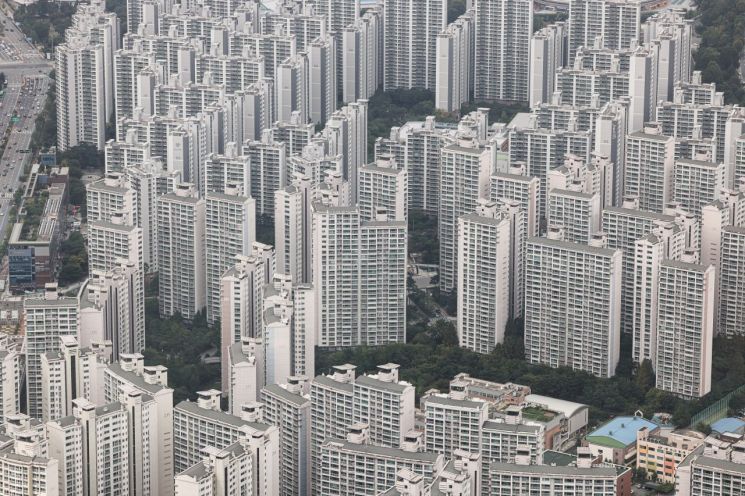 Apartment complexes in Songpa and Gangnam areas as seen from the 'Seoul Sky' observatory at Lotte World Tower, Jamsil, Songpa-gu, Seoul [Image source=Yonhap News]
The rate of increase in apartment prices in Seoul and the greater metropolitan area has all narrowed. This is interpreted as a slight pause in buying demand as government loan regulations have tightened and the perception that housing prices have peaked has spread. Although jeonse prices continue to rise with the autumn moving season, the rate of increase has also slightly decreased.
According to the weekly apartment price trend for the second week of October announced by the Korea Real Estate Board on the 14th, as of the 11th, apartment prices in the metropolitan area rose by 0.32%, a smaller increase compared to the previous week (0.34%). The metropolitan area had maintained a high growth rate of 0.40% for five consecutive weeks since mid-August, but recently the rate has slowed to 0.36% → 0.34% → 0.32%.
The apartment price increase rate in Seoul narrowed from 0.19% last week to 0.17% this week. The Real Estate Board explained, "Prices rose mainly in popular complexes, but buying demand decreased due to the reduction of mortgage loan limits by banks and fatigue from previous price increases, resulting in a slight decrease in the rate of increase compared to last week."
In Seoul, Yongsan-gu (0.26%) and Mapo-gu (0.26%) saw significant increases. Nowon-gu (0.22%), where prices had risen considerably due to reconstruction expectations, increased mainly in large complexes in Junggye-dong and Sanggye-dong, but the rate of increase narrowed. The Gangnam 4 districts?Gangnam-gu (0.23%), Songpa-gu (0.22%), Seocho-gu (0.21%), and Gangdong-gu (0.17%)?also generally saw a decrease in buying demand.
Incheon (0.44% → 0.42%) and Gyeonggi-do (0.41% → 0.39%) also showed a slowdown in the upward trend. In Incheon, Yeonsu-gu (0.52%) saw significant increases mainly in Okryeon and Seonhak-dong, which have transportation benefits, and Songdo New City, where development expectations are high. Gyeyang-gu (0.50%) and Bupyeong-gu (0.44%) also continued their upward trends.
In Gyeonggi-do, Osan-si (0.75%) surged mainly in newly built areas in Nu-eup and Yangsan-dong, which are perceived as low-priced, and Anseong-si (0.62%) and Icheon-si (0.55%), where expectations for transportation improvements are high, also saw large increases.
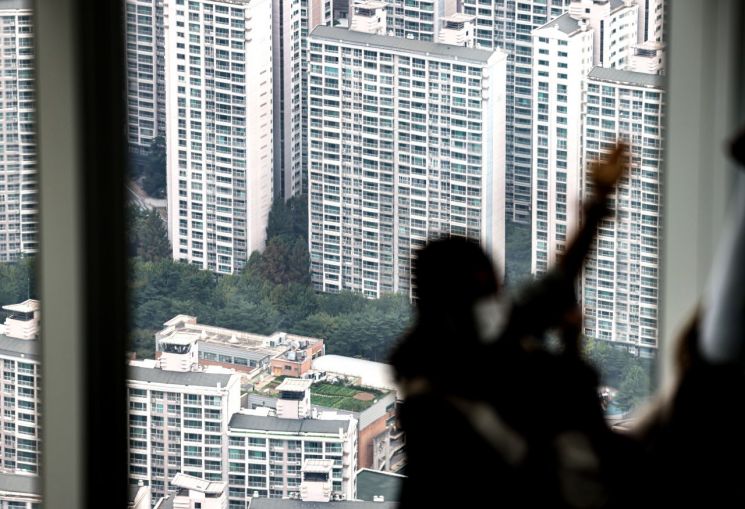 Apartments in Songpa-gu as seen from the 'Seoul Sky' observatory at Lotte World Tower, Jamsil, Songpa-gu, Seoul [Image source=Yonhap News]
Jeonse prices mostly showed stability compared to last week. In Seoul (0.14% → 0.13%), the upward trend continued due to the autumn moving season, but the rate of increase narrowed as listings increased and asking prices fell in some complexes that had previously seen high increases. Mapo-gu (0.18%), Seodaemun-gu (0.18%), Jongno-gu (0.17%), and Gangdong-gu (0.16%) saw relatively significant increases in jeonse prices, while Dongjak-gu (0.17%) and Yeongdeungpo-gu (0.15%) still showed somewhat unstable conditions.
Apartment jeonse prices in Incheon rose by 0.25%, a smaller increase compared to the previous week (0.30%). Gyeonggi-do (0.28% → 0.27%) showed a generally similar trend to the previous week. Yangju-si (0.59%) saw increases mainly in areas near stations such as Deokgye and Deokjeong-dong, as well as Gwangsa, Mansong, and Samsung-dong. Dansan Danwon-gu (0.50%) saw increases mainly in major complexes in Gojan and Wongok-dong. Siheung-si (0.49%), Anseong-si (0.47%), and Icheon-si (0.43%) also had relatively large increases.
© The Asia Business Daily(www.asiae.co.kr). All rights reserved.


















