Survey on 52-Hour Workweek for SME and Shipbuilding Workers Conducted
Half of SMEs Struggle with Hiring Difficulties and Wage Costs
"Workers Take Second Jobs Due to Wage Cuts... Government Needs to Provide Support Measures"
[Asia Economy Reporter Kim Bo-kyung] More than half of small and medium-sized enterprises (SMEs) still find it difficult to implement the 52-hour workweek system. Additionally, 76% of workers at small shipbuilding companies oppose the 52-hour workweek system due to reasons such as wage reductions.
The Korea Federation of SMEs announced on the 14th the results of a survey on the 52-hour workweek system conducted on 414 SMEs with 5 to 299 employees and 171 workers at small shipbuilding companies.
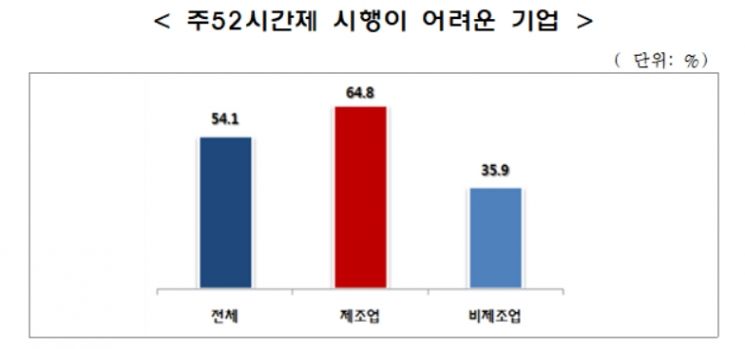
Among SMEs, 54.1% responded that "implementing the 52-hour workweek system is still difficult," with manufacturing industries (64.8%) finding it more challenging than non-manufacturing industries (35.9%).
The main reason cited for the difficulty in implementing the 52-hour workweek system was "difficulty in hiring" at 52.2%. This was followed by "difficulty in utilizing flexible work systems due to challenges in forecasting pre-orders (51.3%)" and "burden of labor costs due to additional hiring (50.9%)."
Regarding responses to the 52-hour workweek system, excluding the 35.0% who answered "original working hours were within the 52-hour limit," the most common response was "introduction of flexible work systems such as flexible working hours and selective working hours" at 30.7%.
This was followed by "additional hiring (18.6%)," "utilization of special extended work permit system due to difficulty in pre-planning work schedules (17.1%)," and "utilization of the 8-hour additional extended work system (16.2%)."
Notably, in companies with 5 to 29 employees, "utilization of the 8-hour additional extended work system (40.9%)" was the highest. For companies with 30 to 49 employees, "introduction of flexible work systems such as flexible working hours and selective working hours (37.7%)" was the main response.
In response, the Korea Federation of SMEs analyzed, "Most companies with fewer than 50 employees, which have been subject to the 52-hour workweek system since this year, are still exceeding 52 hours. This suggests a very high dependence on the temporarily operated 8-hour additional extended work system among companies with fewer than 30 employees."
Regarding government support measures, many companies felt burdened by labor costs, responding that "support for labor costs when hiring additional personnel (57.2%)" and "support for wage compensation costs for existing personnel (57.2%)" were necessary.
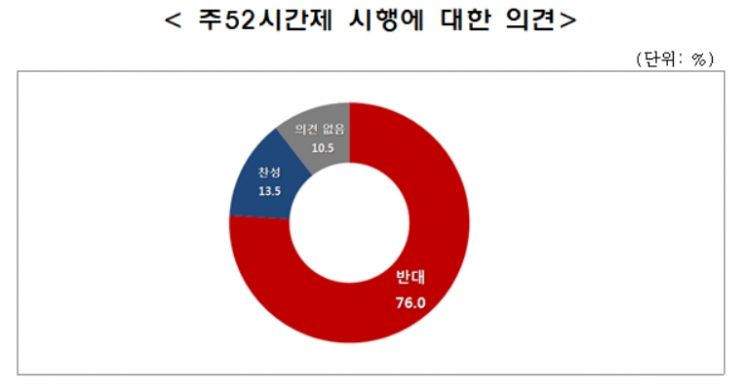
As a result of a survey conducted on 171 workers at small shipbuilding companies, 76.0% of workers opposed the implementation of the 52-hour workweek system.
The main reason for opposition was "negative impact on livelihood due to wage reduction from decreased overtime," which accounted for 96.9%. This was followed by "difficulty in additional hiring leading to intensified labor for existing workers (43.1%)" and "worsened work-life balance compared to before due to working two jobs to compensate for reduced overtime pay (40.8%)."
Regarding the impact of the 52-hour workweek system on wages, 91.8% of workers reported a decrease, stating that their monthly wages decreased by an average of 658,000 KRW compared to before the system was implemented.
Lee Tae-hee, head of the Smart Job Division at the Korea Federation of SMEs, said, "A significant number of SMEs still find it difficult to implement the 52-hour workweek system, and workers are working two jobs to compensate for the reduction in overtime pay rather than enjoying an evening life."
He emphasized, "At the very least, institutional supplements such as the introduction of a monthly extended work system based on labor-management agreement allowing more work if both parties agree, and improvements to the special extended work permit system, must be prepared as soon as possible."
© The Asia Business Daily(www.asiae.co.kr). All rights reserved.
![User Who Sold Erroneously Deposited Bitcoins to Repay Debt and Fund Entertainment... What Did the Supreme Court Decide in 2021? [Legal Issue Check]](https://cwcontent.asiae.co.kr/asiaresize/183/2026020910431234020_1770601391.png)


















