Lee Jun-seok "Whether to have a one-on-one contest or open competition should be discussed"
Outcome depends on public opinion survey question design
[Asia Economy Reporter Naju-seok] The People Power Party will reflect 50% of the public opinion polls in the final presidential candidate selection. Since the advantage or disadvantage among candidates depends on how the questions are designed, a full-scale ‘war of rules’ is anticipated.
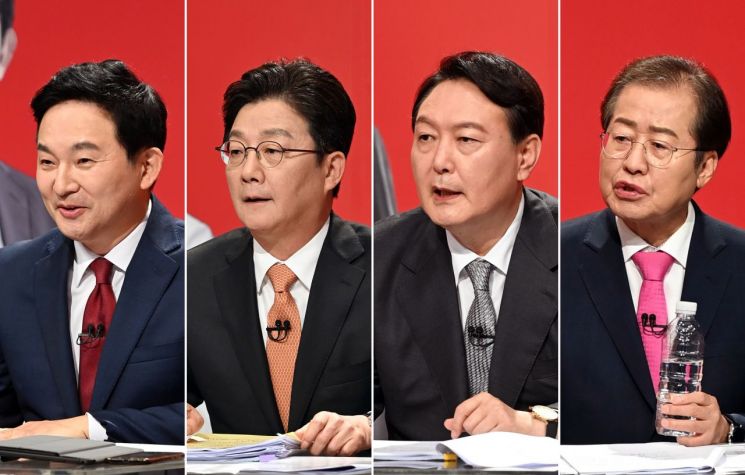
According to the People Power Party on the 14th, the presidential candidate election management committee will establish a ‘Public Opinion Poll Expert Advisory Committee’ by receiving recommendations of advisory members from each campaign to begin discussions on designing the questions for the main primary public opinion polls. Until now, there has been a prevailing atmosphere within and outside the party that the questions will be designed in a hypothetical two-candidate format such as ‘Won Hee-ryong vs. Lee Jae-myung,’ ‘Yoo Seung-min vs. Lee Jae-myung,’ ‘Yoon Seok-youl vs. Lee Jae-myung,’ and ‘Hong Joon-pyo vs. Lee Jae-myung’ to assess competitiveness. The day before, Kim Jae-won, a Supreme Council member of the People Power Party, also stated, “The basic structure of competitiveness has been decided,” effectively confirming the hypothetical two-candidate matchups for each candidate.
However, campaign officials have stated, “Nothing has been decided yet.” Lee Jun-seok, the leader of the People Power Party, also appeared on a radio show that day and said, “Discussions need to be held on whether to ask questions about a one-on-one contest between Lee Jae-myung, the Democratic Party presidential candidate, and our candidate, or to ask about competitiveness in a different way,” leaving the conclusion open.
In political circles, it is believed that the outcome of the election could be determined by how the questions are designed. Depending on the design and content of the questions, the results of the public opinion polls can vary.
In fact, a public opinion poll conducted by Dailyan through the Public Opinion Poll Fairness Committee (survey conducted on the 11th, with a sampling error of ±3.1% at a 95% confidence level, wireless ARS method, refer to the Central Election Commission website) carried out hypothetical two-candidate matchups between the Democratic Party presidential candidate (Lee Jae-myung) and the People Power Party presidential primary candidates. The results showed that Hong Joon-pyo, former Prosecutor General Yoon Seok-youl, former Jeju Governor Won Hee-ryong, and former lawmaker Yoo Seung-min ranked in order of competitiveness. On the other hand, in the Asia Economy public opinion poll (survey conducted on the 9th-10th, with a sampling error of ±3.1% at a 95% confidence level, wireless ARS method, refer to the Central Election Commission website), which asked who is suitable as the conservative opposition presidential candidate by listing candidate names and having respondents choose one, the order was Yoon Seok-youl, Hong Joon-pyo, Yoo Seung-min, and Won Hee-ryong. Looking only at the survey results, in the question ‘Who would be competitive against Lee Jae-myung?’ Hong Joon-pyo and Won Hee-ryong scored higher, but in the question ‘Which candidate do you support?’ Yoon Seok-youl and Yoo Seung-min were advantageous.
It is known that each candidate’s campaign has not yet made a judgment on the gains and losses depending on the question design. However, as various public opinion poll results are announced in the future, intense psychological warfare is expected, with each side insisting on the method favorable to themselves. For example, the reason former Governor Won, who had been classified as the fourth-place candidate, rose to third place in some polls is analyzed as the result of a strategy that raised suspicions related to Daejang-dong to the extent that he was called the ‘Daejang-dong 1st Star Lecturer.’ A campaign official for Won said, “When asked ‘Lee Jae-myung versus whom,’ the candidate who instinctively comes to mind is former Governor Won,” and explained, “The strategy of highlighting his clarity regarding this candidate seems effective.”
Additionally, whether to ask a follow-up question to respondents who answered ‘no preferred candidate’ is also a contentious issue. In the previous Seoul mayoral primary, it was analyzed that this type of public opinion poll question format had a decisive impact on the outcome. Generally, when a follow-up question is asked to identify a preferred candidate, candidates with moderate tendencies are known to have an advantage.
© The Asia Business Daily(www.asiae.co.kr). All rights reserved.
!["The Woman Who Threw Herself into the Water Clutching a Stolen Dior Bag"...A Grotesque Success Story That Shakes the Korean Psyche [Slate]](https://cwcontent.asiae.co.kr/asiaresize/183/2026021902243444107_1771435474.jpg)
















