Supply Shortages to Persist Amid Bottlenecks and Logistics Crisis
"Vehicle Semiconductor Supply Shortage Expected to Continue Until Next Year"
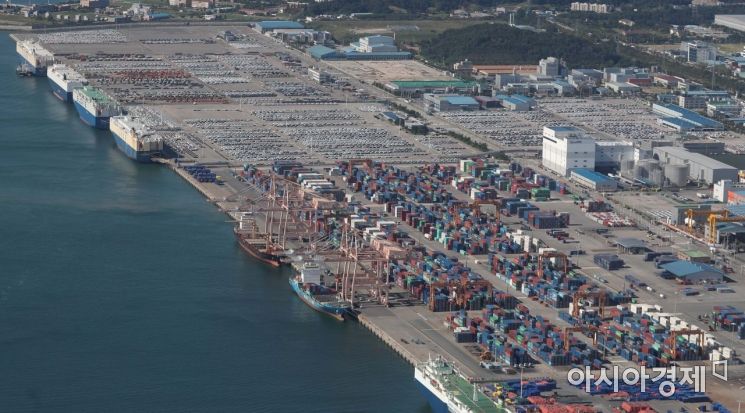 On the 17th, one day before the Chuseok holiday, export vehicles are waiting to be loaded at Pyeongtaek Port in Gyeonggi. Photo by Mun Ho-nam munonam@
[Asia Economy Reporter Yoo Je-hoon] As the spread of COVID-19 subsides in Southeast Asian regions such as Malaysia, signs of some relief are emerging in the vehicle semiconductor supply shortage that has severely impacted the domestic completed car industry. However, since orders for vehicle semiconductor parts are backlogged by about 2.5 months and recent logistics crises have erupted across the air and maritime markets, the prevailing analysis is that production disruptions and delivery delays for completed car manufacturers are likely to continue at least until next year.
According to related industries on the 14th, as Malaysian authorities have recently begun to gradually ease lockdown measures due to COVID-19, expectations for semiconductor production normalization are growing. Malaysia hosts nearly a quarter of Southeast Asia's semiconductor factories.
In fact, according to local media such as The New Straits Times, as of the previous day, the number of new confirmed COVID-19 cases across Malaysia was 7,950, nearly half compared to the 15,000 to 20,000 range seen in the previous month. As of the 12th, about 21.22 million people had completed COVID-19 vaccination, accounting for 90.6% of the total adult population.
Domestic and foreign completed car industries initially expected the semiconductor supply shortage to ease around the third quarter, but lockdown measures in Southeast Asian countries due to the spread of the Delta variant caused significant damage. Semiconductors produced by major semiconductor makers are sent to Southeast Asia, including Malaysia, for packaging and other post-processing steps. The lockdowns due to COVID-19 disrupted this process, causing semiconductor risks to resurface. In fact, last month, domestic completed car production volume was about 230,000 units, down 33% compared to the same month last year.
The problem is that despite these positive signs, there is still a long way to go before production normalizes. Even if production normalization begins, a 'bottleneck effect' due to the backlog of orders is inevitable. Recently, power shortages in China have also deepened concerns for companies with supply lines in China. KB Securities recently reported, "Lockdown measures in Malaysia are being gradually lifted from October, but orders have been backlogged by about 2.5 months since June," adding, "It is highly likely that the semiconductor supply shortage will not be resolved within this year."
The new car delivery crisis, which has continued since last year, is also expected to persist for some time. This is because bottlenecks continue as demand increases on top of the semiconductor supply shortage. For example, for the Kia Sorento Hybrid, it is reported that even if an order is placed on the 1st, delivery takes about 11 months. An industry insider said, "Although the situation in Malaysia has somewhat improved and things are getting better, it still takes time for semiconductors that have undergone post-processing in Southeast Asia to arrive and be deployed on site, so this month is a critical period," adding, "Recently, power shortages in China have intensified, and some domestic companies with supply lines in China are also reportedly struggling to secure semiconductor supplies."
The industry expects some relief in the supply shortage due to the easing of lockdown measures in Southeast Asia but believes that production disruptions and delivery delays will inevitably continue for the time being as the overall supply-demand imbalance has not been resolved. COVID-19, which can become a risk at any time like the Delta variant, remains a problem.
Kim Ju-hong, Executive Director of the Korea Automobile Manufacturers Association (KAMA), said, "Although the situation in Southeast Asia has improved, it is still difficult to say that the fundamental imbalance in vehicle semiconductor supply has been resolved, and uncertainties such as the resurgence of COVID-19 remain," adding, "With recent logistics crises as well, it is expected that the effects of the semiconductor supply shortage will continue at least until next year."
© The Asia Business Daily(www.asiae.co.kr). All rights reserved.

















