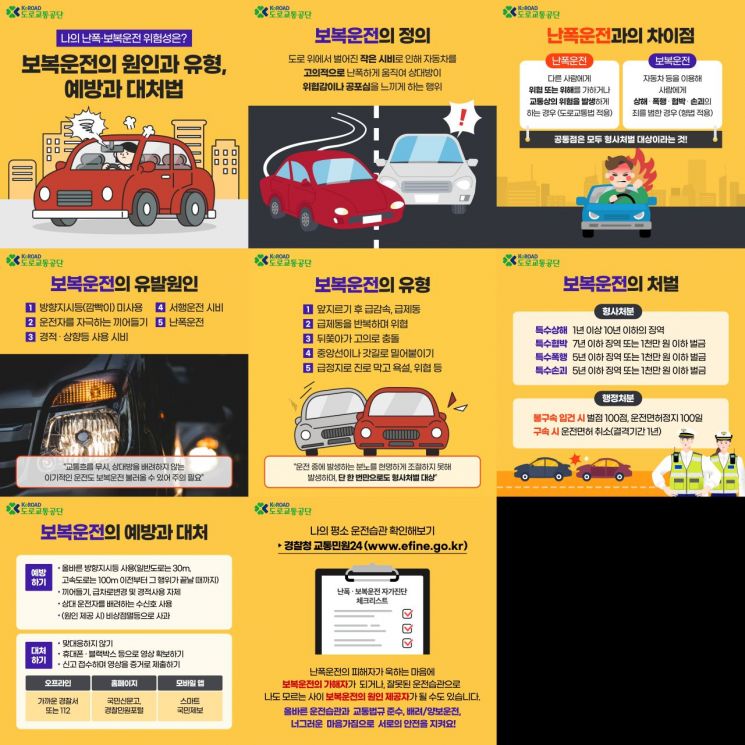
[Asia Economy Reporter Lee Gwan-joo] The Korea Road Traffic Authority announced on the 14th that it has produced and distributed a card news titled 'Causes and Types of Retaliatory Driving, Prevention and Response Methods' to prevent retaliatory driving traffic accidents.
The Authority organized the material to focus on explaining retaliatory driving and to clearly distinguish it from reckless driving. Retaliatory driving involves committing crimes such as injury, assault, threat, or damage to a person using a vehicle, and unlike reckless driving governed by the Road Traffic Act, it is subject to the Criminal Act. In particular, retaliatory driving applies even if the act occurs only once and results in injury, assault, threat, or damage, and it differs from reckless driving in that it involves intentional threats to a specific person.
Causes that trigger retaliatory driving include failure to use turn signals (blinkers), disputes over slow driving, cutting in that provokes the driver, reckless driving, and disputes over the use of horns or high beams. Representative types include sudden deceleration and abrupt braking after overtaking, repeated abrupt braking to threaten, and deliberately colliding by chasing from behind.
In cases of special injury caused by retaliatory driving, a minimum of one year imprisonment can be imposed, and for special threats, special assault, or special damage, imprisonment of up to 5 or 7 years or a fine of up to 10 million won may be imposed. Additionally, depending on whether detention is applied, administrative penalties such as 100 demerit points and a 100-day suspension or cancellation of the driver's license will be enforced.
To prevent and respond to this, drivers should use hand signals to show consideration for other drivers, use turn signals correctly, and refrain from sudden lane changes and horn use. In case of disputes, do not retaliate; instead, secure evidence videos and report to the nearest police station or through the National Police Agency's Civil Complaint Portal (website), the National Civil Complaint Portal, or the Smart National Report (mobile app).
A representative from the Korea Road Traffic Authority stated, "In moments of anger, one may become a perpetrator of retaliatory driving or unknowingly cause retaliatory driving due to poor driving habits, so caution is necessary," and added, "We ask everyone to maintain proper driving habits, practice considerate and yielding driving, and have a generous mindset to prevent unfortunate accidents caused by retaliatory driving."
© The Asia Business Daily(www.asiae.co.kr). All rights reserved.

















