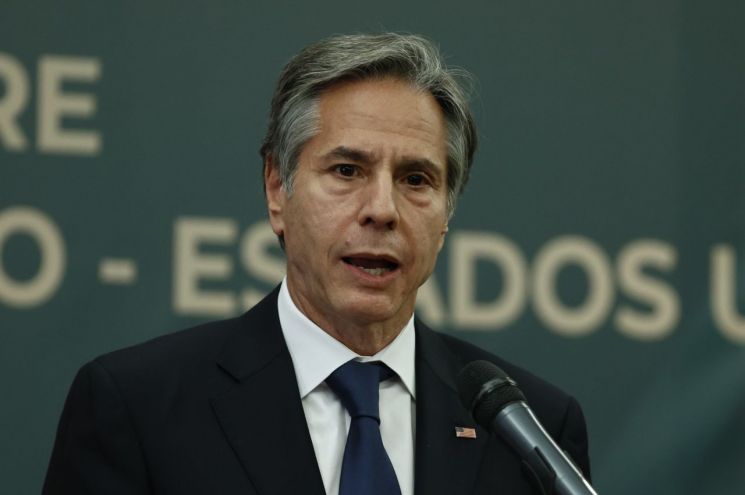
[Asia Economy Reporter Hyunwoo Lee] U.S. Secretary of State Tony Blinken maintained his stance on reopening the Palestinian consulate in Jerusalem despite Israel's continued opposition. Regarding the Iran nuclear deal issue, he reiterated a warning that military options could be considered if diplomatic agreements fail.
On the 13th (local time), after meetings with Israeli Foreign Minister Yair Lapid and United Arab Emirates (UAE) Foreign Minister Mohammed bin Zayed Al Nahyan, Secretary Blinken emphasized at a joint press conference, "We will move forward with the process of reopening the consulate in Jerusalem to deepen relations with the Palestinians." However, seemingly mindful of Israel's position, he did not mention a specific reopening date during the conference.
Previously, in 2018, the former Donald Trump administration moved the U.S. embassy to Israel from Tel Aviv to Jerusalem despite Palestinian opposition, closing the Palestinian consulate and placing its functions under the embassy's jurisdiction. Since President Joe Biden took office, the U.S. government has consistently stated that while maintaining the embassy, it intends to restore the Palestinian consulate.
Israel, which considers all of Jerusalem as its capital, strongly opposes this. However, Secretary Blinken, who has supported the so-called "two-state solution" dividing Jerusalem into east and west to separate Palestine as an independent state, announced in May that the embassy would remain as is while the consulate would be restored. The Palestinian Authority also hopes to designate East Jerusalem as the future capital of their state.
Meanwhile, on this day, the U.S., Israel, and UAE discussed regional issues including the Abraham Accords and the Iran nuclear deal negotiations. The Abraham Accords are agreements signed last year in which the UAE and Qatar officially recognized Israel as a state and normalized diplomatic relations; Bahrain, Morocco, and Sudan have also signed similar accords with Israel.
Regarding the Iran nuclear deal, Secretary Blinken warned, "While we believe diplomacy with Iran is the best approach, the important factor is Iran's willingness," adding, "Diplomatic channels with Iran are closing, and we are setting other options to prevent Iran from acquiring nuclear weapons." This statement is interpreted as a renewed emphasis on considering military options should diplomatic negotiations fail.
© The Asia Business Daily(www.asiae.co.kr). All rights reserved.
![User Who Sold Erroneously Deposited Bitcoins to Repay Debt and Fund Entertainment... What Did the Supreme Court Decide in 2021? [Legal Issue Check]](https://cwcontent.asiae.co.kr/asiaresize/183/2026020910431234020_1770601391.png)















