Increasing Importance of HUG Housing Sale Guarantee
Insurance Against Apartment Developer Bankruptcy
Industry Concerns Over Possible 'Market Opening'
Public Interest May Decline if Competition Intensifies
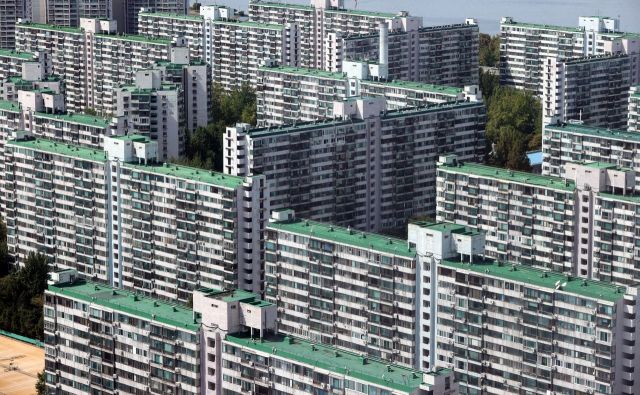
There are concerns from political circles and the industry regarding calls to open the 'housing pre-sale guarantee,' which is exclusively managed by the Housing and Urban Guarantee Corporation (HUG), to the market. They warn that if the market is opened and competition intensifies, guarantees may be handled with a profit-oriented approach, potentially increasing harm to pre-sale buyers. Since the purpose of introducing the housing pre-sale guarantee is to secure public interest rather than profit, a more careful approach is necessary.
According to the real estate industry on the 13th, as economic uncertainty continues to grow, the importance of HUG's housing pre-sale guarantee is also increasing day by day. The housing pre-sale guarantee is a guarantee that takes responsibility for completing apartment construction or refunding the deposit and interim payments made by the pre-sale contract holder if the project owner cannot fulfill the pre-sale contract. It essentially acts as 'insurance' in case the developer suddenly goes bankrupt.
Currently, HUG exclusively manages such housing pre-sale guarantees in South Korea. Over the past 27 years, it has issued housing pre-sale guarantees worth 1,034 trillion KRW for 6.08 million households, contributing to stable housing supply. In this process, HUG has spent 4.2684 trillion KRW on construction costs and refunding pre-sale payments to fulfill guarantees for projects with guarantee incidents, protecting the 'dream of homeownership' for 330,000 households.
Recently, voices have emerged advocating for the introduction of competition principles into the housing pre-sale guarantee market, but many in the industry believe that opening the pre-sale market could infringe on citizens' rights and interests. The housing pre-sale guarantee system was introduced to protect pre-sale buyers, and if private businesses enter, there is concern that profit-driven guarantee handling could cause market confusion.
According to So Byung-hoon, a member of the Democratic Party of Korea, there have been only 51 housing pre-sale guarantee incidents (with an incident amount of 2.7766 trillion KRW) from 2011 to July this year. Considering that the total unsold housing stock reached 60,000 to 70,000 units due to excessive housing supply in 2011-2012, the number of incidents is relatively low. So explained, "This is because the housing pre-sale guarantee system built around the Housing and Urban Guarantee Corporation has operated stably."
The importance of the public nature of the housing pre-sale guarantee is well illustrated by experiences during the 1997 International Monetary Fund (IMF) foreign exchange crisis. During the IMF financial crisis, the private housing business mutual aid association was responsible for housing pre-sale guarantees. As a result, the association represented private companies' interests, failed to manage reckless loans, and could not bear the guarantee incident amounts, leading to its eventual abolition.
On the other hand, during the 2008 subprime-triggered global financial crisis, the public enterprise Korea Housing Guarantee protected citizens' property rights through guarantee fulfillment amounting to 2.3639 trillion KRW.
The Korea Development Institute (KDI) explained, "If the housing pre-sale guarantee market is opened, new guarantee institutions may focus on low-risk, high-return businesses, and if the real estate market stagnates, they may reduce or suspend operations. Also, if competition overheats due to market opening, the asset soundness of both new and existing guarantee institutions may decline simultaneously."
So said, "Rather than hastily opening the housing pre-sale guarantee market, the government needs to maintain a stable management system centered on HUG by incorporating expert opinions. Efforts to strengthen HUG's public nature should also be explored, such as further reducing HUG's housing pre-sale guarantee fees, establishing special guarantee measures for small and medium-sized companies, and expanding guarantees for social housing."
© The Asia Business Daily(www.asiae.co.kr). All rights reserved.
![Clutching a Stolen Dior Bag, Saying "I Hate Being Poor but Real"... The Grotesque Con of a "Human Knockoff" [Slate]](https://cwcontent.asiae.co.kr/asiaresize/183/2026021902243444107_1771435474.jpg)











