Kwanghee Lee - Strange GIST Professor Team
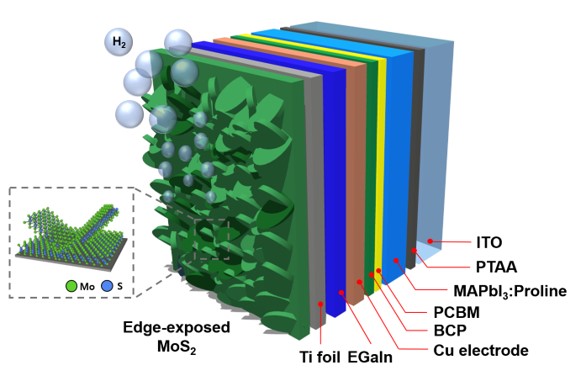 Schematic diagram of a perovskite photoanode combined with MoS2 deposited on a titanium foil protective layer using pulsed laser deposition method
[Asia Economy Reporter Kim Bong-su] Domestic researchers have developed a technology that enables efficient hydrogen production without using expensive platinum as a catalyst.
The research team led by Professors Lee Kwang-hee and Lee Sang-han from the Department of New Materials Engineering at Gwangju Institute of Science and Technology (GIST) announced on the 13th that they have developed a photoelectrode based on perovskite that shows the highest efficiency and stability reported to date. The team combined a nanostructured molybdenum disulfide catalyst with an organometal halide perovskite solar cell, demonstrating technology capable of efficient hydrogen production without costly platinum.
Photoelectrochemical water splitting using perovskite faces challenges because perovskite materials are vulnerable to moisture, resulting in insufficient stability. So far, high-efficiency perovskite photoelectrodes have all been combined with expensive platinum catalysts, protective layers, and perovskite, causing cost issues that hinder commercialization. Therefore, there is a need to develop low-cost, high-efficiency, and highly stable catalysts for hydrogen generation reactions and perovskite photoelectrodes that can replace platinum’s high efficiency with cheaper and more stable alternatives.
The research team fabricated molybdenum disulfide (MoS2), one of the representative platinum-alternative catalysts for hydrogen generation reactions, on a perovskite protective layer (titanium foil) using pulsed laser deposition, a typical physical vapor deposition method. When producing MoS2 on titanium foil, they successfully controlled the nanostructure of MoS2 by adjusting the number of pulses, one of the deposition conditions. The nanostructured MoS2 exhibited higher hydrogen generation reaction efficiency than planar MoS2. Subsequently, the titanium foil with MoS2 was sealed using a liquid metal indium-gallium alloy, successfully preventing moisture from penetrating the perovskite material, thereby ensuring high stability.
The perovskite photoelectrode developed by the research team successfully prevented the rapid initial performance degradation of photoelectrodes caused by the easy delamination of conventional platinum catalysts, thanks to the high stability and efficiency of MoS2. Notably, it achieved the longest stability of 120 hours and the highest half-cell efficiency of 11.07% among perovskite photoelectrodes reported to date.
Professor Lee Sang-han stated, "The significance of this research lies in demonstrating that it is possible to fabricate high-efficiency, highly stable perovskite-based photoelectrodes without expensive platinum catalysts," adding, "It is expected to contribute to accelerating the practical application of eco-friendly hydrogen production technology."
The research results were selected as the cover paper on the 12th and published online in the 'Journal of Materials Chemistry A' (IF=12.732), a top 7% journal in the energy field.
© The Asia Business Daily(www.asiae.co.kr). All rights reserved.

















