US Growth Rate Lowered by 1 Percentage Point to 6.0%
China Also Downgraded by 0.1 Percentage Point to 8.0%
Emerging Markets Outlook Upgraded Due to Rising Commodity Prices
Inflation Concerns: "Central Banks Must Be Ready for Swift Response"
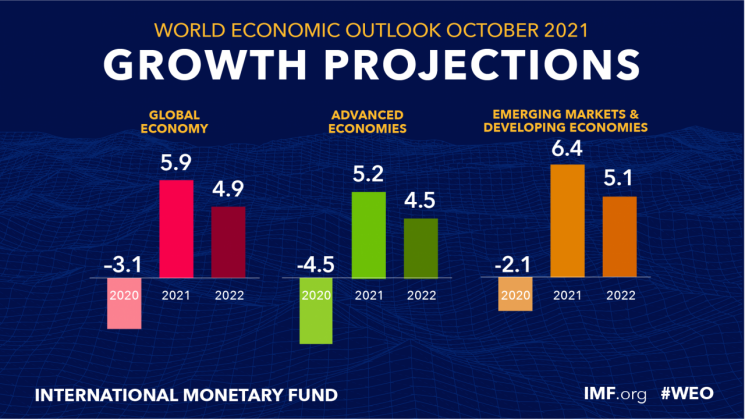
[Asia Economy New York=Correspondent Baek Jong-min] The International Monetary Fund (IMF) has slightly revised down its global economic growth forecast for this year to 5.9%.
The growth forecast for the United States, hampered by supply chain issues, dropped by 1 percentage point, and China’s forecast was also revised down by 0.1% compared to previous estimates.
Although growth forecasts for advanced economies were significantly lowered, growth expectations for emerging markets rose slightly due to increases in commodity prices.
On the 12th (local time), the IMF announced in its "World Economic Outlook" report that it had lowered the global economic growth forecast for this year from 6.0% to 5.9%. The growth forecast for next year remained at 4.9%, as previously announced.
This downward revision mainly reflected the sluggishness of advanced economies. The growth forecast for advanced economies this year was 5.2%, down 0.4 percentage points compared to July.
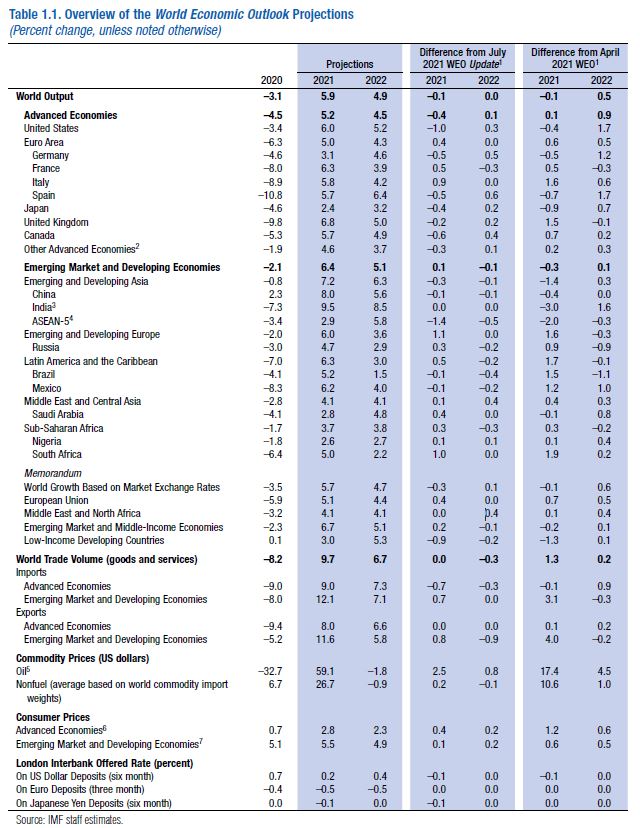
By country, the expected growth rate for the United States was cut by 1.0 percentage point to 6.0%. Japan and the United Kingdom’s growth rates were 2.4% and 6.8%, respectively, down 0.4 and 0.2 percentage points compared to July.
The Euro area (the 19 European Union countries using the euro) is expected to grow by 5.0% this year, up 0.4 percentage points from the July forecast. The Euro area’s growth rate last year was -6.3%.
The expected growth rate for emerging and developing economies this year was revised up by 0.1 percentage points to 6.4%. China’s forecast was lowered by 0.1% to 8.0%, while India’s forecast remained at 9.0%, the same as in July.
South Korea’s economic growth forecast for this year was 4.3%, unchanged from the July forecast. The IMF had initially set Korea’s forecast at 3.6% in April and raised it by 0.7 percentage points in July.
The IMF explained that while the global economic recovery continues, the spread of the Delta variant and supply chain disruptions have worsened conditions in advanced economies and low-income developing countries. Commodity-exporting countries such as those exporting oil are expected to see short-term growth increases.
Gita Gopinath, IMF Chief Economist, stated that total production in advanced economies will recover to pre-COVID-19 levels next year, but emerging and developing economies excluding China will remain 5.5% below pre-pandemic projections in 2024, highlighting this divergence between countries as a major concern.
The IMF forecasted inflation this year at 2.8% for advanced economies and 5.5% for emerging and developing economies, up 0.4 and 0.1 percentage points respectively from the July forecast.
© The Asia Business Daily(www.asiae.co.kr). All rights reserved.


















