Increase in Minimum Wage as the Primary Redistribution for Common Prosperity in 16 Chinese Provinces
People's Daily Overseas Edition Promotes New Minimum Wage and Unemployment Insurance Hikes
[Asia Economy Beijing=Special Correspondent Jo Young-shin] According to the overseas edition of the People's Daily, the official newspaper of the Chinese Communist Party, most regions among China's 31 provinces, municipalities directly under the central government, and autonomous regions have raised and implemented their monthly minimum wages starting from October 1. The increase in minimum wages appears to be widely reported through the overseas edition of the People's Daily as it aligns with Chinese President Xi Jinping's "common prosperity" policy, which aims for a society where everyone prospers together.
On the 12th, the People's Daily reported that 16 provinces, municipalities, and autonomous regions including Heilongjiang Province, Liaoning Province, Zhejiang Province, Shanxi Province, Gansu Province, Hubei Province, Shandong Province, Jiangsu Province, Tibet Autonomous Region, Xinjiang Autonomous Region, Shanghai, and Beijing have raised and implemented their monthly minimum wages.
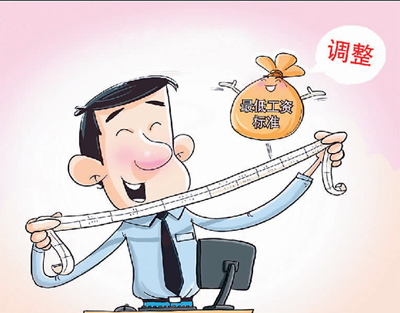
The People's Daily explained that this year's monthly minimum wage increase ranges from 80 to 300 yuan, with variations depending on the region and urban areas. It added that the hourly minimum wage has increased by 20 yuan in major cities such as Beijing (25.3 yuan).
The People's Daily also reported that the monthly minimum wages in major cities such as Shanghai (2,590 yuan), Beijing (2,320 yuan), and Tianjin (2,180 yuan) exceed 2,000 yuan. Guangdong Province (Shenzhen), Zhejiang Province, Jiangsu Province, and Hubei Province also have monthly minimum wages exceeding 2,000 yuan.
Jiang Libin, a researcher at the China Labor and Social Security Science Research Institute, said, "The minimum wage is a means of livelihood that guarantees the basic living of workers and their families. Since the minimum wage reflects inflation and other factors, it is very important for ensuring the lives of low-income earners and increasing their income."
China's minimum wage is divided into regular minimum wages and non-regular (hourly) minimum wages. Additionally, even within the same province, the minimum wage is applied differently by dividing areas into four districts, including urban and non-urban areas. China's minimum wage is usually adjusted once every two to three years.
Above all, President Xi mentioned the term "common prosperity" at the 10th Central Financial and Economic Affairs Commission meeting held in August, referring to the lives of 1.4 billion people, which had anticipated the increase in minimum wages. Common prosperity begins with distribution and is achieved through three stages. The first distribution is carried out according to market mechanisms. The increase in minimum wages corresponds to the first distribution. The second distribution (redistribution through taxes, etc.) is the role of the state (Communist Party), and the third distribution (donations by companies and high-income groups) represents the social role.
The People's Daily further explained that besides the minimum wage, this year’s unemployment insurance payment standards and disability allowances for work-related injuries (Beijing standards) have also been adjusted, enhancing workers' rights and interests. It added that since the government has sufficiently provided room for minimum wage increases through tax reductions for companies and comprehensive financial support such as various fees, the burden on companies due to the minimum wage increase is not significant.
However, despite China’s per capita GDP reaching 70,892 yuan (approximately 13.16 million Korean won) in 2019, surpassing 10,000 USD, it is known that among the total population of 1.4 billion, 600 million people earn only 1,000 yuan (about 180,000 Korean won) per month, leading to criticism that raising the minimum wage alone is insufficient to resolve the wealth gap.
© The Asia Business Daily(www.asiae.co.kr). All rights reserved.
![Clutching a Stolen Dior Bag, Saying "I Hate Being Poor but Real"... The Grotesque Con of a "Human Knockoff" [Slate]](https://cwcontent.asiae.co.kr/asiaresize/183/2026021902243444107_1771435474.jpg)

















