Operation of RoboShuttle, Autonomous Vehicle Control System, and Autonomous Parking Tower Infrastructure
Pilot Service of Solati-based RoboShuttle Circulating Inside the Research Institute Starts from the 7th of This Month
Introduction of Autonomous Vehicle Control System...System Monitoring and Remote Vehicle Support Available
Construction of Parking Tower for Remote Autonomous Parking Technology Development...Completion Targeted for the Second Half of Next Year
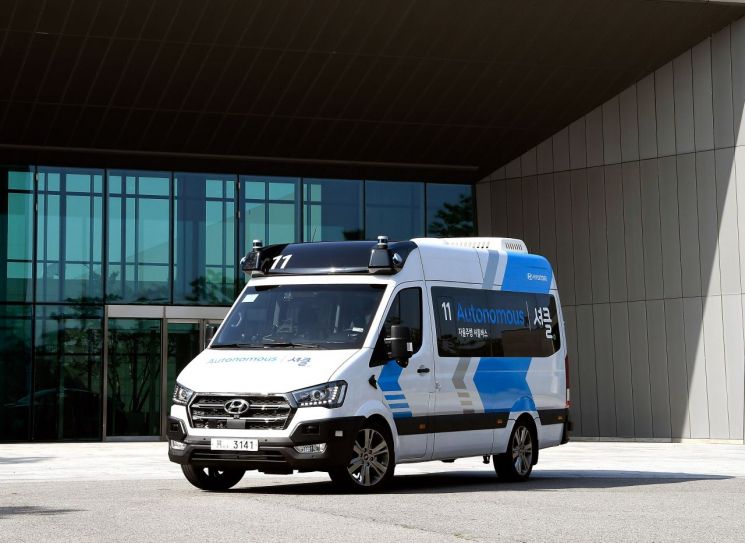
[Asia Economy Reporter Kim Hyewon] Hyundai Motor Company is preparing to enter the autonomous driving era by establishing an 'Autonomous Driving Demonstration Testbed' at the Hyundai Motor and Kia Namyang Technology Research Center.
On the 12th, Hyundai Motor announced plans to create autonomous driving infrastructure within the research center so that researchers can demonstrate various autonomous driving technologies and develop related software and systems to be quickly applied to new vehicles.
The autonomous driving testbed construction project is divided into three parts based on Hyundai Motor's autonomous driving and autonomous parking technologies under development: operating a demand-responsive robo-shuttle within the research center, developing an autonomous vehicle control system, and constructing an autonomous parking tower for remote autonomous parking technology development.
First, Hyundai Motor began a pilot service on the 7th with four robo-shuttles circulating inside the research center. The vehicles used in the pilot service are autonomous vehicles based on the Solati model, developed in-house by Hyundai Motor's autonomous driving division, and are the same model as the robo-shuttle that conducted a pilot service in Sejong City from August to September.
These vehicles apply Level 4 autonomous driving core technologies, enabling the vehicle to perceive and judge driving situations independently and control the vehicle, with no emergency driver intervention except in some limited situations. Hyundai Motor integrated the AI-based demand-responsive mobility service called Shucle into the robo-shuttle to reduce travel time and improve dispatch efficiency.
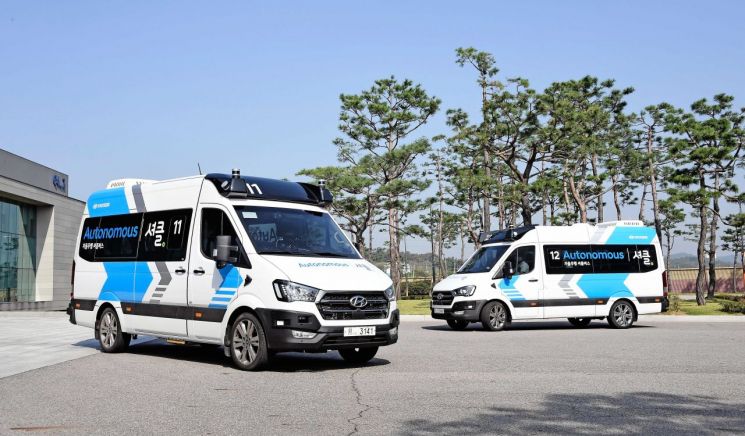
The existing shuttle buses circulating inside the Namyang Research Center stop at all 45 bus stops on a round trip basis, but the robo-shuttle only stops at stops where users request boarding or alighting through the Shucle application, thereby reducing travel time.
Moreover, since the vehicle's route is generated in real-time according to passenger demand, more efficient operation is possible. When a passenger calls a vehicle from a nearby stop through the app, the vehicle moves to the requested location following the optimal route generated by the AI algorithm.
Hyundai Motor plans to continuously accumulate autonomous driving data through the robo-shuttle and utilize it for developing related autonomous driving technologies such as AI software. The company also plans to operate a robo-shuttle pilot service in the Pangyo area of Seongnam City, Gyeonggi Province, in the first half of next year.
Along with operating the robo-shuttle, Hyundai Motor introduced a newly developed web-based autonomous vehicle control system. This system monitors vehicles deployed for autonomous driving services in real-time and is used when normal autonomous driving is impossible due to situations such as temporary road blockages. Controllers remotely access the vehicle's autonomous driving system to provide support services such as resetting the vehicle's driving route.
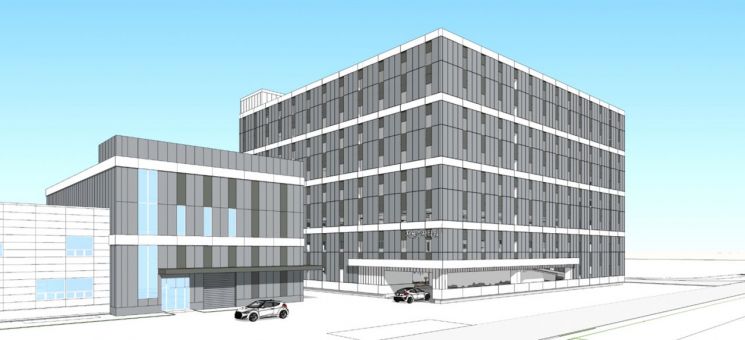
Finally, as part of building the autonomous driving demonstration testbed, Hyundai Motor plans to construct a parking tower inside the Namyang Research Center to focus on developing remote autonomous parking technology. The parking tower is an eight-story building capable of parking over 600 vehicles, with completion targeted for the second half of next year.
The autonomous parking tower is custom-designed to be suitable for developing various new technologies such as Remote Parking Pilot (RPP). Remote autonomous parking is a technology where the driver exits the vehicle at the parking lot entrance, and the vehicle searches for an empty space and parks itself; when the driver returns, the vehicle moves back to the parking lot entrance so the driver can board immediately.
Hyundai Motor plans to create an environment in the autonomous parking tower where vehicles can independently select target parking spaces and generate optimal routes for autonomous parking. The parking spaces are composed of different forms such as straight and curved ramps, and each floor uses different floor materials such as asphalt, epoxy, and concrete to verify autonomous parking technologies in various environments.
Jang Woongjun, Executive Director of Hyundai Motor's Autonomous Driving Division, said, "We will advance autonomous driving perception, judgment, and control technologies through the testbed construction at the Namyang Research Center. Based on this, we will continue to introduce various mobility services such as safe robo-shuttles, robo-taxis, and robo-delivery."
© The Asia Business Daily(www.asiae.co.kr). All rights reserved.



















