Conflict Surrounding Daeguseon Islamic Mosque
Muslims Seek Permission to Build Mosque
Residents Oppose as It Enters Residential Area
Gender and Generational Conflicts Persist
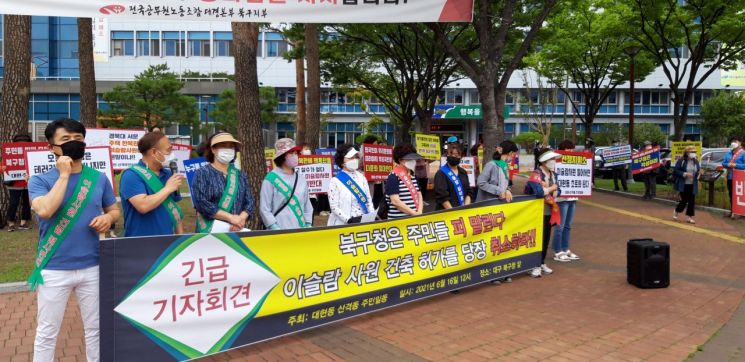 On June 16th, residents opposing the construction of an Islamic temple held a rally in front of the Buk-gu Office in Daegu during the daytime. [Image source=Yonhap News]
[Asia Economy Reporter Lee Jung-yoon] Korean society is witnessing numerous conflicts to the extent that it is called a "Conflict Republic." Conflicts between groups or individuals are surfacing in many areas of our society, including religion, gender, and generations. Among the 30 OECD member countries, Korea ranks third in the conflict index, placing it among the top countries.
One of the current intense conflicts is the confrontation between residents of Daehyeon-dong, Buk-gu, Daegu, and Muslims over the construction of an Islamic mosque. Muslim students attending Kyungpook National University obtained permission and began promoting the mosque construction last December. However, when residents filed collective complaints, the Buk-gu Office temporarily halted the construction. In response, Muslim international students and civic groups filed a "request for provisional injunction to suspend the enforcement of the construction suspension order," which the Daegu District Court accepted.
The Muslim international students argue that there is no problem since they already have building permits and claim that the construction is being obstructed due to residents' prejudices. The National Human Rights Commission viewed the Buk-gu Office's notification to stop construction, based on unilateral complaints rooted in negative stereotypes against Muslims without clear evidence, as halting mosque construction due to religion. It also expressed the opinion that it is desirable to take necessary measures to resume construction.
Residents, on the other hand, claim they oppose the construction because a religious facility is located in the middle of their residential area. Seo Jae-won, the head of the Anti-Islamic Mosque Construction Emergency Committee, said, "We oppose the construction of the mosque in the middle of the residential area and plan to continue our actions," adding, "If we had opposed other religious facilities such as churches or temples and tried to drive them out, it would have happened in the past." Residents are also conducting one-person protests against the construction. More than 175,000 people agreed to a Blue House petition opposing the mosque construction, which closed on the 3rd of this month.
Gender conflict is also one of the long-standing conflicts in Korean society. In May, GS25 became a battleground for gender conflict. A poster produced for promotion was alleged to have used a symbol from "Megalia," a female-centered community known for disparaging men. This quickly escalated into a controversy over male disparagement, leading to a campaign to lower GS25's stock price, mainly in communities with many male users. Eventually, GS25 issued an apology.
Even the US CNN broadcast focused on Korea's gender conflict, publishing an article titled "Why are Korean companies uneasy about hand gestures?" reporting that "a 'gender war' has been raging in Korea for decades, and recently this war has reached an extreme state." It also analyzed that the cause of this conflict is anti-feminism prevalent among young men.
Intergenerational disputes are another long-standing conflict in Korean society. These conflicts appear in various forms, from issues like fare evasion on subways and buses to social policy issues such as jobs and pensions.
Experts explain that the roles of the government and leaders in various fields are crucial to reducing the confrontations seen in many conflicts. Professor Im Myeong-ho of Dankook University's Department of Psychology said, "If the depth of conflicts continues to deepen, resonance situations will eventually occur," adding, "The government must make efforts to mediate various conflicts, and opinion leaders in each field who can shape public opinion should engage in dialogue, communication, and compromise, as well as adopt an attitude of concession to ease conflicts."
© The Asia Business Daily(www.asiae.co.kr). All rights reserved.

















