[Asia Economy Reporter Park Byung-hee] The Wall Street Journal (WSJ) reported on the 10th (local time), citing an analysis by Japanese securities firm Nomura Holdings, that the debt scale of Chinese real estate developers exceeds the size of Japan's Gross Domestic Product (GDP).
Nomura estimated that as of the end of June, the debt scale of Chinese real estate developers reached $5.2 trillion (approximately 6,219 trillion won). Japan, the world's third-largest economy, had a GDP of $5.065 trillion in 2019, according to World Bank statistics.
According to Nomura, the largest portion of Chinese real estate developers' debt is bank loans, accounting for 46% of total debt. Bonds account for about 10%. Regarding bonds alone, dollar bonds amount to about 40%, or $217 billion, of which a significant portion is estimated by Nomura to be junk (non-investment grade) rated.
Following Evergrande Group, Fantasia Group also reportedly failed to repay bonds that matured on the 4th. As a result, bond prices of Chinese real estate developers plunged last week. Among 59 Chinese real estate company bonds included in the ICE BofA Asia Dollar Bond Index, bonds of 24 companies are currently trading at yields exceeding 20%. WSJ explained that a 20% yield indicates a high risk of default.
The debt scale of Evergrande Group, which triggered the current crisis, is known to exceed $300 billion. However, Goldman Sachs estimated that Evergrande's off-balance-sheet bonds could amount to $156 billion, suggesting the actual debt scale might be larger. Off-balance-sheet bonds refer to debts not recorded on a company's books.
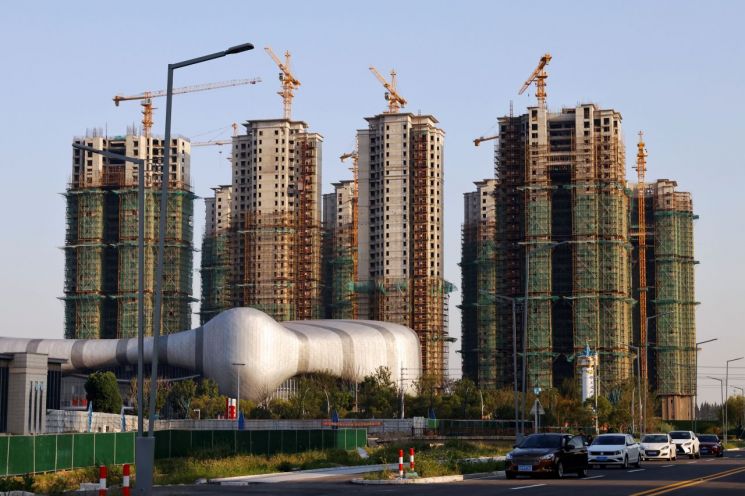
The Chinese real estate market has fallen into a slump. Housing sales plummeted as construction of homes being built nationwide by Evergrande Group was halted.
According to Chinese real estate information firm CRIC, the sales of the top 100 Chinese real estate developers in September decreased by 36% year-on-year. In particular, sales of the top 10 developers, including Vanke and Evergrande Group, dropped by 44%.
Especially since real estate developers have recently increased presales, the sales slump could deal a greater blow to them. As government regulations on the real estate market tightened and cash flow became constrained, developers increased presales to secure funds. They secured funds by selling homes before completion. The National Bureau of Statistics stated that presales were the largest source of funds for real estate developers until August this year.
Nomura diagnosed that debt from presales accounts for about 26% of total debt. FactSet Research estimated that debt arising from presales by five real estate developers, including Evergrande and Vanke, increased by 42% over the past three years, reaching $341 billion as of the end of June.
Song Hu, a fellow at the Paulson Institute, a U.S. think tank, predicted that despite the real estate market slump, the Chinese government’s regulations on the real estate market will continue.
With President Xi Jinping aiming for a third term next year, the Chinese government must maintain social stability at all costs. Real estate is considered a factor that could undermine social stability. Over the past few years, steep housing price increases have made home ownership increasingly difficult, heightening social discontent. According to JP Morgan Asset Management, median home prices in Beijing or Shenzhen exceed 40 times the median household disposable income.
However, the large share of the real estate market means that its slump inevitably lowers China’s economic growth rate, which is a concern for the Chinese government. Kenneth Rogoff, a Harvard University economics professor and Nobel laureate, estimated in a report published last year that the real estate and construction industries account for 29% of China’s economic activity. According to Moody’s, as of the end of June, Chinese bank loans amounted to $29.8 trillion, of which 27% were real estate loans.
Oxford Economics lowered its forecast for China’s third-quarter economic growth rate from 5% to 3.6% on the 6th. The forecast for next year’s economic growth rate was also lowered from 5.8% to 5.4%.
© The Asia Business Daily(www.asiae.co.kr). All rights reserved.
![Clutching a Stolen Dior Bag, Saying "I Hate Being Poor but Real"... The Grotesque Con of a "Human Knockoff" [Slate]](https://cwcontent.asiae.co.kr/asiaresize/183/2026021902243444107_1771435474.jpg)










