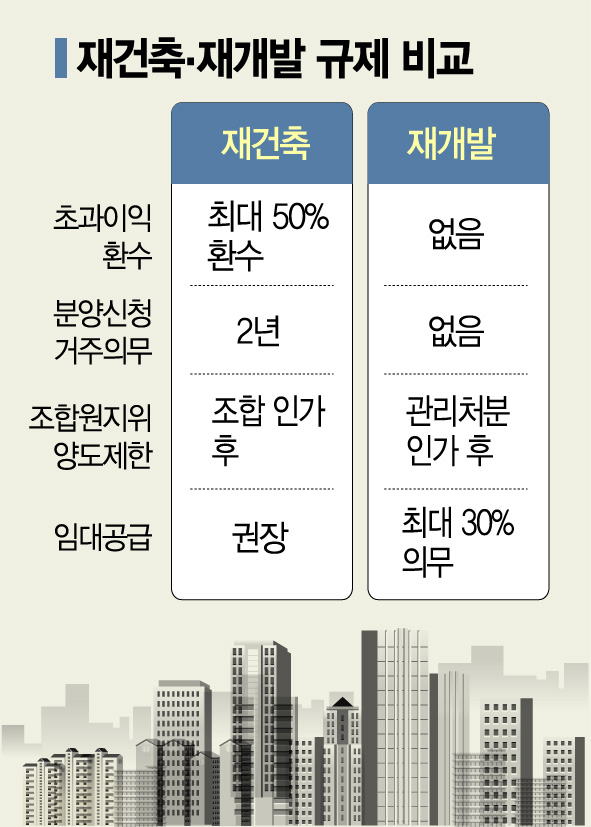
[Asia Economy Reporter Ryu Tae-min] Recently, as housing prices have soared continuously, interest among non-homeowners who find it difficult to purchase their own homes is turning to redevelopment and reconstruction projects as a breakthrough. Although redevelopment and reconstruction may seem similar at first glance because both involve renovating old buildings to create new residential environments, they are distinctly different projects.
First, redevelopment refers to developing residential environments in areas with poor living conditions and inadequate maintenance infrastructure. It involves refurbishing poor infrastructure and constructing new housing to reorganize the residential environment and urban landscape, making redevelopment a public-oriented project. Redevelopment does not require a separate safety inspection.
Reconstruction refers to demolishing and rebuilding houses where maintenance infrastructure such as roads, sewage, and parks is already well established. According to the Enforcement Decree of the Urban and Residential Environment Improvement Act, houses that have been completed for more than 20 years or have significant safety issues are designated as reconstruction targets. In Seoul, reconstruction can only proceed if the building is over 30 years old and receives a safety inspection rating of D or lower.
It is common to think that apartment-dense areas are for reconstruction and single-family house-dense areas are for redevelopment, but this is not always the case. In fact, in Bangbae-dong, Seocho-gu, Seoul, a '10,000 household' single-family house reconstruction project is underway. However, in the case of apartment complexes, maintenance infrastructure is generally well established, and only the buildings are aging, so reconstruction is preferred.
There are also differences in the criteria for approval of association establishment and the consent rate of association members. For redevelopment, consent must be obtained from more than 3/4 of landowners and more than 1/2 of the land area. For reconstruction association establishment, consent from more than 3/4 of the owners of the housing complex and more than 3/4 of the landowners of the site area is required.
The compensation standards also differ. In reconstruction, compensation for the owned house is based on market value, so compensation reflects development gains. However, business compensation, resettlement support, moving expenses, and relocation costs cannot be received in reconstruction projects. On the other hand, in redevelopment, compensation is based on an amount that does not reflect development gains. Compensation is determined based on the publicly announced land price, and business compensation, resettlement support, moving expenses, and relocation costs can be received.
© The Asia Business Daily(www.asiae.co.kr). All rights reserved.

![A Woman with 50 Million Won Debt Clutches a Stolen Dior Bag and Jumps... A Monster Is Born [Slate]](https://cwcontent.asiae.co.kr/asiaresize/183/2026021902243444107_1771435474.jpg)















