Professor Kim Heetak's Research Team at KAIST
[Asia Economy Reporter Kim Bong-su] A Korean research team has developed a core technology for next-generation lithium batteries that dramatically increase energy storage capacity by eliminating the anode material.
The Korea Advanced Institute of Science and Technology (KAIST) announced on the 7th that Professor Kim Hee-tak's research team from the Department of Biological and Chemical Engineering developed a current collector structure for operating anode-free high-energy-density lithium batteries and elucidated its operating principle.
The research results were published online on the 20th of last month in the international journal Nature Communications, gaining international recognition.
Anode-free lithium batteries are a next-generation battery structure that eliminates the graphite anode material, which accounts for much of the volume and weight of lithium-ion batteries used in portable electronic devices and electric vehicles. Instead, only a copper current collector that stores the anode active material is used as the anode component, and energy is stored in the form of lithium metal with high energy density on the current collector. This technology is actively researched in industry and academia because it can achieve 60% higher energy density compared to conventional batteries.
However, when lithium ions are stored in the anode as lithium metal instead of graphite, irreversible lithium loss continuously occurs due to dendritic growth of lithium metal, significantly reducing charge-discharge efficiency. Additionally, galvanic corrosion occurs as microcurrents flow between copper and lithium, which have different reactivities, causing lithium corrosion and electrolyte decomposition on the copper surface simultaneously.
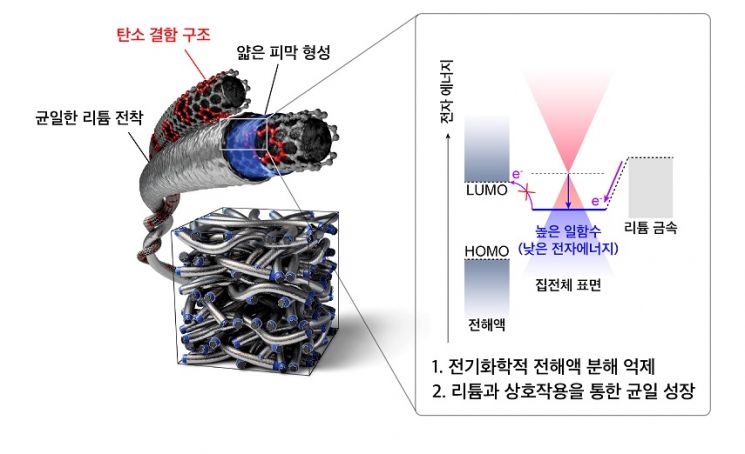
The research team demonstrated that increasing the work function (the energy required to remove an electron from the surface of a solid) of the three-dimensional anode current collector surface suppresses lithium dendritic growth and inhibits corrosion between lithium and the electrolyte on the current collector surface, enabling the operation of anode-free lithium batteries. They artificially introduced carbon defect structures on the carbon current collector surface to increase the work function. This made it difficult for electrons to escape from the current collector surface, significantly suppressing the reduction reaction in which the electrolyte accepts electrons and decomposes. At the same time, the current collector strongly interacted with lithium metal, which has a low work function, inducing uniform lithium metal growth on the current collector and enabling stable energy storage. The research team showed that the developed current collector exhibited significantly higher performance compared to conventional copper current collectors and confirmed that it could operate even in a lean electrolyte environment where only a minimal amount of electrolyte is injected into the battery.
Professor Kim Hee-tak said, "This research result is significant in that it newly proposed a design direction for current collectors to realize anode-free lithium batteries, the ultimate form of lithium batteries," and added, "We hope it will be applied to the anode design of various next-generation lithium batteries based on this."
© The Asia Business Daily(www.asiae.co.kr). All rights reserved.
![Clutching a Stolen Dior Bag, Saying "I Hate Being Poor but Real"... The Grotesque Con of a "Human Knockoff" [Slate]](https://cwcontent.asiae.co.kr/asiaresize/183/2026021902243444107_1771435474.jpg)
















