Fed Likely to Shift Toward Early Tightening
Concerns Over Debt Ceiling Increase Negotiation Breakdown
Warning of Corporate Earnings Decline Due to Inflation
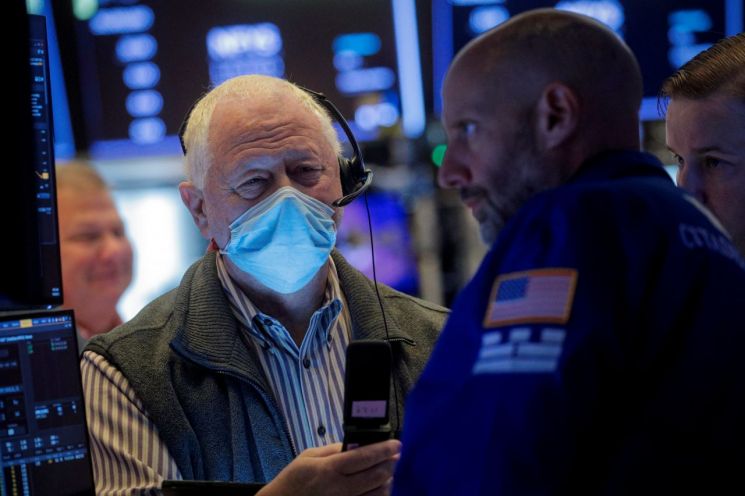
[Asia Economy New York=Correspondent Baek Jong-min] The decline in the U.S. New York stock market is deepening. Amid unresolved concerns about inflation and the U.S. federal government default, strong employment data is raising fears that the Federal Reserve (Fed) will accelerate the normalization of monetary policy, suppressing the market.
On the 6th (local time), private employment data processor ADP announced that private employment increased by 568,000 in September. This significantly exceeded the market expectation of 428,000.
ADP's private employment results were interpreted as a signal that the U.S. Labor Department's September employment report, to be released on the 8th, will also be positive. The September employment data has been anticipated as an important basis for the Fed's decision on whether to taper asset purchases.
Before the ADP announcement, the U.S. 10-year Treasury yield had surged to 1.57%, but it reversed course and fell to 1.515%, yet it is leading the weakness in technology stocks.
Major indices on the New York Stock Exchange are increasing their losses again after a rebound the previous day.
Key technology stocks such as Apple, Facebook, Microsoft, and Alphabet declined, causing the Nasdaq index to widen its intraday loss to 1.9%.
However, the Nasdaq index later saw buying at lower prices, reducing its loss to 0.5%. The Dow Jones Industrial Average is down 0.9%, and the S&P 500 index is down 0.8%.
Paul Ashworth, Chief U.S. Economist at Capital Economics, predicted, "It appears that the appropriate progress in employment mentioned by Fed Chair Jerome Powell has been reached. A decision to taper asset purchases will be made at the November FOMC meeting."
The problem is that interest rates are expected to rise rapidly following tapering.
Jane Foley, Head of FX Strategy at Rabobank, expressed concern that the timing of interest rate hikes could be brought forward, recalling that the Bank of England warned it might raise rates to counter inflation caused by rising energy prices.
With the unprecedented U.S. national default crisis deadline set for the 18th, the deadlock over raising the federal government debt ceiling is also fueling investor anxiety.
President Joe Biden mentioned a day earlier that he could change Senate rules to exclude the debt ceiling increase from the filibuster, intensifying conflicts between the Democratic and Republican parties.
Despite Biden's remarks, Senator Joe Manchin of the Democratic Party maintained his position that he can only support $1.5 trillion in spending and opposes changing the debt ceiling rules, making the plan unlikely to be realized.
The Democratic Party is negative about implementing the budget reconciliation process, which could bypass Republican opposition. The White House is also reportedly excluding this option considering the lengthy time required for the budget reconciliation process.
According to the White House, President Biden invited business leaders including Jamie Dimon, CEO of JPMorgan Chase; Brian Moynihan, CEO of Bank of America; Adena Friedman, CEO of Nasdaq; and Pat Gelsinger, CEO of Intel, to the White House to discuss the necessity of measures to avoid a U.S. national default and to pressure Republicans.
Despite White House pressure, the Republicans show no signs of backing down. The Democrats plan to attempt another procedural vote in the Senate to raise the debt ceiling, but Republicans firmly oppose it.
Art Hogan, Chief Investment Strategist at New York National Securities, expressed concern, saying, "The deadlock in Washington has worsened to the point that the debt ceiling increase cannot be resolved before the deadline."
Hogan warned, "Even if the debt ceiling increase is achieved, the third-quarter earnings season could be negative due to rising inflationary pressures."
Rising oil prices are already reflected in corporate earnings. On this day, Goldman Sachs downgraded the investment ratings of airlines American Airlines and JetBlue from hold to sell, citing concerns over deteriorating earnings due to rising oil prices. As a result, most airline stocks showed significant declines.
© The Asia Business Daily(www.asiae.co.kr). All rights reserved.

















