RPS Mandatory Supply Ratio Raised from 9% This Year to 12.5% Next Year
Increased to 25% by 2026... KEPCO Faces Rising Pressure to Raise Electricity Rates Due to Climate and Environmental Costs
[Sejong=Asia Economy Reporter Kwon Haeyoung] The mandatory supply ratio of electricity generated from expensive renewable energy sources such as solar and wind power by power generation companies will significantly increase from the current 9% of total power generation to 12.5% next year. This is to expand the supply of renewable energy, and the government plans to gradually raise this ratio to the legal cap of 25% by 2026. This is raising concerns that the increased burden on Korea Electric Power Corporation (KEPCO) to compensate power companies for purchasing renewable energy will eventually boomerang as an increase in electricity rates.
The Ministry of Trade, Industry and Energy announced on the 6th that it will give prior legislative notice of a partial amendment to the Enforcement Decree of the Act on the Development, Use and Promotion of New and Renewable Energy (hereinafter referred to as the New and Renewable Energy Act), which gradually raises the mandatory supply ratio under the Renewable Portfolio Standard (RPS) system, which had been fixed at 10% since 2022.
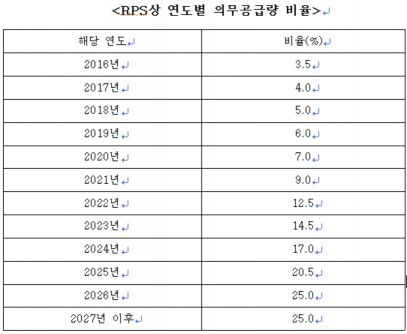
According to the amendment, the annual mandatory ratios will be 12.5% in 2022, 14.5% in 2023, 17% in 2024, 20.5% in 2025, and the legal cap of 25% from 2026 onward.
This follows the amendment to the New and Renewable Energy Act in April, which expanded the upper limit of the mandatory supply ratio under the RPS from the previous 10% to 25%. Public and private power generation companies with power generation facilities of 500 MW or more, including six power generation subsidiaries under KEPCO, are obligated to supply a certain amount of electricity generated from renewable energy. The government sets the supply amount of renewable energy through the mandatory supply ratio under the RPS, and this amendment to the enforcement decree raises the annual mandatory ratios. Power companies mainly fulfill their RPS obligations by purchasing Renewable Energy Certificates (RECs) from solar power operators and others.
An official from the Ministry of Trade, Industry and Energy stated, "We plan to finalize the mandatory ratio within this year by reflecting the legislative notice, opinions from related agencies, and trends in discussions on the Nationally Determined Contribution (NDC), and apply the revised mandatory ratios from 2022."
The increase in the mandatory supply ratio of renewable energy this time is not only aimed at achieving carbon neutrality but also a result of the government's overly ambitious rapid expansion of solar power supply. Solar power operators produce electricity, receive RECs, and sell these RECs to power companies subject to RPS to earn profits. Due to the oversupply of solar power generation facilities under the current administration, REC prices have plummeted, putting private operators at risk of bankruptcy. In response, the government decided to sharply raise the mandatory supply ratio under the RPS for power companies in line with this year's amendment to the New and Renewable Energy Act. The Ministry of Trade, Industry and Energy also explained, "We prepared the draft annual mandatory ratios by comprehensively considering the situation of REC oversupply."
The problem is that KEPCO compensates the major power companies for the costs of fulfilling RPS obligations, meaning that ultimately the public bears all the costs. KEPCO's RPS fulfillment costs amounted to 2.247 trillion won in 2020 (when the mandatory supply ratio was 7%) and 1.6773 trillion won in the first half of this year (when the mandatory supply ratio was 9%). Simply put, KEPCO bears about 320 billion won for every 1 percentage point increase in the mandatory supply ratio under the RPS. It is projected that KEPCO's RPS fulfillment costs will exceed 8 trillion won by 2026 when the ratio rises to 25%.
© The Asia Business Daily(www.asiae.co.kr). All rights reserved.


















