Swedish Royal Academy of Sciences Announces Joint Laureates Including Two Climatologists and One Fundamental Physicist
Recognized for Foundations in 'Climate Change Research' and Contributions to 'Molecular Motion Principles' Respectively
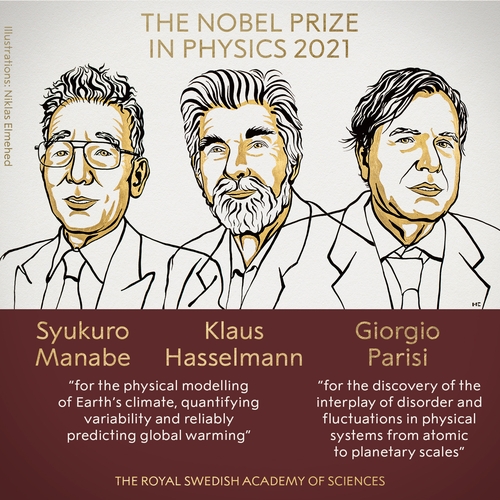
[Asia Economy Reporter Kim Bong-su] This year's Nobel Prize in Physics was jointly awarded to two climatologists who studied climate change and one fundamental physicist who analyzed the properties of matter at the atomic level.
The Royal Swedish Academy of Sciences announced on the afternoon of the 5th (local time) that the prize was jointly awarded to Shukuro Manabe, a Japanese-American professor at Princeton University who laid the foundation for research on climate change caused by global warming; Klaus Hasselmann, a professor at the Max Planck Institute in Germany; and Giorgio Parisi, a fundamental physicist at Sapienza University of Rome, Italy, who elucidated the movement of complex molecules.
Manabe and Hasselmann were recognized for their research on physical modeling of the Earth's climate, enabling stable predictions of climate variability and global warming. The Royal Academy described Professor Parisi as having "discovered the interplay of disorder and fluctuations in physical systems ranging from atomic to planetary scales."
Professor Manabe was born in Japan in 1931 and earned his doctorate at the University of Tokyo. He currently serves as a senior meteorology professor at Princeton University. Professor Hasselmann was born in Hamburg, Germany, in 1931, obtained his doctorate from the University of G?ttingen, and conducts meteorological research at the Max Planck Institute. Professor Parisi, born in 1948, earned his doctorate at Sapienza University and is currently a professor there.
This year's Physics Prize carries a reward of approximately 10 million kronor (about 1.35 billion KRW), half of which will be awarded to Professors Manabe and Hasselmann, and the other half to Professor Parisi. The award ceremony is scheduled for early December in Stockholm, Sweden. However, due to COVID-19, most laureates are expected to participate online from their home countries. Marking its 120th anniversary this year, the Nobel Prize announced the Physiology or Medicine laureates on the 4th, with Chemistry on the 6th, Literature on the 7th, Peace on the 8th, and Economics on the 11th.
According to Professor Son Seok-woo of the Department of Earth and Environmental Sciences at Seoul National University, who attended a Nobel Prize-related briefing hosted by the Korean Federation of Science and Technology Societies, Professor Manabe is regarded as a meteorologist who laid the foundation for research on Earth's climate warming due to increased carbon dioxide (CO2) in the 1960s. Manabe focused on how energy changes occur when clouds form in the atmosphere and how temperatures change up to the stratosphere. At that time, there were no artificial satellites, but based on mathematical theory and utilizing the physical properties of the atmosphere, he developed a three-dimensional climate model estimating atmospheric temperature changes. Professor Son explained, "Manabe's estimation of how the climate would change if CO2 concentrations doubled still holds almost exactly today," adding, "Creating a 3D climate model less than 20 years after weather forecasting began with the ENIAC computer in the 1950s was a remarkable achievement."
Professor Hasselmann, an ocean climatologist, devised a method called the fingerprint to distinguish between natural and anthropogenic climate changes. He also published research showing that atmospheric variability can cause long-term ocean variability. Professor Son said, "Among the factors affecting climate change, the ocean plays a significant role," and added, "He revealed that the ocean plays an important role in long-term climate change."
Professor Parisi is a physicist who studied fundamental physics at the atomic level. He is famous for presenting the "spin glass" model in 1979, which elucidated the movement of atoms when glass is formed. Professor Park Hyung-kyu of the Institute for Basic Science explained, "When heated glass liquid is suddenly immersed in cold water, molecules cannot find their places and settle randomly, hardening into various forms," adding, "Professor Parisi mathematically solved this phenomenon with a simple model and published it using a methodology called the 'replica method.'"
The spin glass model has recently begun to be referenced in social analysis, artificial intelligence (AI), and big data research. Professor Park explained, "The spin glass model can also be applied to social relationships," and said, "In a situation where all systems are connected via the internet and interactions occur, it can be used to study the frequency of typical structures arising in social relationships."
Professor Parisi is also widely known as one of the authors of the KPZ equation. This equation revealed that random interfaces existing in nature have certain regularities. For example, when mold grows in a laboratory, it initially clusters in the center and gradually spreads out, and its boundary is not round but wavy. The KPZ equation provided regularity to these wavy surfaces.
© The Asia Business Daily(www.asiae.co.kr). All rights reserved.

















