Chuseok Special Inspection... 58 Unlabeled Sites and 20 Falsely Labeled Sites Detected
Unlabeled: Fines up to 10 Million KRW
False Labeling: Imprisonment up to 7 Years or Fines up to 1 Billion KRW
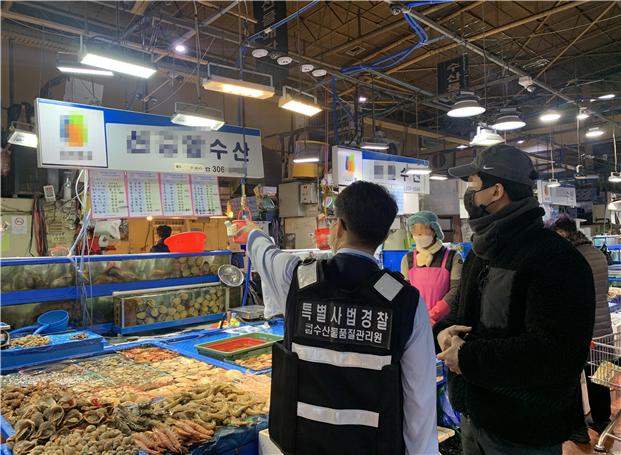
[Sejong=Asia Economy Reporter Moon Chaeseok] Seventy-eight companies were caught by the government for falsely labeling imported products as domestic or improperly indicating the origin.
On the 5th, the Ministry of Oceans and Fisheries announced that during a special inspection of seafood origin labeling conducted over four weeks from August 30 to September 24, 78 companies were found violating regulations such as failure to indicate origin, improper labeling methods, and false labeling. The ministry inspected 24,391 locations including restaurants, distributors, and wholesale and retail stores. They examined products such as dried yellow corvina (jogi), pollock, octopus, sea bream species, squid, cutlassfish, red sea bream, scallops, sea squirts, skate, octopus, and eel.
Among the violations, 58 companies failed to indicate the origin, and 20 companies falsely labeled the origin. By product, there were 12 cases involving sea bream species, 10 cases of octopus, 8 cases of scallops, 8 cases of yellow corvina, 7 cases of shrimp, 6 cases of squid, 5 cases of sea squirts, and 5 cases of sea bass, totaling 104 cases of either missing or false origin labeling. When categorized by country of origin, 38 cases (36%) involved products from China, and 18 cases (17%) involved products from Japan.
For the 58 companies that failed to indicate origin, fines of up to 10 million KRW were imposed depending on the violation amount. The 20 companies that falsely labeled origin will face further investigation and may be sentenced to up to 7 years in prison or fined up to 100 million KRW.
The Ministry of Oceans and Fisheries plans to strengthen the criteria for imposing fines related to failure to indicate seafood origin. After consultations with related ministries and local governments within this month, they will finalize and announce a legislative amendment to the Enforcement Decree of the Origin Labeling Act.
Im Taehoon, Director of Distribution Policy at the Ministry of Oceans and Fisheries, stated, "We will strengthen the management of distribution history for imported seafood, expand the list of items requiring labeling in restaurants, and conduct thorough origin inspections along with continuous institutional improvements. We hope seafood sellers who have the obligation to properly label origin will actively participate."
© The Asia Business Daily(www.asiae.co.kr). All rights reserved.

















