New Geological and Fossil Records Confirmed ‥ Discovering Dinosaur Era Land of the Korean Peninsula
[Asia Economy Yeongnam Reporting Headquarters Reporter Kim Yong-woo] There was a 'Nanmu-jang' in Gijang, Busan, where dinosaurs danced and played!
Early last year, a graduate student happened to discover and report a site, which was confirmed through preliminary investigation to be a rock layer preserving fossils and footprints from the dinosaur era.
According to the investigation team, this stratum was found to be similar to regions in the Korean Peninsula and Japan's Kyushu area, confirming that Korea and Japan were once connected and later separated due to continental drift.
On the 5th, Gijang County announced the completion of a basic academic survey on the dinosaur footprint fossil site around Sinpyeongso Park in Ilgwang-myeon.
Gijang County commissioned the Pukyong National University Industry-Academic Cooperation Foundation (lead researcher Professor Baek In-seong) to conduct a three-dimensional analysis of the late Cretaceous period's paleogeography, paleotopography, paleoecology, and paleoclimate during the late dinosaur era on the Korean Peninsula.
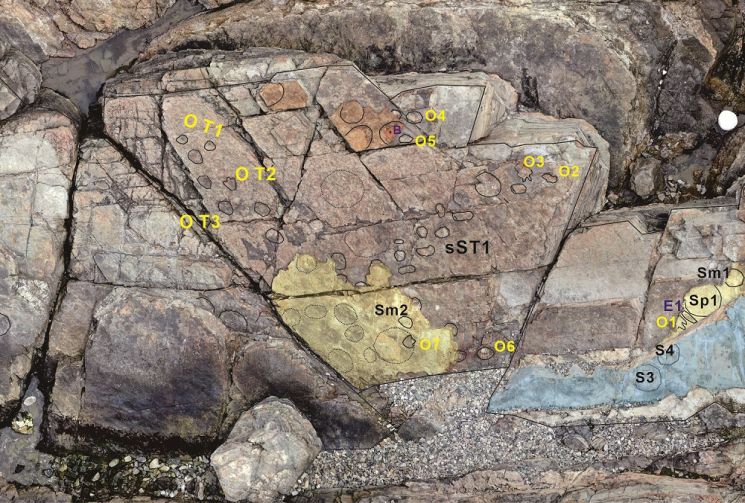
The survey confirmed that geological and fossil records are concentrated in the dinosaur footprint fossil site along the Sinpyeong-ri coast.
In this investigation, various types and forms of dinosaur footprint fossils such as sauropods, ornithopods, and theropods, as well as dinosaur bone fossils, bird footprints, uniquely shaped vertebrate footprints, and conifer plant fossils were newly identified in the Cretaceous sedimentary layers.
This is the first time that such fossil records have been found together in the Yucheon Formation sedimentary layers, which are late Cretaceous strata from the dinosaur era on the Korean Peninsula.
Additionally, the conglomerate layer survey in this area revealed that Korea and Japan were connected by land during the Mesozoic Cretaceous period.
The investigation team confirmed the presence of chert pebbles containing Bansan-chung fossils, which indicate land connection.
The team estimated this to be highly unique and rare. It is a very useful record for understanding the paleogeography and topographical characteristics of East Asia during the Cretaceous period of the dinosaur era on the Korean Peninsula in a more three-dimensional way outdoors.
Gijang County views the Cretaceous sedimentary rock layer site along the Sinpyeong-ri coast in Ilgwang-myeon as having excellent accessibility and convenience, and as a natural history experience space with high utilization value for understanding the paleoecological and paleoenvironmental characteristics of the late dinosaur era on the Korean Peninsula.
Gijang County expects to utilize it as a symbolic small-scale geological tourism site in the Gijang area.
A Gijang County official said, “Based on the results of this investigation, we plan to conduct a comprehensive academic survey of dinosaur-era strata throughout Gijang County in the future to continuously discover the natural heritage value of the Gijang area.”
© The Asia Business Daily(www.asiae.co.kr). All rights reserved.
![User Who Sold Erroneously Deposited Bitcoins to Repay Debt and Fund Entertainment... What Did the Supreme Court Decide in 2021? [Legal Issue Check]](https://cwcontent.asiae.co.kr/asiaresize/183/2026020910431234020_1770601391.png)















