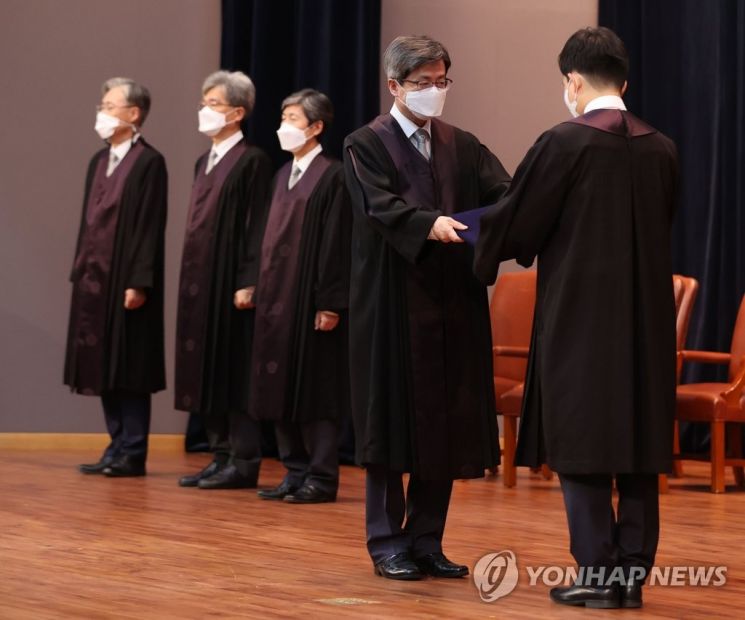
 On the afternoon of the 5th, Chief Justice Kim Myung-soo is presenting appointment certificates to new judges at the appointment ceremony held at the Supreme Court in Seocho-gu, Seoul.
[Asia Economy Reporter Choi Seok-jin, Legal Affairs Specialist] On the 5th, Chief Justice Kim Myung-soo emphasized active interest and participation for the realization of 'good trials' in his speech at the new judge appointment ceremony.
The Supreme Court held a new judge appointment ceremony on the 5th at the main auditorium of the Seocho-dong building in Seoul, appointing 156 general legal professionals with more than five years of legal experience as judges.
In his appointment speech, Chief Justice Kim said, "You have walked the path of excellent legal professionals by serving in various legal fields such as lawyers, prosecutors, judicial researchers, judicial research officers, government agencies, and public institutions for a period ranging from five to thirteen years. I believe that the experience and wisdom you have gained while working in various legal sectors will become a valuable foundation for your future path as judges and a rich asset for the judiciary."
He added, "Since 2013, the unified legal profession system has been operated to select judges from those with certain legal experience, resulting in judges with diverse experiences and backgrounds. This year, for the first time, more judges were appointed who graduated from law schools than those who completed the Judicial Research and Training Institute," he revealed.
He continued, "Appointing legal professionals with diverse backgrounds and broad legal experience like you as judges is to meet the public's expectation that those with sound judgment and insight become judges. I hope that all of you will grow into excellent judges so that the unified legal profession system can take firm root," he said.
Chief Justice Kim urged the newly appointed judges to take interest and participate actively in the realization of 'good trials.'
He said, "Since my inauguration, I have consistently emphasized the realization of 'good trials.' Various changes related to judicial administration, such as the abolition of the position of chief judge of the high court and the formation of panels with equivalent experience, were to support the realization of 'good trials,'" he explained.
He added, "This year, to establish a foundation for thorough hearings, we introduced a long-term judge service system to avoid frequent transfers, and we plan to expand the specialized judge system to strengthen judges' expertise. I ask for your active interest and participation so that 'good trials' can be realized through these new systems," he said.
Chief Justice Kim mentioned the recent amendment to the Civil Procedure Act, which introduced the video trial system, pointing out that "easy access to courts is also an important element of 'good trials.'"
He said, "With the establishment of electronic litigation and video trials, the nature of trials can fundamentally change. I hope you will create a desirable form of trial with an open mind, an innovative attitude, and creativity to realize 'good trials,'" he repeatedly urged.
Chief Justice Kim emphasized, "Judges have a noble mission to protect the independence of trials. Currently, conflicts and confrontations among various interests and values are intensifying in our society. At such times, judges must have the courage and sense of mission to declare justice and judge solely according to law and conscience to protect the independence of trials."
While emphasizing the 'independence of trials,' Chief Justice Kim pointed out that 'independence of trials' itself is not the ultimate goal, and that the ultimate purpose is to guarantee the freedom and rights of the people through 'good trials.'
He stated, "'Independence of trials' cannot be the ultimate goal in itself. The true meaning of the system lies in guaranteeing the freedom and rights of the people through 'good trials.' Without ensuring the independence of trials, it is difficult for the judiciary to fulfill its constitutional mission, so the independence of trials is necessary," he explained.
Lastly, Chief Justice Kim added, "Judges are required to have a high level of morality and character both in public and private spheres. Always maintaining the dignity befitting a judge and earning the trust of the people will also be a way to protect the independence of trials," he concluded.
The newly appointed judges who received their appointment letters on this day are scheduled to undergo 'new judge training' at the Judicial Research and Training Institute for about five months from October 6 to the end of February next year. The training includes thinking exercises necessary for case handling, judgment writing, and education on virtues and qualities required as judges, after which they will be assigned to various courts in March next year.
Recently, amid the National Assembly's rejection of the amendment to the Court Organization Act that would lower the judge appointment requirement to more than five years of legal experience, the requirement will be raised to more than seven years of legal experience from next year in accordance with the previously amended supplementary provisions of the Court Organization Act to promote the unified legal profession system.
© The Asia Business Daily(www.asiae.co.kr). All rights reserved.
![Clutching a Stolen Dior Bag, Saying "I Hate Being Poor but Real"... The Grotesque Con of a "Human Knockoff" [Slate]](https://cwcontent.asiae.co.kr/asiaresize/183/2026021902243444107_1771435474.jpg)
















