Illegal Acts Occurring in Phone and In-Person Complaints
34,484 Cases in 2018 → 38,054 in 2019 → 46,079 in 2020
Surge in Inquiries Due to Non-Face-to-Face Normalization After COVID-19...Union Says "Counselors Treated Like Phone-Answering Machines"
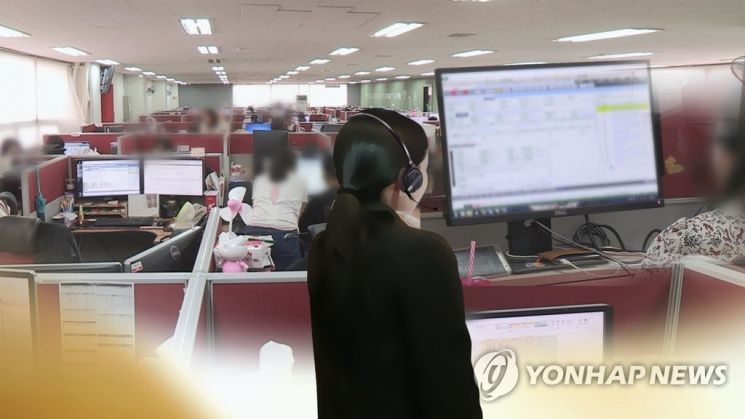 Call center workers have been found to suffer serious harm due to verbal abuse and insults during their work.
 [Image source=Yonhap News]
[Asia Economy Reporter Kim Soyoung] The issue of malicious complainants who indiscriminately verbally abuse or curse call center workers is emerging as a social problem.
Recently, a man in his 50s, Mr. A, who verbally abused and cursed call center employees, was sentenced to prison. Mr. A was sentenced to eight months in prison last year for repeatedly verbally abusing and cursing four call center counselors of a certain corporation's service center at his home in Gangnam-gu, Seoul.
He reportedly spewed abusive language such as "You damn bastards, you make the counseling disgusting," and "What kind of bastard who can't even counsel talks back? You must have grown up eating shit without hearing curses." The court explained the sentencing by stating, "The defendant has a history of multiple criminal punishments for similar offenses and committed this assault during the recidivism period (three years after the completion or exemption of sentence execution)."
In February last year, a man in his 50s, Mr. B, was prosecuted for making 23 instances of verbal abuse and insults over two days by calling the Korea Disease Control and Prevention Agency's 1339 call center, saying things like "What are you doing?" and "Don't lie." The court sentenced him to six months in prison, judging that "the counselors likely suffered significant mental distress" and "strict punishment commensurate with the guilt is inevitable."
According to the Ministry of the Interior and Safety, illegal acts such as verbal abuse, insults, threats, assault, and sexual harassment occurring in phone and in-person complaints have increased annually: 34,484 cases in 2018, 38,054 in 2019, and 46,079 in 2020.
Given this situation, the emotional exhaustion of call center workers has reached its peak. According to the Korea Workers' Compensation and Welfare Service on the 14th of last month, applications for mental illness industrial accident compensation surged from 268 cases in 2018 to 331 in 2019 and 581 last year. Up to May this year, 294 applications for mental illness industrial accidents have been filed. Earlier, a labor health survey conducted in August last year targeting National Health Insurance Service customer center workers found that 84.5% of respondents scored 2 or more out of 6 on the depression screening scale (PHQ-2), classifying them as at risk for depression.
Along with this, the poor working conditions of call center employees are also cited as a problem. The work environment does not allow them to leave their posts even briefly due to the flood of inquiries. This situation worsened with the increase in non-face-to-face activities during the COVID-19 pandemic. In particular, the Korea Disease Control and Prevention Agency's infectious disease specialized call center (1399) faced a surge in COVID-related inquiries, making measures such as workforce expansion unavoidable. On January 29 last year, the infectious disease specialized call center of the Korea Disease Control and Prevention Agency expanded its dedicated counseling staff from 27 (19 existing counselors and 8 dispatched epidemiologists) to about 170.
Mr. C, a university student in his 20s, said, "Honestly, waiting a long time to make a COVID-related inquiry is exhausting, but I wait because I know everyone is having a hard time," adding, "Understanding each other's situation comes first."
There are laws to protect call center workers. The 'Emotional Labor Protection Act' (employer obligations related to emotional labor under the Occupational Safety and Health Act) was established in 2018, but related issues persist. It is pointed out that this is insufficient to protect workers from workplaces rife with verbal abuse.
Some voices call for changing the culture of unconditional kindness demanded from call center workers. Comments include, "The concept of kindness and service needs to change. Saying 'yes, yes' unconditionally is not kindness; at least basic manners should be observed to receive service," "Don't use honorifics for people who speak informally," and "Are call center workers scapegoats for insults? They should be able to respond strongly."
Mr. D, a worker in his 30s, lamented, "Nowadays, phrases like 'The person answering the phone could be your family' have been added, but awareness still needs improvement," and said, "Although some progress is ongoing, it might be better for both sides if the counselors were entirely replaced by AI, even if there are inconveniences."
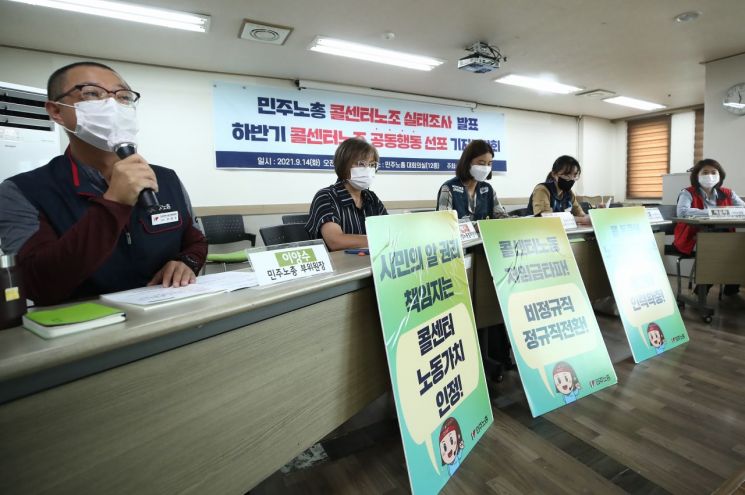 On the 14th of last month, Lee Yang-su, Vice Chairman of the Korean Confederation of Trade Unions (KCTU), is speaking at a press conference held at the KCTU in Jung-gu, Seoul, announcing the results of the KCTU Call Center Union survey and declaring joint actions for the second half of the year. [Image source=Yonhap News]
The Korean Confederation of Trade Unions (KCTU) Call Center Union held a press conference on the 14th of last month, urging measures to address the surge in workload and difficulties due to COVID-19.
The union stated, "With longer waiting times, complaints from clients have surged, and in a reality where even minimal labor standards like vacations are hard to guarantee, nine out of ten workers suffer from severe depression," adding, "Expanding the call center workforce is essential to provide stable counseling to clients."
According to a survey conducted by the union among call center labor unions within the KCTU, the average number of calls per day for call center workers is 110.3, with an average call time of 4.4 hours. The union demands △ elimination of low wages in call center work △ conversion of irregular workers to regular workers △ abolition of monitoring and rating systems for call center work △ expansion of regular workforce in call centers.
Kang Mihyun, Policy Director of the National Health Insurance Service Customer Center Branch of the Public Transport Union, said, "Counselors are treated like machines answering phones and are even controlled when going to the restroom, seriously damaging their health rights," and urged, "Public nature cannot be maintained under private consignment systems. Direct employment is absolutely necessary."
© The Asia Business Daily(www.asiae.co.kr). All rights reserved.


















