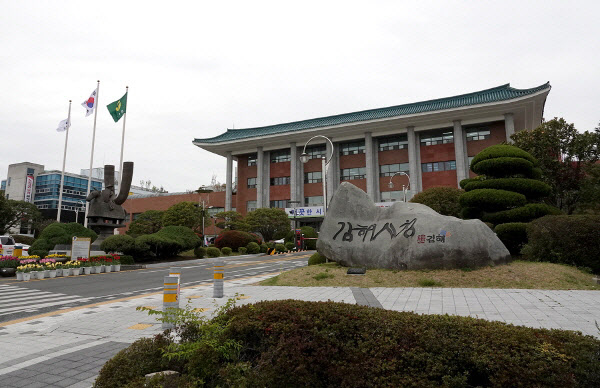
[Asia Economy Yeongnam Reporting Headquarters Reporter Lee Sang-hyun] Gimhae City, Gyeongnam announced a research project on the establishment of a public medical institution on the 5th.
The city collaborated with Inje University to conduct a four-month research project on the "Necessity and Expansion Plan for the Introduction of Public Healthcare."
As a result, Gimhae was found to be the only major city outside the metropolitan area without a public medical institution, leading to weak public healthcare that fails to guarantee citizens' right to health and cannot effectively respond to medical disasters such as COVID-19.
It was also identified that essential medical services such as emergency care, childbirth, and rehabilitation are not properly provided, causing excessive or insufficient treatment deviating from standard care.
While the scale of medical institution beds capable of providing quality medical care is considered to be over 300 beds, the city has only one medical institution with more than 300 beds, ranking 32nd among 36 medical service areas (with populations over 300,000) in terms of beds per 1,000 people.
Due to poor medical services, the utilization rate of higher-level hospitals in other regions is also high. The estimated annual direct medical expenses of Gimhae citizens in 2019 were 1.4 trillion KRW, with 550 billion KRW spent annually on medical institutions in other regions, resulting in a 39% utilization rate of medical institutions outside the area.
Currently, in the COVID-19 disaster situation, there is no infectious disease specialized hospital, forcing local COVID-19 patients to be transferred not only to nearby cities within the province but also as far as Jeolla and Chungcheong provinces, hindering effective response.
Citizens' medical expenses are also higher compared to other regions. For public medical institution treatments, the health insurance coverage rate is 68.2%, whereas for private medical institutions it is 63.7%, meaning patients bear less burden when using public medical institutions.
This study reported that a public medical institution with more than 300 beds is urgently needed in Gimhae to respond to the national public healthcare activation policy and solve regional medical service problems.
Based on these results, the city plans to hold a seminar this month for the establishment of a public medical institution, involving related experts, the city council, and civic groups.
Mayor Heo Seong-gon stated, "We will attract public medical institutions to eliminate health inequality among citizens, provide various medical services, and strengthen the response capacity to large-scale infectious diseases."
© The Asia Business Daily(www.asiae.co.kr). All rights reserved.

















