Concerns Over Early Rate Hikes Amid US Debt Negotiation Stalemate
China Risks Including Evergrande Crisis and Power Shortages Also Weigh Down
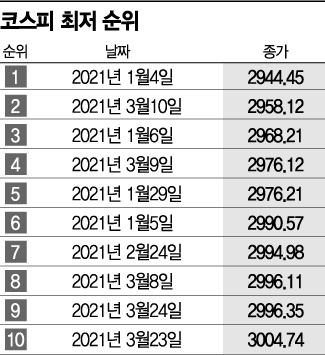
[Asia Economy Reporter Ji Yeon-jin] On the 5th, the KOSPI fell below the 3000 mark, approaching its lowest level this year. This was due to a combination of negative factors including inflation and concerns over U.S. monetary tightening that have pressured the domestic stock market since the beginning of the year, along with the China Evergrande crisis and green inflation. The financial investment industry expects the possibility of a further sharp decline to be low, but anticipates that the "wait-and-see market" may continue, potentially prolonging the adjustment period.
The U.S. situation that triggered the sharp drop on this day continues to weigh on the stock market. The vote on the Biden administration’s $1.2 trillion (approximately 1,421.52 trillion KRW) infrastructure investment bill, which had been a positive factor for global markets, has been postponed to October 31. Progressive lawmakers argue that a $3.5 trillion social spending bill should be passed first, while moderate lawmakers such as Senator Joe Manchin are demanding cuts. Sang-young Seo, a researcher at Mirae Asset Securities, explained, "The weakening expectations for government fiscal spending and the rising concerns over a U.S. credit rating downgrade lead to a contraction in investor sentiment," adding, "The Biden administration’s tough stance on China, including the U.S. Trade Representative’s announcement to maintain tariffs on China, is also a burden."
Green inflation is being perceived as a signal that accelerates the early tightening of U.S. monetary policy, which has shaken global financial markets throughout this year. Initially, the market expected the U.S. Federal Reserve (Fed) to implement a gradual tapering of asset purchases to minimize shocks to the stock market, focusing on economic recovery. However, the recent global power shortage has worsened supply chain bottlenecks and steep price increases, raising discussions about early interest rate hikes in the U.S. Sang-hyun Park, a researcher at Hi Investment & Securities, stated, "Unexpected supply chain disruptions and green inflation risks since COVID-19 are materializing new inflationary pressures on the global economy," and added, "Considering the COVID-19 situation, these issues are unlikely to be resolved in the short term. As the Fed’s tightening becomes more visible, increased inflation uncertainty could lead to a sharp rise in U.S. Treasury yields, posing significant burdens on both financial markets and the economic cycle."
Moreover, the China Evergrande Group crisis is worsening. Since trading of Evergrande Group and Evergrande Property Services (Hengda Wuye), which manages Evergrande’s real estate business, was temporarily suspended on the Hong Kong stock market the previous day, there is a possibility of increased uncertainty in China after the National Day holiday. Attention should also be paid to the debt ceiling negotiations scheduled for mid-month, which are also restraining the domestic stock market. Additionally, the prolonged supply chain instability in global semiconductor and automobile sectors is a challenge for the business conditions and earnings uncertainty of domestic companies.
Kyung-min Lee, a researcher at Daishin Securities, advised, "While the possibility of a further sharp decline in the KOSPI is low, it is time to focus on changes in the accumulated negative factors," and added, "With supply chain bottlenecks prolonging and supply instability exacerbated by China’s power shortage, it is necessary to watch over time whether the KOSPI can secure momentum for a reversal." Jaehwan Heo, a researcher at Eugene Investment & Securities, forecasted, "The more frightening negative factor is China’s power shortage," and said, "There is a risk that China’s growth rate could decline more sharply than expected in the second half, so stagflation concerns may arise from China rather than the U.S., which could be a major factor shaking the upward trend of the domestic stock market."
© The Asia Business Daily(www.asiae.co.kr). All rights reserved.

















