[Asia Economy Reporter Seulgina Jo] The Ministry of Science and ICT announced on the 5th the '2021 4th Industrial Revolution Indicators,' a performance index that allows the public to feel the growth and innovation of data, network, and artificial intelligence (D.N.A.), the foundation of the 4th Industrial Revolution.
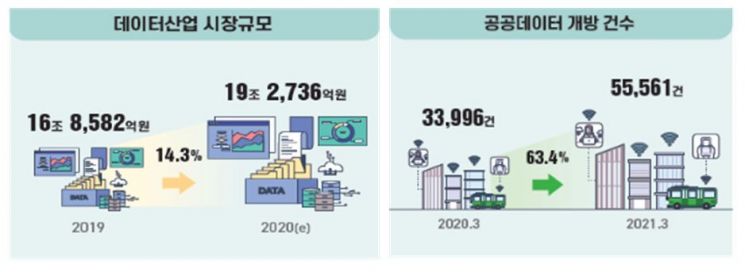
First, it was found that the expansion of the DNA sector, the core infrastructure of digital transformation, is continuing. The total market size of the data industry was KRW 19.2736 trillion in 2020, growing 14.3% compared to the previous year. The number of public data openings was 55,561 cases (March 2021), an increase of 63.4% compared to the previous year, providing a foundation for revitalizing the data economy.
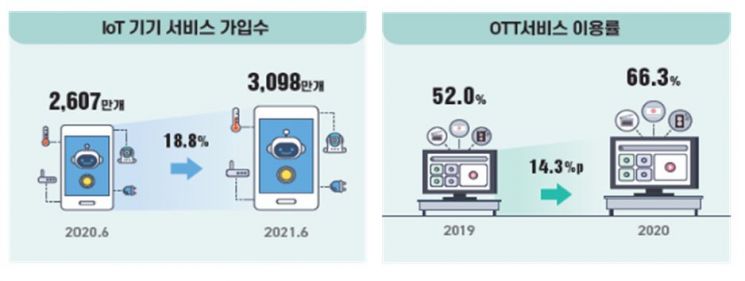
In the case of networks, the number of Internet of Things (IoT) service subscriptions reached 30.98 million (June 2021), an 18.8% increase from the previous year, and the usage rate of Over-The-Top (OTT) online video services rose from 52.0% in 2019 to 66.3% in 2020, an increase of 14.3 percentage points, showing the development of ICT technology and changes in people's lives after COVID-19.
Furthermore, AI industry sales amounted to KRW 689.5 billion (2020(E)), growing 16.3% compared to the previous year. The number of uses of AI training data for more advanced AI development also increased by 153.4% year-on-year, reaching 96,826 times (cumulative as of August 2021).
In the digital transformation process of the 4th Industrial Revolution, future promising industries leading innovative growth such as cloud computing and virtual/augmented reality (VR·AR) are also emerging. The cloud industry, a catalyst for digital competitiveness, recorded sales of KRW 3.3 trillion (2019), growing 13.8% compared to the previous year, and individual cloud usage increased from 30.8% in 2019 to 35.3% in 2020, showing that cloud utilization is becoming more widespread.
Both the VR·AR industry sales (KRW 803.2 billion in 2020(E), up 6.8% year-on-year) and the number of participants (5,940 in 2019, up 10.6% year-on-year) showed growth trends.
The expansion of the DNA sector and the emergence of promising industries are becoming the foundation for active digital innovation across the economy, and visible achievements that the public can feel in their lives are becoming clearer, the Ministry of Science and ICT emphasized.
As of 2020, the online education usage rate among students (98.9%) rose by 37.1 percentage points compared to the previous year, rapidly spreading the use of online education across society due to the normalization of non-face-to-face activities after COVID-19. Additionally, the digital information level of vulnerable groups compared to the general public was 72.7% (2020), showing a trend of narrowing the digital divide.
In the financial sector, the growth of internet-only banks and the popularization of simple payment services confirm the innovation of ICT-based financial industries represented by fintech. The number of internet-only bank accounts was 31.03 million (as of March 2021, up 29.3% year-on-year), and the number of customers was 18.07 million (up 36.2% year-on-year), both increasing. The average daily usage of simple payment and remittance services was KRW 805.7 billion (2020), a significant increase of 46.0% compared to the previous year.
The government is also leading the digital transformation in the public sector. The usage rate of e-government services provided to enhance public convenience was 88.9% (2020), up 1.3 percentage points from the previous year, and meaningful achievements were made through continuous digital government promotion, including ranking first in the Digital Government Composite Index (’20, OECD) and eighth in the Digital Competitiveness Index (’20, IMD).
The number of registered drones, a new growth momentum for ICT technology-based industries, was 26,035 (June 2021), a 96.7% increase from the previous year, and the number of autonomous vehicles also rose to 136 (March 2021), up 46.2% year-on-year, showing clear innovation in ICT-based mobility.
In the medical field, the number of hospitals participating in electronic exchange of medical information between medical institutions (cumulative) reached 6,497 (March 2021), a 49.7% increase from the previous year, expanding the exchange of patient medical information between institutions and improving patient convenience.
Additionally, the major national digital road network (ITS), which will contribute to improving the quality of life for the public, is planned to be expanded by 2,170 km by December 2021. The number of smart factories leading digital innovation in manufacturing reached 19,799 (as of December 2020), a 56.4% increase compared to the previous year.
Cho Kyung-sik, Vice Minister of the Ministry of Science and ICT, stated, “The importance of digital transformation is increasing to overcome the COVID-19 crisis and create new growth momentum,” and added, “We ask for the continued interest and cooperation of the public to successfully achieve digital innovation through the promotion of the 4th Industrial Revolution.”
Going forward, the Ministry of Science and ICT plans to continuously advance the indicators so that the public can easily recognize the achievements of the 4th Industrial Revolution through changed figures by promoting the 4th Industrial Revolution, including the Digital New Deal.
© The Asia Business Daily(www.asiae.co.kr). All rights reserved.
![Clutching a Stolen Dior Bag, Saying "I Hate Being Poor but Real"... The Grotesque Con of a "Human Knockoff" [Slate]](https://cwcontent.asiae.co.kr/asiaresize/183/2026021902243444107_1771435474.jpg)












