Functional Polymers, Biomaterials, and Semiconductor Nanostructure Fabrication Applications
[Asia Economy Reporter Kim Bong-su] Domestic researchers have developed a core technology for fabricating nano capsules using salt.
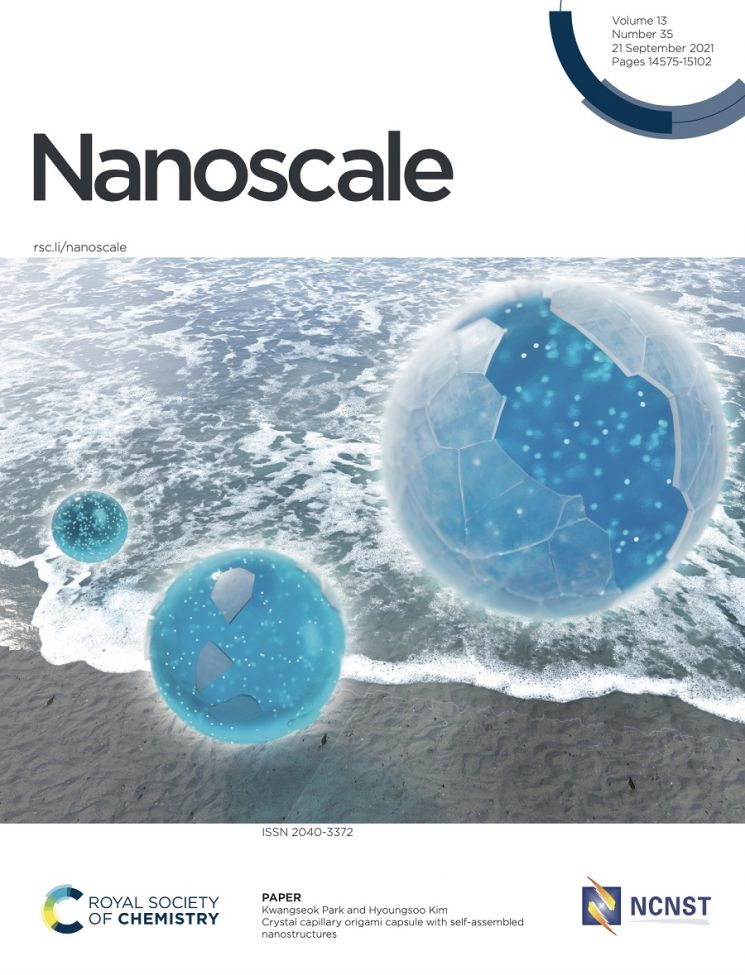
The Korea Advanced Institute of Science and Technology (KAIST) announced on the 5th that a research team led by Professor Kim Hyung-soo of the Department of Mechanical Engineering and doctoral student Park Kwang-seok developed a core technology to fabricate nano and micro capsules by controlling the crystallization process of salt through surface tension effects. The team also named this technology "Crystal Capillary Origami Technology."
Recently, nano-material self-assembly technology has been utilized in fields such as functional polymers, bio-materials, and semiconductor nano-structure manufacturing, leading to technological convergence and development between biotechnology (BT) and information and communication technology (IT) sectors. It is expected to have a tremendous economic impact on future industries, increasing interest in this field.
Typical self-assembly technology is a bottom-up approach that uses predetermined basic units. Usually, polymers or colloids are used to form the final shape, and this technology can be applied across a wide range of length scales from molecular to micrometer levels. Using self-assembly technology, nano capsules can be fabricated; however, due to the nature of the process, a curing step is essential for encapsulation, making the fabrication process complex.
Professor Kim explained, "There are countless minerals on Earth, and if we can discover and utilize crystals with thin and flexible basic crystal structures like certain salts used in this study, we can spontaneously and effectively trap desired substances inside emulsions or droplets."
The research results were published as a cover paper on the 10th of last month in Nanoscale, a prestigious journal of the Royal Society of Chemistry in the UK.
© The Asia Business Daily(www.asiae.co.kr). All rights reserved.

















