Illegal Information Monitoring: 1.5 Persons in Charge at Korea Communications Standards Commission
[Asia Economy Reporter Cha Min-young] Recently, although internet personal broadcasting has increased, there have been criticisms that corrective actions against harmful information are insufficient. A fundamental issue is also identified as the lack of personnel at the Korea Communications Standards Commission, which is responsible for managing internet personal broadcasting.
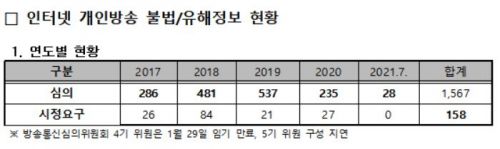
According to data submitted by the Korea Communications Standards Commission to Yang Jeong-suk (Independent) of the Science, Technology, Information and Broadcasting Committee on the 4th, out of 1,567 cases reviewed for internet personal broadcasting from 2017 to the end of July 2021, only 158 cases, or 10%, were subject to corrective demands.
By type, the total reviews were ▲obscenity and sexual content, which accounted for the largest portion at 51% with 802 cases, followed by ▲gambling with 68 cases (4%), ▲rights infringement with 17 cases (1%), and ▲illegal food and pharmaceuticals with 1 case (0.06%). Among these, corrective demands were made only for ▲obscenity and sexual content with 143 cases (90.5%) and ▲other legal violations with 15 cases (9.4%), while no corrective demands were processed for gambling, rights infringement, or illegal food and pharmaceuticals.
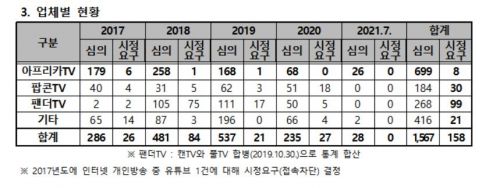
By company, the number of reviews were ▲AfreecaTV with 699 cases (44.6%), ▲PandaTV with 268 cases (17.1%), ▲Popcorn TV with 184 cases (11.7%), and ▲others with 416 cases (26.5%). Among the total 158 corrective demands, ▲PandaTV accounted for the most with 99 cases (62.7%), followed by ▲Popcorn TV with 30 cases (19%), ▲AfreecaTV with 8 cases (5.1%), and ▲others with 21 cases (13.3%).
Representative Yang Jeong-suk pointed out that although there are two personnel responsible for reviewing internet personal broadcasts at the Korea Communications Standards Commission, one of them is concurrently assigned to other duties, making it insufficient to actively respond to illegal and harmful information on internet personal broadcasts.
Representative Yang said, “Not a single case of gambling or rights infringement has been reviewed, and since PandaTV accounts for a high rate of corrective demands, it is necessary for the platform itself to manage harmful information.” She added, “As ICT technology advances and internet broadcasting increases significantly, the management system for harmful information must be improved.”
Yang also stated, “To monitor numerous personal broadcasting platforms and countless personal broadcasts daily and to review illegal information, additional personnel deployment is necessary, and securing the budget for this is urgent.” She added, “Platforms also need to thoroughly manage harmful information by establishing and operating a ‘User Committee’ that independently reviews harmful information, similar to broadcasting.”
Meanwhile, according to the partial amendment bill of the 'Act on Promotion of Information and Communications Network Utilization and Information Protection, etc.' which Representative Yang Jeong-suk proposed in June, a legal basis was established to obligate major information and communication service providers to install and operate a ‘User Committee’ composed of experts in relevant fields who can present opinions or request corrections regarding the distribution of illegal information that poses a high risk to users' interests.
© The Asia Business Daily(www.asiae.co.kr). All rights reserved.


















