Hybrid Method of Sowing Natural Grass on Mat-Type Artificial Turf
Reduces Turf Depressions, Enhances Evenness, Helps Prevent Player Injuries and Improves Performance
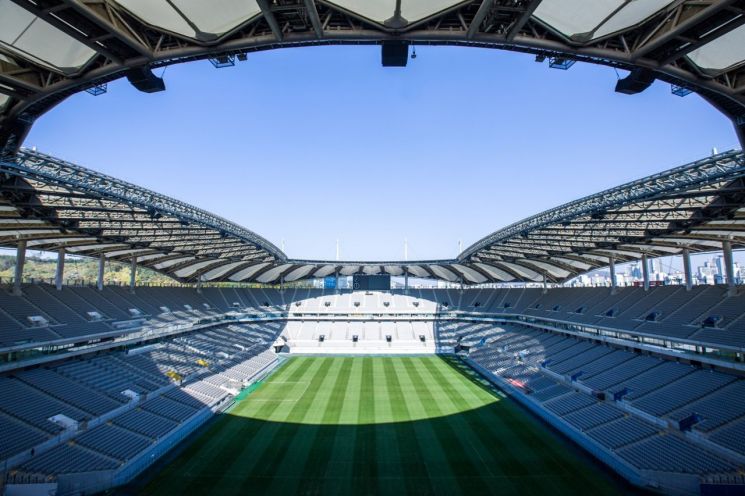
[Asia Economy Reporter Lim Cheol-young] The Seoul Facilities Corporation announced on the 4th that it will begin construction on the 5th to replace the turf at Seoul World Cup Stadium with "hybrid turf."
The introduction of hybrid turf is the first attempt at a domestic football stadium. The main stadium's ground, which has been maintained with Hanji-type natural grass since its opening in 2001, will be improved by replacing it with hybrid turf, a mixture of natural grass and artificial turf. The construction will start on the 5th and is expected to be completed within this year, providing an optimal football playing environment year-round starting from the K League in the first half of next year.
The hybrid turf, first introduced by the corporation, consists of artificial turf mats (1m×10m) seeded with natural grass. The artificial turf fibers protect the roots of the natural grass. The main purpose is to prevent ground depression, and maintaining flatness helps prevent player injuries and improves game performance by allowing the ball to roll consistently during passes. Being in mat form also allows for immediate replacement of damaged sections.
The corporation has been researching the suitability of domestic and international artificial turf products for hybrid use to improve turf ground quality. Over three years, they monitored grass species, seed mixing ratios, and the appropriate length of artificial turf fibers for hybrid turf using multipurpose fields and reserve pitches as test beds. The results were applied to actual planting in some sections of the main stadium, completing a Korean-style hybrid turf combination optimized for the stadium environment.
After FC Seoul’s home games conclude in early October, the natural grass and sand will be removed from the main stadium, and from November, the hybrid turf, which has grown for two years, will be sequentially planted. Along with this, the sand layer of the turf planting bed, which has deteriorated in drainage capacity after 20 years of use, will be completely replaced, and advanced management equipment will be introduced and utilized for successful establishment. The corporation plans to pay special attention to establishing maintenance foundations, considering this is the first domestic stadium to introduce and operate hybrid turf.
Director Cho Sung-il stated, “Since hybrid turf is the first attempt in Korea, we will continuously improve and develop it without stopping suitability research,” adding, “We will strive not only to build a perfect ground environment by applying IoT technology to maintenance but also to create a standard model for hybrid turf management.”
© The Asia Business Daily(www.asiae.co.kr). All rights reserved.
!["The Woman Who Threw Herself into the Water Clutching a Stolen Dior Bag"...A Grotesque Success Story That Shakes the Korean Psyche [Slate]](https://cwcontent.asiae.co.kr/asiaresize/183/2026021902243444107_1771435474.jpg)
















