1306 Complaints Related to 'Black Consumers' in the Past 5 Years... Annual Average of 130 Cases
Expert: "Black Consumers Exploit Supplier Vulnerabilities with False Actions"
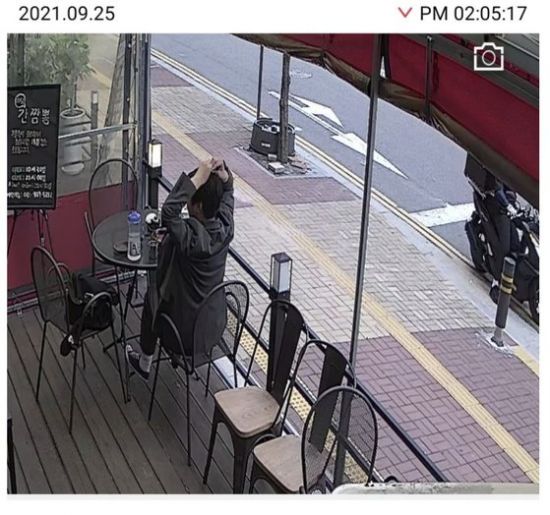 CCTV photo posted on the 25th of last month in 'Because It's Painful, It's the Boss'. Photo by Online Community
[Asia Economy Reporter Kim Soyoung] The malicious acts of 'black consumers'?who deliberately file complaints such as demanding refunds by claiming there are issues with the store after placing their own hair in the food?continue unabated. The term black consumer is a compound of 'black,' meaning malicious, and 'consumer,' referring to consumers who intentionally and habitually file malicious complaints.
On the 25th of last month, a post titled "There was hair..." was uploaded on the online community 'Because It Hurts, It's the Boss.' According to the author, Mr. A, who runs a jjambbong specialty restaurant in Paju, Gyeonggi Province, a woman who visited the store ordered jjambbong and complained that she found hair in her food. She left without paying.
However, the hair claimed to have come from the food was straight black hair, and since Mr. A and all the staff at the store had curly or dyed hair, he felt something was off. Upon reviewing the closed-circuit television (CCTV) footage, it was revealed that customer B, after finishing the meal, drank water and pulled out hair to put into the food.
Netizens who saw this expressed anger, saying, "Judging by the natural behavior, she must have done similar things many times. I wonder how many people have been harmed," "I hope she gets what she deserves," and "Selling your conscience for a bowl of jjambbong? Her identity should be disclosed."
This is just one example related to black consumers. On August 10, SBS's 'Morning Wide' aired a shocking twist involving a customer who claimed to have found eggshells and body hair in their food.
A man and woman in their 40s who visited a galbi restaurant in Pohang ordered food worth about 60,000 won and claimed to have found eggshells in the meat and body hair in the rice while eating. They loudly protested and eventually left without paying.
However, the owner found it suspicious that eggshells were found in the meat despite the meat preparation area being separate from where eggs were used. CCTV footage clearly showed the customers taking something from inside their bodies and pulling out their own body hair to put into the food.

Criticism has also arisen that stores are helpless against such unreasonable refund demands. One reason black consumers thrive offline is the review and rating system. This includes incidents like the shrimp tempura abuse death case that occurred in May.
Office worker Mr. B (29) said, "I really don't understand why people would do this just to save a few bucks," adding, "Because of them, even when the store makes a real mistake, people hesitate to speak up."
Actual punishments for black consumers are also being enforced. Leaving reviews that disrespect or insult the personality of restaurant owners or staff can result in imprisonment of up to one year or a fine of up to 2 million won (defamation under Article 311 of the Criminal Act).
Even if one evaluates the quality of ordered food, if the purpose deviates from providing information to other consumers for the public good and is intended to defame, it can lead to imprisonment of up to three years or a fine of up to 30 million won under the Information and Communications Network Act (Article 70, Paragraph 1).
In cases where false reviews damage the reputation of the store owner, penalties are increased to imprisonment of up to seven years or a fine of up to 50 million won (Article 70, Paragraph 2). If this causes business obstruction, it can lead to imprisonment of up to five years or a fine of up to 15 million won under the Crime of Obstruction of Business (Article 314 of the Criminal Act).
According to data submitted by the Anti-Corruption and Civil Rights Commission to Assemblywoman Im O-kyung of the Democratic Party, there have been 1,306 complaints related to black consumers in the past five years, averaging 130 reports annually. According to the Korea Chamber of Commerce and Industry, 83.4% of small and medium-sized enterprises have experienced black consumers.
On the 14th of last month, Assemblywoman Im, who proposed the 'Partial Amendment to the Framework Act on Consumers' and the 'Act on Promotion of Information and Communications Network Utilization and Information Protection' to protect self-employed people suffering from black consumers and malicious comments, stated, "With the surge in delivery app usage due to the growth of non-face-to-face consumption caused by COVID-19, the number of self-employed and small business owners suffering from 'malicious reviews' and 'review abuse' is increasing," emphasizing, "We must eradicate unfair consumption behaviors like those of black consumers and create a healthy ecosystem."
Experts emphasize the need to raise awareness about such malicious complaints by black consumers. Professor Lee Eun-hee of Inha University's Department of Consumer Studies explained, "Information such as reviews spreads rapidly among consumers. As a result, suppliers are somewhat intimidated, and some consumers exploit this vulnerability to engage in false acts, which is problematic."
Professor Lee added, "To prevent suppliers from suffering unjust damage, it must be made clear that the actions of black consumers are punishable." She also suggested, "Campaign-style education targeting consumers is necessary to convey that black consumers disrupt market order."
© The Asia Business Daily(www.asiae.co.kr). All rights reserved.

![A Woman with 50 Million Won Debt Clutches a Stolen Dior Bag and Jumps... A Monster Is Born [Slate]](https://cwcontent.asiae.co.kr/asiaresize/183/2026021902243444107_1771435474.jpg)
















