186 Households Increased Due to Floor Area Ratio Increase Approval
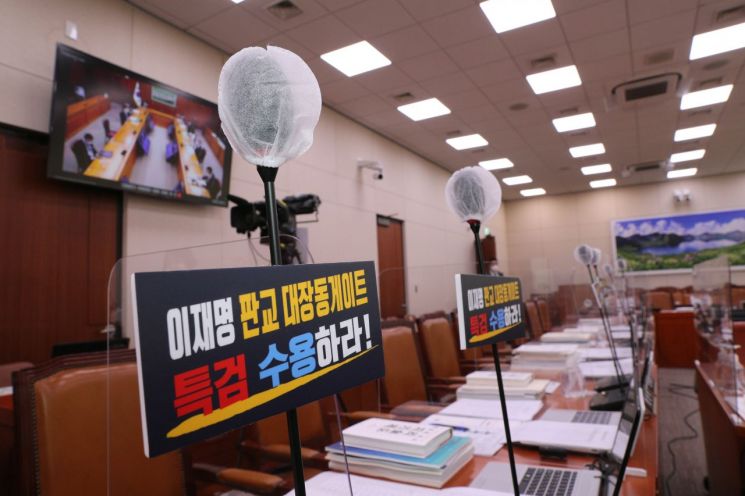 On the morning of the 1st, during the National Assembly Foreign Affairs and Unification Committee's audit of the Ministry of Foreign Affairs, Korea International Cooperation Agency, Korea Foundation, and Overseas Koreans Foundation, People Power Party lawmakers demanded a special prosecutor regarding the 'Daejang-dong development preferential treatment suspicion,' protested by standing microphones and holding placards. The Foreign Affairs and Unification Committee's audit was suspended after opening that morning.
 Since 'Seongnam's Deul' was selected as the implementing company for the Daejang-dong public development project in Seongnam-si, Gyeonggi Province, it has been revealed that the floor area ratio (the ratio of the total floor area of a building to the site area) was increased beyond the original plan.
Hwacheon Daeyu, an asset management company that participated in Seongnam's Deul and led the project, was able to build and sell 186 additional apartment units, and it is estimated that they gained over 100 billion KRW in additional sales through this.
According to the 'Pangyo Daejang Urban Development Project Amendment Plan Approval' announced by Seongnam-si in November 2016, the floor area ratio for the 12 apartment complexes in Daejang-dong was set between 185% and 195%, with a total of 5,268 households.
Previously, in March 2015, at the time of selecting the private developer for this project area, the public bidding guidelines specified that the floor area ratio for all 13 apartment complexes was 180%, with a total of 5,089 households. As the floor area ratio increased by 5 to 15 percentage points, the total number of housing units increased by 179.
The number of apartment complexes decreased by one because one complex was divided into two others (A7 and A8 blocks). By approving the floor area ratio increase requested by Seongnam's Deul to build more apartments, Seongnam-si effectively granted additional benefits.
In particular, Hwacheon Daeyu directly implemented four apartment complexes (A1, A2, A11, A12 blocks), where the floor area ratio increased from 180% to 195%, raising the total number of households from 1,778 to 1,964, an increase of 186 units.
These apartments are 84㎡ units with sale prices ranging from 700 million to 800 million KRW, and Hwacheon Daeyu is estimated to have earned an additional 130 billion KRW in sales revenue.
The Seongnam-si side has not provided a clear explanation. They are currently verifying with related employees at the time, but some have retired, and it is known that the specific reasons for approving the floor area ratio increase have not been identified.
Meanwhile, Hwacheon Daeyu is expected to have earned total sales profits in the 400 billion KRW range from the five blocks it directly implemented.
In addition to sales profits, Hwacheon Daeyu earned 57.7 billion KRW in dividend profits, which is 1,154 times the invested capital (50 million KRW), and Cheonhwa Dongin 1 to 7, related to Hwacheon Daeyu, received 346.3 billion KRW in dividends, intensifying the controversy over preferential treatment.
Meanwhile, allegations of preferential treatment related to the apartments directly implemented by Hwacheon Daeyu have also surfaced.
© The Asia Business Daily(www.asiae.co.kr). All rights reserved.

















