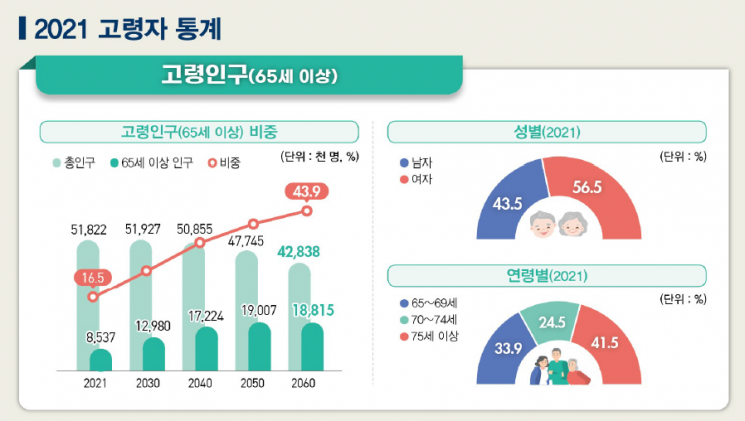
[Sejong=Asia Economy Reporter Son Seon-hee] It is projected that South Korea will enter a 'super-aged society' by 2025, when the proportion of the population aged 65 and over exceeds 20%. Furthermore, by 2050, the elderly population is expected to approach 40%, which is double that figure.
According to the '2021 Elderly Statistics' recently released by Statistics Korea on the 2nd, the elderly population aged 65 and over accounted for 16.5% of the total population as of this year. This is expected to increase to 20.3% in 2025, then 25% in 2030, 33.9% in 2040, 39.8% in 2050, and 43.9% in 2060.
Some regions have already entered a super-aged society as the proportion of elderly population exceeded 20%. Jeonnam had the highest elderly population proportion nationwide at 23.8%, followed by Gyeongbuk (21.5%), Jeonbuk (21.4%), and Gangwon (20.9%).
The region with the lowest elderly population proportion nationwide was Sejong City, at 9.6%, the only area with a single-digit percentage. This was followed by Ulsan (12.9%), Gyeonggi (13.5%), and Incheon (14.3%). Statistics Korea forecasts that by 2028, all regions except Sejong will enter a super-aged society.
As of this year, households with a head aged 65 or older numbered 4.88 million, accounting for 23.7% of all households. This proportion is expected to continue increasing annually, and by around 2047, about half (49.6%) of all households in Korean society will be elderly households, according to Statistics Korea.
Among these elderly households, those living alone reached 1.661 million last year, accounting for 35.1% of all households. The age group with the highest proportion among elderly living alone was those in their 70s, at 44.1%. By gender, women accounted for 71.9%, more than twice the number of men.
Although the number of 'single elderly' households is increasing, preparations for old age are found to be insufficient. As of 2019, only 33% of elderly households living alone responded that they were preparing for old age, while about two-thirds were not preparing for their later years.
© The Asia Business Daily(www.asiae.co.kr). All rights reserved.

















