FKI Claims Through Report on 'ESG Supply Chain Human Rights Management Trends and Implications'
[Asia Economy Reporter Kim Heung-soon] As the United States and the European Union (EU) strengthen human rights protection obligations in global supply chains, there are calls for Korean companies, including small and medium-sized exporters, to prepare countermeasures.
The Federation of Korean Industries (FKI) forecasted in its report titled "Trends and Implications of ESG (Environment, Social, Governance) Supply Chain Human Rights Management" on the 1st that major countries such as the US and EU will expand disclosure obligations regarding human rights conditions in corporate supply chains.
Expansion of Sanctions on Inhumane Practices in US and EU Corporate Supply Chains
There is growing demand for disclosure of information on supply chain worker policies in the 'social' aspect of ESG, centered on the EU and the US. If human rights issues are found in a company’s suppliers or partners, the company must resolve them, and failure to comply will result in sanctions. The FKI expects measures such as fines, disqualification from public procurement projects, and import bans.
The European Commission has submitted a Corporate Governance and Supply Chain Due Diligence Act, which is scheduled to be enforced from 2024. This legislation targets not only companies based in the EU but also companies selling goods and services within the region. It can apply to Korean large corporations with local subsidiaries as well as small and medium-sized export companies.
In addition to the EU-wide supply chain due diligence law, countries such as Germany, the United Kingdom, France, and the Netherlands are individually implementing or promoting due diligence laws. In the US, the "Corporate Slavery Eradication Certification Act" was proposed last year. Separately, an annual Xinjiang supply chain business advisory report is published, imposing sanctions on supply chains and investments related to the Xinjiang region based on the Chinese government's oppression of the Uyghur people. For example, the Japanese apparel company Uniqlo faced import bans in the US and other countries due to allegations of using Xinjiang Uyghur cotton.
At Least 160 German Partner Companies in Korea
Gradual Expansion of Supply Chain Due Diligence Law Scope
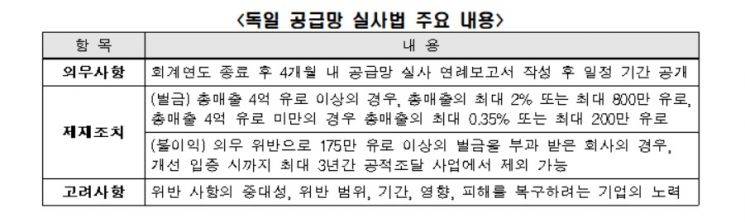
Germany, Korea’s top trading partner with the EU, implemented the supply chain due diligence law in 2023, which also applies to Korean exporters. Among the top 20 German companies by market capitalization, including Volkswagen, Siemens, Adidas, BMW, and Delivery Hero, there are 163 publicly disclosed Korean partner companies. Notable examples include Samsung SDI, LG Chem, SK Innovation, and Hyundai Mobis (partners of Volkswagen and Daimler).
Among the disclosed companies, 18 are large corporations, and the remaining 145 are medium-sized and small enterprises. The German supply chain due diligence law applies to companies with 3,000 or more employees from 2023 and will expand to companies with 1,000 or more employees in 2024.
These companies must prepare and disclose an annual supply chain due diligence report within four months after the end of each fiscal year. They are required to identify and resolve human rights issues such as forced labor and child labor throughout their entire supply chain, including their own workplaces and first- and second-tier suppliers, and report the results to the German government.
Korean Companies Must Conduct Self-Checks to Prepare for Supply Chain Human Rights Due Diligence
Domestically, legal and institutional support as well as voluntary corporate efforts are underway to protect human rights within supply chains. Currently, the Basic Human Rights Policy Act, which includes principles to prevent human rights violations, is pending in the National Assembly. The Ministry of Justice established the Corporate Human Rights Management Standard Guidelines in May 2019 to serve as a standard for corporate human rights management. At the corporate level, companies such as Samsung Electronics, Hyundai Motor, SK Innovation, POSCO, and CJ have implemented codes of conduct, human rights due diligence, ESG evaluations of partners regarding human rights, and ethical mineral management policies.
An FKI official said, "While ESG management has mainly focused on environmental issues, as supply chain human rights management is being legislated in major export countries, attention to the 'social' aspect is also necessary. Since legal sanctions from trading partner countries are expanding, it is important to review and reorganize supply chain management systems to comply with global standards."
© The Asia Business Daily(www.asiae.co.kr). All rights reserved.
![User Who Sold Erroneously Deposited Bitcoins to Repay Debt and Fund Entertainment... What Did the Supreme Court Decide in 2021? [Legal Issue Check]](https://cwcontent.asiae.co.kr/asiaresize/183/2026020910431234020_1770601391.png)















