[Asia Economy Reporter Choi Seok-jin, Legal Affairs Specialist] A Supreme Court ruling has recognized the responsibility of Samsung Heavy Industries and the subcontractor representative in connection with the 2017 crane accident at the Geoje shipyard that claimed the lives of six workers.
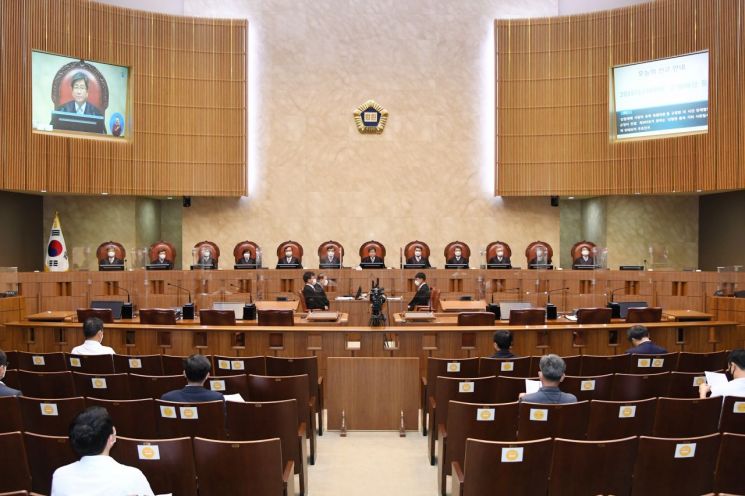
On the 30th, the Supreme Court's 2nd Division (Presiding Justice Cheon Dae-yeop) overturned the lower court's acquittal of Samsung Heavy Industries, subcontractor representative A, and former shipyard director B?who were indicted for violating the Industrial Safety and Health Act and for professional negligence resulting in death and injury?and remanded the case to the Changwon District Court.
The Supreme Court quashed the lower court's acquittal regarding Samsung Heavy Industries and A for violations of the Industrial Safety and Health Act, while dismissing the charges against B, who passed away in May last year.
The court stated, "The lower court's acquittal of defendants Samsung Heavy Industries and A on the charges misapplied the legal principles concerning the employer's duty to implement safety measures under Article 23 of the former Industrial Safety and Health Act and the subcontracting employer's duty to prevent industrial accidents under Article 29 of the same Act, which affected the judgment and constitutes a legal error."
Previously, Samsung Heavy Industries and others were prosecuted for failing to fulfill their duty to prevent a tower crane accident that occurred on May 1, 2017, at a shipyard in Geoje City, Gyeongsangnam-do.
At the time, an 800-ton Goliath crane collided with a 32-ton tower crane, resulting in six deaths and 25 injuries among workers on site.
The first and second trials acquitted Samsung Heavy Industries and A, finding no responsibility for the accident.
However, the Supreme Court ruled that Samsung Heavy Industries and others had a duty to prevent the accident.
The court noted, "This industrial site is a large-scale shipyard where numerous workers are simultaneously deployed, multiple large pieces of equipment frequently move and operate, and heavy steel structures form blocks that are assembled into the hull. Large cranes are constantly in use, and the site has a history of various industrial accidents, including collisions between cranes."
It continued, "Considering the characteristics of this workplace and the obligations stipulated in the former Industrial Safety and Health Act, its enforcement regulations, and individual safety and health rules, it is interpreted that the employer defendants Samsung Heavy Industries and A were imposed with a duty to take reasonably necessary safety measures to prevent industrial safety accidents caused by collisions between cranes."
The court cited Article 23, paragraphs 1 and 2 of the former Industrial Safety and Health Act, which imposed on employers the duty to take necessary measures to prevent risks from machinery, equipment, heavy object handling, and other facilities or unsafe work methods; as well as Article 23, paragraph 3, Article 29, paragraph 3, and Enforcement Rule Article 30, paragraph 4, which specifically require taking necessary measures to prevent risks in places where work involving cranes or other lifting equipment with collision hazards is performed. The court added, "It can be seen that the employer, as the subject of compliance, is required to prevent major safety accidents caused by crane collisions by reinforcing safety measures within a reasonably necessary scope."
The court also pointed out, "According to former Safety and Health Rule Article 38, paragraph 1, item 11, and Appendix 4, which require the preparation of a work plan including safety measures to prevent fall, drop, overturn, crush, and collapse hazards when handling heavy objects, Samsung Heavy Industries and defendant A were obligated to include specific measures to prevent crane collisions in the work plan and to carry out work according to that plan."
It further stated, "Nevertheless, defendants Samsung Heavy Industries and A did not include specific safety measures to prevent crane collision risks in the work plan prepared at the time of the incident."
The court added, "Except for the 'general signaling methods according to crane signaling regulations' and the fact that radio communication was possible between the signalman of the Goliath crane and the jib crane operator, the defendants did not establish separate signal coordination methods to prevent the risks of overlapping crane operations."
© The Asia Business Daily(www.asiae.co.kr). All rights reserved.

















