Government "Considering introduction of vaccine pass with phased daily recovery from late October to early November"
Unvaccinated without PCR negative certificate restricted from multi-use facilities
"Respect needed for patients with underlying conditions" vs "Benefit gained despite fear"
'Opposing vaccine pass' petition appears at Blue House
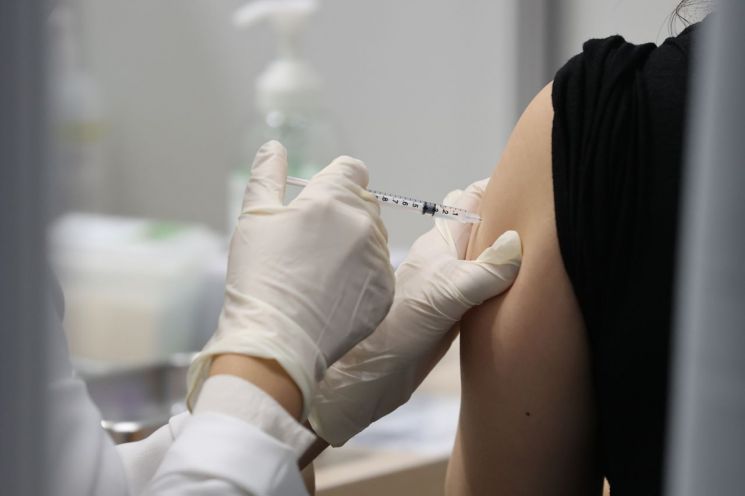 On the morning of the 28th, a citizen is receiving a vaccine at the COVID-19 vaccination center set up at the Mapo-gu Community Sports Center in Seoul. [Image source=Yonhap News]
[Asia Economy Reporter Kim Soyoung] "It's not that they refuse, it's that they cannot get vaccinated," "Are the unvaccinated criminals?"
The government’s announcement that it is considering the introduction of a vaccine pass as part of the 'gradual return to daily life (With Corona)' phase has sparked strong backlash. The reason is that the restrictions associated with the vaccine pass should not lead to forced vaccination.
The vaccine pass is a type of health certificate that allows only those who have completed vaccination to use multi-use facilities. If the vaccine pass is introduced, unvaccinated individuals will face some restrictions on access to multi-use facilities unless they present a negative PCR test certificate. However, exceptions are being considered for younger age groups or students who have not yet been given the opportunity to be vaccinated.
On the 29th, Son Young-rae, head of the Social Strategy Division at the Central Disaster and Safety Countermeasures Headquarters of the Ministry of Health and Welfare, explained at a regular COVID-19 briefing, "We are analyzing the situations in foreign countries where vaccine passes have been introduced," adding, "Foreign countries also restrict participation in events or use of multi-use facilities for unvaccinated people who do not carry a negative PCR test certificate through vaccine passes."
Son said, "These restrictions are not only intended to protect the unvaccinated but also to increase vaccination rates by causing some inconvenience to the unvaccinated," and added, "If Korea introduces a vaccine pass, it is highly likely that unvaccinated individuals who do not carry a negative PCR test certificate will face restrictions on participation in multi-use facilities or events."
However, he noted, "There is a need to separately consider younger age groups or students who have not been given vaccination opportunities," and added, "It is necessary to review exceptions to these vaccine pass restrictions for those below a certain age."
Many netizens have expressed the view that vaccination should not be forced. They said, "There are various reasons why people haven't been vaccinated. They shouldn't be pressured," "Freedom of choice must be guaranteed, and other alternatives to increase vaccination rates should be found," "Control over bodily freedom is unconstitutional. People should have the freedom not to get vaccinated," and "Dividing benefits and disadvantages based on vaccination status itself is terrifying."
On the other hand, some voices call for strengthening quarantine measures for vaccinated people who have become lax. Comments include, "Why should those who are more careful than vaccinated people who don't follow quarantine rules be treated like criminals?" "Vaccinated people should wear masks properly," and "Is the vaccine an invincible shield? Vaccinated people can still get COVID-19. I don't understand."
There are also strong calls for respect for those who cannot be vaccinated due to underlying conditions or allergies. "It is wrong to disadvantage those who cannot be vaccinated for health reasons. I have been vaccinated, but if there is discrimination, I will fight alongside them," and "It seems like policies ignore people with underlying diseases. Isn't this a policy to isolate those who are already suffering from society?"
One netizen said, "I can't get vaccinated due to underlying conditions, and I get annoyed every time people around me ask if I have been vaccinated," adding, "If personal quarantine is done well, it should be fine, but the stress comes from being seen as if the unvaccinated have committed a crime."
Concerns have also been raised that differential restrictions based on vaccination status may cause feelings of deprivation among citizens. One netizen expressed dissatisfaction, saying, "At restaurants or cafes with friends, when the restricted time comes, only the unvaccinated are told to leave? Are you kidding? This is a novel way to ostracize," "Isn't this just fostering hostility between each other?" and "I'm afraid children will say, 'Don't play with that kid because they are unvaccinated.'" They argue that benefits for vaccinated people should be increased rather than imposing restrictions on the unvaccinated.
Conversely, some netizens said, "Those who got vaccinated endured the fear, so there should be a difference from those who didn't," "If unvaccinated people are going to stay home anyway to be cautious, it doesn't matter," and "Although benefits might be reverse discrimination, I think they are necessary."
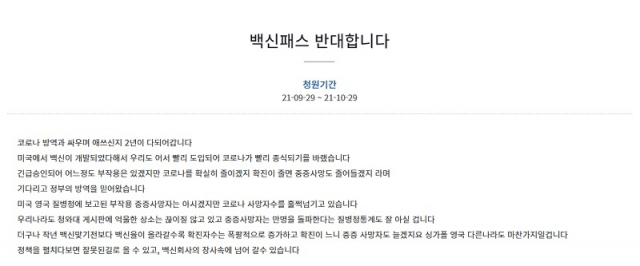 A petition opposing the introduction of the vaccine pass posted on the Blue House National Petition Board on the 29th. Photo by Blue House National Petition Board
In this regard, on the 29th, a petition titled "Oppose the Vaccine Pass" was posted on the Blue House National Petition Board. The petitioner stated, "There are people who could not complete vaccination due to personal illnesses, constitution, allergies, or side effects. Can vaccination be forced unconditionally?" and added, "Even now, unvaccinated people face social pressure at work and suffer significant personal damage, but penalties such as group entry restrictions are causes of social division and violations of basic human rights, making them subject to constitutional lawsuits."
Meanwhile, the government is expecting the vaccination rate to reach the target around late October to early November for the gradual return to daily life, so discussions on the vaccine pass under review are expected to accelerate.
On the 29th, Lee Sang-won, head of the Epidemiological Investigation and Analysis Team at the Central Disease Control Headquarters, explained at a COVID-19 briefing, "Please understand the vaccine pass as a safety device or step toward gradual daily recovery," adding, "Rather than excluding certain groups, it is about reaching social consensus, and many countries are implementing it."
In countries currently using vaccine passes, many recognize the validity of the vaccine pass for up to six months based on the date of vaccination, considering the effectiveness of vaccination. Lee said, "There is room for change, but usually about six months can be recognized." He added, "Scientifically, COVID-19 vaccination usually has an effect lasting more than six months, and foreign countries also recognize a six-month effect," and explained, "Therefore, I cannot say that there will be no validity period for the vaccine pass, and looking at foreign precedents, there is a certain validity period."
© The Asia Business Daily(www.asiae.co.kr). All rights reserved.


















