Ministry of Science and ICT Provides Free AI Chatbot Counseling for Emotional Disorder Prevention and Management
Invests 28.9 Billion KRW by 2024 to Address Emotional Disorders Including COVID Blue
[Asia Economy Reporter Kim Bong-su] The government will provide digital therapeutics to address emotional disorders such as depression and anxiety among the public caused by the prolonged COVID-19 pandemic.
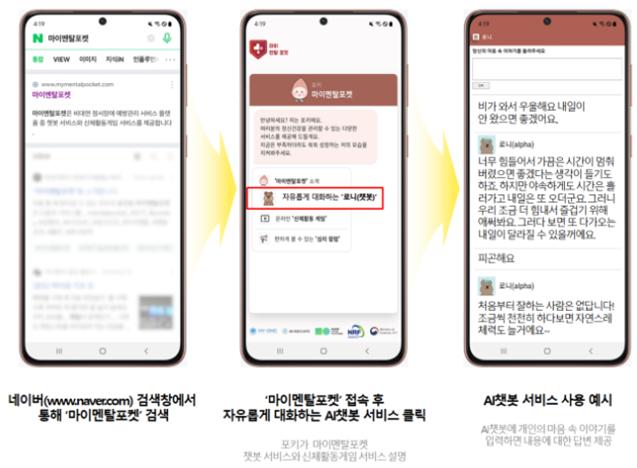
The Ministry of Science and ICT announced on the 30th that, together with the National Research Foundation of Korea, it will pilot the AI emotional disorder management service 'MyMentalPocket' starting from the 1st of next month. It will be available for free to anyone via the internet search bars on PCs and mobile phones.
This service offers real-time chat counseling with AI that manages depressive states and online physical activity games that can alleviate depression. The AI counseling learns from counseling cases analyzed by psychological counseling experts to improve the accuracy of depression assessment and management efficiency. The research team decided to conduct a pilot service first to collect a wider variety of counseling cases. More than 200 psychiatrists and psychological counseling experts participating in the analysis of counseling data for this service will also be significantly expanded to create a more effective service.
The government selected Professor Kim Hyung-sook's team at Hanyang University as the lead research institution in July for the 'Post-COVID era non-face-to-face emotional disorder prevention and management platform technology development.' The goal is to develop a digital therapeutics platform to prevent and manage depression in non-face-to-face situations caused by COVID-19. A total of 28.9 billion KRW (14 billion KRW from the government and 14.9 billion KRW from the private sector) will be invested from this year through 2024.
According to a survey by the National Health Insurance Service, the number of depression patients has been rapidly increasing since COVID-19. It rose by 5.9% from 750,000 in 2018 to 790,000 in 2019, and medical expenses increased by 12%. With the pandemic lasting over a year and nine months, restrictions on activities, economic downturn, and anxiety are expected to further increase the number of depression patients.
Digital therapeutics use software such as games, VR/AR (virtual/augmented reality), chatbots, and AI to prevent, treat, and manage diseases like ADHD, dementia, epilepsy, and obsessive-compulsive disorder. The global market size was $2.12 billion in 2018 and is expected to grow to $9.64 billion by 2026.
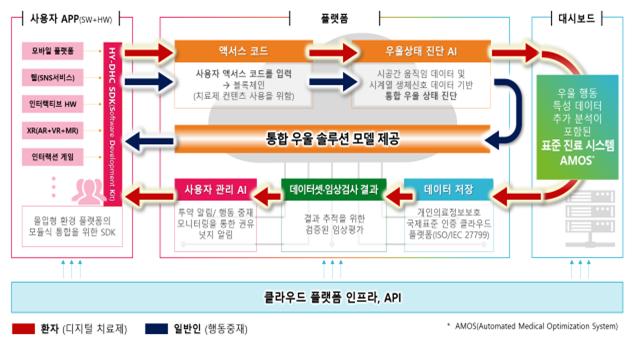
Researchers from various fields including behavioral science, AI, mental health clinical practice, and cloud computing are participating in this digital therapeutics R&D. First, Professor Kim Hyung-sook's team will build a dataset of depressive behavior characteristics through digital therapeutics based on physical activity and cognitive neuroscience, and study the analysis and standardization so that the collected data is automatically linked on cloud computing. Professor Han Bo-hyung's team from Seoul National University's Department of Electrical and Computer Engineering, experts in AI, will be responsible for advancing the AI algorithm for depression diagnosis by utilizing various data collected during the research process through self-supervised learning, transfer learning, and attention-based feature integration. Professor Jeon Hong-jin's team from Samsung Seoul Hospital's Department of Psychiatry, clinical experts, will conduct clinical efficacy verification and clinical trials for the approval of depression digital therapeutics and research a standardized treatment system linked with the digital therapeutic platform. Director Ryu Jae-jun's team from Naver Cloud, cloud computing experts, will be responsible for building the cloud infrastructure for the non-face-to-face emotional disorder digital therapeutic platform and clinical verification, as well as establishing the digital therapeutics business ecosystem.
The research team plans to collect, analyze, process, and utilize user data in real time to provide optimized depression diagnosis and treatment services tailored to individuals. The service will also be available to the general public who want to prevent depression, accessible via devices such as mobile phones and tablet PCs.
Lee Chang-yoon, Director of Basic and Fundamental Research Policy at the Ministry of Science and ICT, said, "This service is expected to help prevent and manage emotional disorders among groups with significant spatial, temporal, and economic constraints, such as students, the elderly, soldiers, North Korean defectors, and low-income groups, especially through non-face-to-face counseling." He added, "We will support the advancement of the service and ensure that socially vulnerable groups can use it more widely in the future."
© The Asia Business Daily(www.asiae.co.kr). All rights reserved.


















