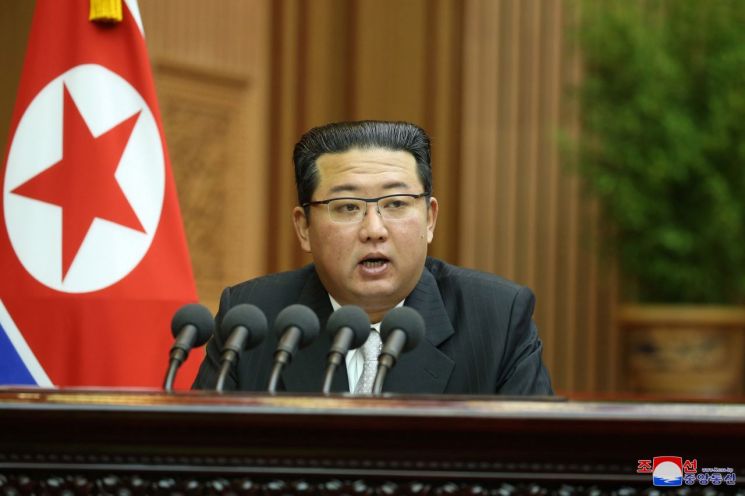
[Asia Economy Reporters Ryu Jeong-min, Lee Ji-eun, Lee Hyun-woo] Kim Jong-un, General Secretary of the Workers' Party of North Korea, expressed a strong determination to lead inter-Korean and North Korea-U.S. dialogues through this policy speech. With about eight months left in President Moon Jae-in's term, this is seen as a positive factor for the 'Korean Peninsula Peace Process,' and the possibility of an inter-Korean summit around the Beijing Winter Olympics in February next year is also increasing. However, since General Secretary Kim insists on the abolition of double standards and hostile policies, a dramatic improvement in relations is expected to be difficult.
Experts evaluated that General Secretary Kim emphasized playing a leading role regarding the situation on the Korean Peninsula in his policy speech. The report by the Korean Central News Agency stating that Kim "declared that we will put main efforts into thoroughly safeguarding our national sovereignty and independent development interests by proactively responding to the increasingly unstable international political situation and surrounding environment in the external affairs sector" supports this.
Professor Kim Yong-hyun of Dongguk University’s Department of North Korean Studies said, "General Secretary Kim showed a willingness to create an atmosphere toward dialogue amid the current situation," adding, "The fog that had been clouding inter-Korean relations has largely lifted."
Professor Yang Moo-jin of the University of North Korean Studies also said, "Considering President Moon’s proposal for a declaration to end the war and the South’s upcoming presidential election next year, it reads as North Korea’s intention to pursue a conciliatory approach toward inter-Korean relations," and explained, "By directly delivering messages to the South and abroad, they intend to actively lead the situation."
Since General Secretary Kim directly expressed his willingness to improve inter-Korean relations, the possibility of an inter-Korean summit around the Beijing Winter Olympics early next year has also increased. Professor Yang analyzed, "After the restoration of communication lines, they will try to more actively test the South’s willingness, and depending on the South’s attitude and measures, they are likely to proceed with an inter-Korean summit and show an attitude to utilize the Beijing Winter Olympics."
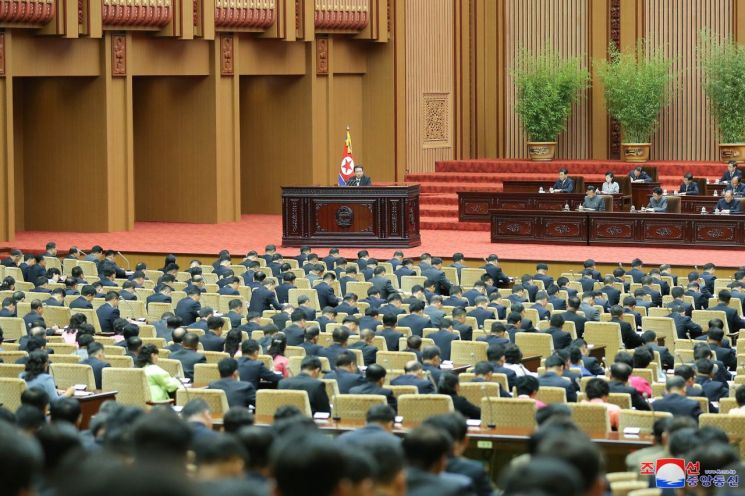
The Blue House does not deny that the Beijing Winter Olympics could be a turning point. The Blue House explained, "A specific occasion like the Winter Olympics can serve as a momentum."
However, the recent trend at the Blue House is somewhat distant from the performance-oriented approach that results must be produced within the current administration’s term. While it would be good to create an opportunity for a major transformation on the Korean Peninsula through the Beijing Olympics, it also means the government could play a 'stepping stone' role so that the goal can be achieved even under the next administration. This is a strategic move to enhance negotiating power regarding inter-Korean relations while cautioning against 'premature optimism' surrounding Korean Peninsula issues.
There are still many hurdles to overcome. General Secretary Kim also mentioned conditions such as the abolition of 'double standards' and 'hostile policies' demanded by Kim Yo-jong, Deputy Director of the Workers' Party, but the possibility of the U.S. responding by changing its existing diplomatic direction is low.
On the day, a U.S. State Department spokesperson responded to written questions from domestic media regarding General Secretary Kim’s remarks by saying, "The United States does not harbor hostile intentions toward North Korea," and "We are ready to meet North Korea without preconditions and hope North Korea responds positively to our contact." The spokesperson reiterated a fundamental response aligned with the 'pragmatic approach' toward North Korea policy announced by the Biden administration in April, stating, "Our policy is a coordinated and pragmatic approach seeking diplomacy with North Korea and being open to diplomacy."
Additionally, the fact that the U.S. government likely led the convening of a U.N. Security Council meeting with the U.K. and France regarding North Korea’s missile launches is also a variable. According to AFP, at the request of the U.S., U.K., and France, the U.N. Security Council plans to hold a closed-door meeting on the 30th (local time) to respond to reports of North Korea’s hypersonic missile test launch. AFP reported that all Western countries except China and Russia among the five permanent members of the Security Council participated, suggesting the U.S. likely led this convening. While keeping diplomatic channels open with North Korea, the U.S. government is analyzed to have led the Security Council meeting to pressure North Korea on security issues through U.N. sanctions, following its existing policy.
James Kim, Director of the U.S. Research Center at the Asan Institute for Policy Studies, explained, "From the U.S. perspective, domestic issues such as COVID-19 and economic problems are the most urgent," adding, "Although North Korea continues provocations such as missile launches, it has not conducted any public nuclear tests since 2017, and the provocations remain at a level manageable from the U.S. standpoint, so it is unlikely to attract significant attention immediately."
© The Asia Business Daily(www.asiae.co.kr). All rights reserved.


















