Animal Groups Urge "Practical Measures to Stop Dog Slaughter and Consumption"
Dog Meat Association Criticizes "Food Regulations Were Not Enforced Even During Military Dictatorship"
Estimated 700,000 to 1.5 Million Dogs Distributed Annually for Consumption
Poor Hygiene Management and Animal Abuse Issues in Some Illegal Facilities
Experts Advise "Careful Approach Considering Livelihoods of Industry Workers"
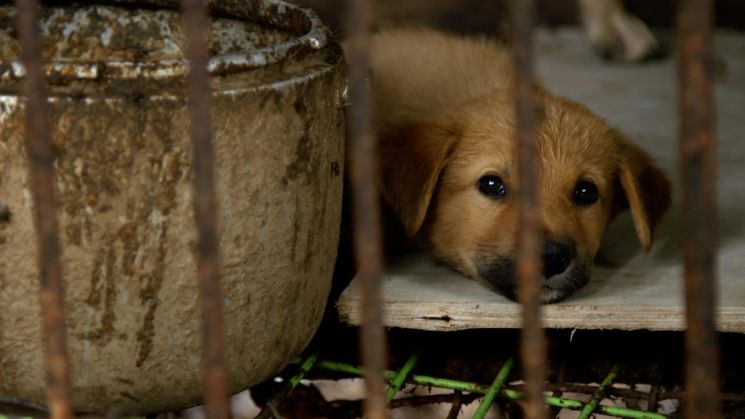
[Asia Economy Reporter Lim Juhyung] As President Moon Jae-in has ordered a review of the 'ban on dog meat consumption,' the controversy over 'Bosintang' has intensified not only in the political sphere but also in civil society. Animal organizations have urged swift legislation, stating that dogs have already attained the status of companion animals domestically, while some voices express dissatisfaction, questioning whether the government needs to regulate food culture. Experts advised that even if a ban on dog meat consumption is pursued, a cautious approach considering those involved in the related industry is necessary.
◆The ignited controversy over the 'ban on dog meat consumption'
It was reported that on the 27th, President Moon Jae-in received a report from Prime Minister Kim Boo-kyum regarding improvements to the management system for abandoned companion animals. Following the report, President Moon reportedly said, "Isn't it time to carefully consider banning dog meat consumption?" according to Blue House spokesperson Park Kyung-mi.
President Moon's mention of reviewing a 'ban on dog meat consumption' differs from his statement at the Blue House three years ago. In August 2018, the Blue House responded to a public petition urging to exclude dogs from livestock by saying, "As consumption of dog meat is decreasing in line with international trends, we should gradually follow this trend," but also expressed a reserved stance, stating, "We must also consider livelihood measures for those involved in the industry."
The political sphere showed divided opinions on President Moon's remarks. Democratic Party presidential candidates Lee Jae-myung and Choo Mi-ae expressed support, while the main opposition party, the People Power Party, criticized it as "populism that ignores market mechanisms and says the state will intervene because the majority wants it," adding, "The state has no right to regulate personal tastes or eating habits."
 A member of an animal organization is urging a ban on the consumption of dogs, cats, and other animals. / Photo by Yonhap News
The controversy continued in civil society as well. On the 28th, 45 animal rights organizations, including the Korea Animal Protection Association, held a press conference at Gwanghwamun Square in Seoul, expressing their support. They urged the government and National Assembly to "quickly prepare practical measures to ban dog slaughter and dog meat consumption."
On the other hand, dog meat industry groups strongly opposed President Moon's remarks, calling them "absurd." Joo Young-bong, Secretary General of the Korea Dog Meat Association, said in an interview with CBS Radio's 'Kim Hyun-jung's News Show' on the 29th, "The president was deceived by falsehoods and made an absurd statement," adding, "Banning the most basic human food by law never happened during the Japanese colonial era or military dictatorship."
He continued, "Dog meat consumption is our long-standing history and culture, and a fact," emphasizing, "Dogs raised for meat have been livestock since the Livestock Act was enacted and have been a proud part of our full-time farming. Just as Kimchi has become a global brand, dog meat can also be globalized."
◆Annual distribution of 700,000 to 1.5 million dogs for consumption... hygiene and abuse issues
Dog meat consumption in Korea is known to have a history of several hundred years. The representative Korean medical book of the Joseon Dynasty, 'Donguibogam' (compiled in 1610), states that "dog meat comforts the five internal organs and strengthens the intestines and stomach," suggesting that dog consumption began at least 400 years ago.
Accordingly, the culture of distributing and cooking dog meat has been widely established. Although there are no official statistics related to dog farms to date, compiling data from the Ministry of Environment, animal rights group 'Kara,' and the Dog Meat Association estimates that approximately 700,000 to 1.5 million dogs are distributed annually for consumption domestically. The revenue generated by the dog meat industry reaches about 280 billion KRW.
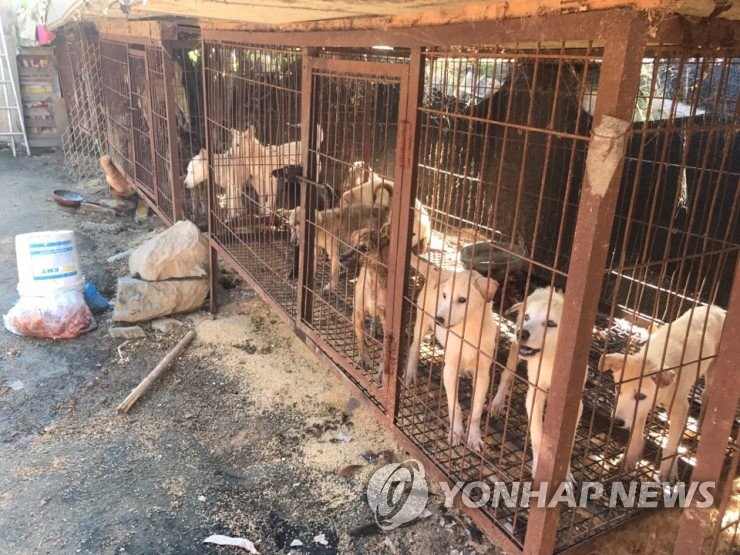
However, as the population of companion dog owners increases, public perception of dog meat is gradually deteriorating. According to a consumer perception survey on dog meat consumption conducted last year by the animal protection organization Humane Society International (HSI) in collaboration with Nielsen Korea, 58.6% of 1,000 respondents supported banning dog meat.
Only 30.8% agreed that "dogs can be consumed as food." This means about 7 out of 10 people view the dog meat culture negatively.
Hygiene issues at farms raising dogs for consumption have also come under scrutiny. The '3R Animal Welfare Research Institute' affiliated with Konkuk University College of Veterinary Medicine conducted tests on 93 dog meat samples collected from traditional markets for bacteria and antibiotics. Results showed that 61 samples (65.4%) contained antibiotic residues, and bacteria capable of causing diseases such as E. coli were detected. This indicates inadequate hygiene management during the breeding and distribution process of dogs for consumption.
There have also been controversies over abuse incidents, such as dogs being beaten to death with sticks or electrocuted at illegal slaughterhouses.
◆"Regulations should carefully consider industry characteristics and current status"
Experts suggest that a cautious government approach is necessary since the livelihoods of industry workers are at stake.
Professor Kim Sung-ho of the Department of Social Welfare at Seongseo University stated, "Because the dog meat industry causes negative issues such as illegal livestock farming and social costs, a ban on dog meat consumption is an inevitable issue in the long term," but emphasized, "It is necessary to carefully examine the livelihoods of those involved in the industry, its characteristics, and current status and approach the matter cautiously."
He added, "The government should pursue industry regulations with a firm will and a future-oriented perspective," and "This issue should not be dragged out; it must be decisively resolved this time."
© The Asia Business Daily(www.asiae.co.kr). All rights reserved.



















