International Collaborative Research Team Including KAIST Professor Inkyu Park Develops Wireless and Battery-Free Sensor
[Asia Economy Reporter Kim Bong-su] A Korean research team has developed a system that automatically measures a patient's skin condition to prevent pressure ulcers through international joint research.
The Korea Advanced Institute of Science and Technology (KAIST) announced on the 29th that Professor Park In-gyu of the Department of Mechanical Engineering and Research Professor Oh Yong-seok, together with Northwestern University in the United States, have developed a wireless, battery-free, soft pressure sensor system capable of continuous measurement of pressure and temperature at the skin interface for pressure ulcer prevention through international joint research.
Pressure ulcers refer to damage to the skin or underlying tissues caused by ischemic tissue necrosis due to circulatory disorders in capillaries caused by continuous pressure applied to specific parts of the body. An increase in skin temperature can accelerate the progression of pressure ulcers. They are becoming more common due to population aging and the increase of chronic diseases. Early diagnosis and prevention are very important because they cause significant pain, including increased hospitalization periods and costs for inpatients.
Until now, the medical community has prevented pressure ulcers by periodically changing the posture of bedridden patients to distribute pressure, based on protocols proposed by the U.S. National Pressure Injury Advisory Panel (NPIAP). Recently, research and development on scientific management using sensors have begun, but it is still in the early stages.
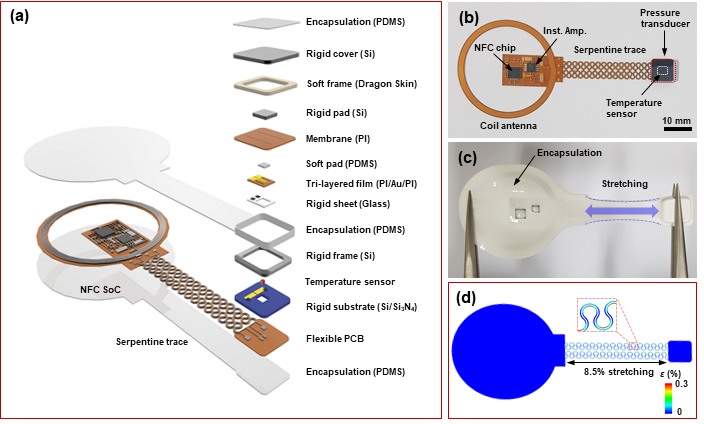
The research team developed a wireless, battery-free system that can continuously monitor pressure and temperature at the skin interface. Pressure is measured by using the resistance increase caused by the sagging of a membrane film composed of metal and polymer, and continuous measurement of skin temperature changes that occur as pressure ulcers develop is also possible.
A square transmitter coil antenna generates a magnetic field enabling near-field communication (NFC). The pressure and temperature sensors on the wireless platform are connected by a serpentine structure with stretchability outside the circular coil, providing stable sensor output under various mechanical deformations (bending, stretching, twisting) and ensuring sufficient power supply and data communication even with patient movement or posture changes.
To cover the patient's entire body, two transmitter coil antennas are placed under the bed mattress, and a reader and multiplexer are positioned beside the bedding. Stable power transmission and data communication are possible with the wireless sensor platform attached to the patient's skin. The distribution, direction, and intensity of the magnetic field generated by the transmitter coil antenna were verified through simulation. Actual performance tests were also completed on patients at risk of pressure ulcers, such as hemiplegic and quadriplegic patients.
Professor Park said, "We have developed the world's first wireless, battery-free sensor system technology capable of continuous measurement of pressure and temperature at key skin interfaces of bedridden patients," adding, "It is expected to be a breakthrough in early diagnosis and prevention of pressure ulcers in patients at risk."
The research results were published online on the 24th of last month in the journal Nature Communications, which covers materials science and convergence research.
© The Asia Business Daily(www.asiae.co.kr). All rights reserved.
![Clutching a Stolen Dior Bag, Saying "I Hate Being Poor but Real"... The Grotesque Con of a "Human Knockoff" [Slate]](https://cwcontent.asiae.co.kr/asiaresize/183/2026021902243444107_1771435474.jpg)
















