Rank Foundation Jointly Awards 7 Pioneers of Perovskite Solar Cells
Professor Seok Sang-il Recognized for Developing World's First 'Heterojunction Structure Solar Cell'
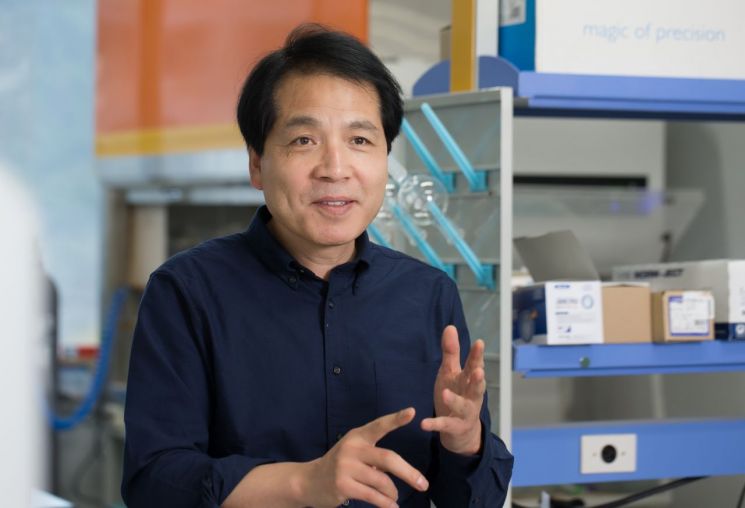
[Asia Economy Yeongnam Reporting Headquarters Reporter Kim Yong-woo] The globally prestigious 'Rank Prize,' awarded to scientists who have contributed to human welfare by overcoming crises, has been awarded to two domestic researchers this year.
In Korea, Professor Sang-il Seok of the Department of Energy Chemical Engineering at Ulsan National Institute of Science and Technology (UNIST) and Professor Nam-gyu Park of Sungkyunkwan University were selected as joint recipients of the 'Rank Prize in Optoelectronics.'
The UK Rank Prize Foundation announced on the 29th that it will jointly award the 2022 Rank Prize in Optoelectronics to seven researchers worldwide, including Professor Sang-il Seok, who contributed to the birth and development of perovskite solar cells.
Professor Seok and others have led research to improve the efficiency of perovskite solar cells based on the heterojunction structure of perovskite solar cells independently developed by them.
Professor Seok holds the record for renewing the certified perovskite solar cell efficiency, i.e., photoelectric conversion efficiency, by the US National Renewable Energy Laboratory (NREL) five times. He currently holds the highest record.
The originality of the research has been academically proven. So far, eight papers have been published only in prestigious journals such as Science and Nature.
Currently, he is jointly commercializing the technology by co-founding a company with a top domestic research team including Professor Nam-gyu Park.
Professor Sang-il Seok said, "I am even more pleased to receive this prestigious award together with several fellow researchers who pioneered perovskite solar cells," adding, "I will devote more effort to developing solar cells that satisfy high stability, high efficiency, and low cost."
Perovskite solar cells are next-generation cells that can be easily manufactured by solution processing and can be made lightweight and flexible, unlike hard and heavy silicon solar cells.
The Rank Prize selection committee stated, "This is an excellent example showing that basic science can play a significant role in solving problems such as the climate crisis facing humanity," and added, "We have announced meaningful selection results ahead of the 26th UN Climate Change Conference."
The Rank Foundation, established by British entrepreneur J. Arthur Rank, awards the 'Rank Prize' to researchers worldwide who have made significant contributions to the welfare of humanity.
Awards are given in the fields of optoelectronics and nutrition.
Established in 1976, the Rank Prize in Optoelectronics is awarded biennially. Shuji Nakamura, who won the Nobel Prize in Physics (awarded in 2017), and Arthur Ashkin (awarded in 2018) also received the Rank Prize in Optoelectronics in 1998 and 1993, respectively.
The award ceremony is scheduled to be held in London, UK, in January 2022.
© The Asia Business Daily(www.asiae.co.kr). All rights reserved.

















