Government Announces at Deputy Minister Meeting on Prices
"Freeze Principle Applies Except for Decided Public Charges"
City Gas Fees Likely to Be Frozen in November
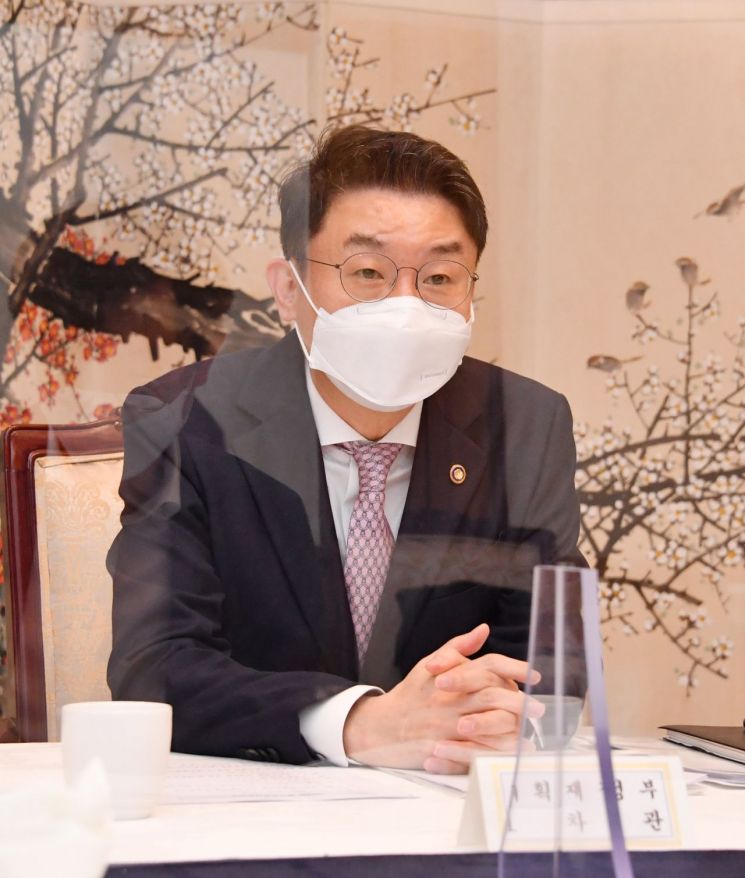 Lee Eok-won, Vice Minister of Strategy and Finance, presides over the 29th Price-Related Vice Ministers' Meeting held on the 29th at the Government Seoul Office in Gwanghwamun, Seoul, delivering opening remarks. (Photo by Ministry of Strategy and Finance)
[Sejong=Asia Economy Reporter Moon Chaeseok] The government has decided to freeze public utility rates such as city gas and railroads until the end of the year. Accordingly, city gas rates, which were highly likely to increase in November, are expected to be maintained for the time being.
Lee Eokwon, the 1st Vice Minister of the Ministry of Economy and Finance, stated on the 29th, "Except for already decided public utility rates, the basic principle is to freeze the remaining public utility rates as much as possible until the end of the year." Although electricity rates have risen, this message indicates that city gas rates, which were expected to increase significantly in November, will be kept unchanged until the end of the year.
According to the Ministry of Economy and Finance, global inflationary pressures are intensifying due to prolonged supply chain disruptions, persistent logistics bottlenecks, and expanded rises in international oil prices. In particular, Brent crude oil prices surpassed the $80 mark during trading on the 28th (local time). So far, the government has managed price increases of agricultural, livestock, and fishery products such as cabbage and eggs, focusing on 16 Chuseok holiday essential items, but due to external factors overseas, petroleum prices are also soaring.
He said, "There are currently no preliminary consultation procedures underway regarding increases in railroad and road toll fees," and added, "We will actively consult with local governments on the principle of freezing local public utility rates such as gas, water and sewage, and garbage bags as much as possible." He further stated, "Although the authority to adjust local public utility rates lies with local governments, we plan to actively consult and manage under the Ministry of the Interior and Safety with the principle of freezing rates in the fourth quarter."
The government's declaration to freeze public utility rates until the end of the year comes amid growing concerns about inflation as prices of agricultural, livestock, and fishery products as well as oil have surged sharply. Regarding this, Vice Minister Lee emphasized, "We will continue to take necessary preemptive measures to stabilize prices so that excessive inflation expectations do not spread."
They also plan to actively manage price trends of milk and petroleum products. Vice Minister Lee explained, "We will hold regular meetings with the food industry, which is facing difficulties due to rising raw material prices, labor costs, and logistics expenses, and strengthen support."
In addition to suppressing price increases of petroleum products, the government plans to establish joint response measures among related ministries against acts that disrupt distribution order. They also intend to promote the conversion of new budget gas stations mainly in metropolitan areas to stimulate competition. This aims to lower consumer prices.
Vice Minister Lee emphasized, "Taking this opportunity, we will actively work to discover and promote structural tasks for price stabilization, such as improving and rationalizing rigid distribution and price determination structures, so that prices can be stabilized fundamentally."
© The Asia Business Daily(www.asiae.co.kr). All rights reserved.

















