Card Payment Reporting Service Launches in December
Installation of Protective Barriers Separating Driver and Rear Seats Expands... Support for Installation Costs on 500 Units This Year, Expansion Next Year
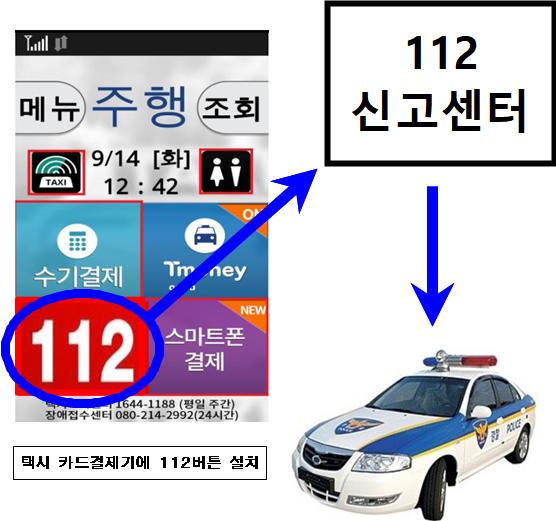
[Asia Economy Reporter Lim Cheol-young] The Seoul Metropolitan Government announced on the 29th that it will introduce an automatic reporting system by December this year, which allows taxi drivers to report to 112 by simply pressing a button on the card payment device in case of an emergency, to protect taxi drivers from passenger assaults and prevent accidents in advance. The installation of protective partitions that physically separate the driver's seat and the back seat will also be expanded.
Recently, incidents such as the assault of a taxi driver in his 60s in Gwanak-gu and the murder of a taxi driver with a weapon inside a taxi near Migeum Station have increased concerns among taxi drivers due to repeated cases of violence by intoxicated passengers. In fact, 74% of taxi drivers have experienced verbal abuse or physical assault by passengers. In particular, since COVID-19, the demand for protective partitions to prevent the spread of infectious diseases has also increased.
Assaults on taxi drivers are subject to stricter penalties under the Act on Aggravated Punishment of Specific Crimes. Assaulting or threatening a driver of a vehicle in operation, including situations where the vehicle is temporarily stopped for boarding or alighting, is punishable by up to five years in prison or a fine of up to 20 million won. However, unless the offender is a repeat offender, most cases are not punished according to these regulations.
Accordingly, Seoul City is promoting protective measures to ensure a safe operating environment for taxi drivers. The main measures include establishing an immediate reporting system through card payment devices, supporting the installation of protective partitions, and mandating the additional installation of alarm sounds on taxi sign lights.
First, Seoul City will establish a system that allows taxi drivers to quickly report to 112 with a simple operation in case of assault. Reporting to 112 by phone or text message during an assault is practically impossible, so drivers have to rely on nearby citizens to report, and delayed reporting can lead to more severe assault damage.
Seoul City plans to jointly develop this system with T-money, the operator of card payment devices, so that pressing a separate operation button on the card payment device inside the taxi will generate a message including the taxi driver's contact information and location, which will be immediately reported to 112. The service is scheduled to launch within this year. It is expected that police will respond more quickly through this system, minimizing the time taxi drivers are exposed to assault.
By the end of the year, Seoul City will support the installation of protective partitions for 500 corporate and individual taxis to protect drivers. Installing protective partitions inside taxis is expected to block COVID-19 infection through droplets, allowing passengers to use taxis more safely.
Taxi partitions are structures that separate the driver's seat from the front passenger seat or the back seat, blocking direct contact between the driver and passengers and preventing assaults. They are commonly installed in taxis operating in the United States, Japan, Europe, and other countries. In Seoul, the installation was first mandated last year for ‘quarantine taxis exclusively for overseas arrivals’ to prevent the spread of infectious diseases, receiving great positive feedback.
Seoul City supported 30 vehicles in a pilot project in 2014 and supported 236 vehicles in 2019 for operators who wished to install partitions. This year, the number of supported vehicles will be expanded to 500, and installation support will continue next year. After conducting demand surveys and collecting opinions from corporate and individual taxi drivers, products that taxi drivers can use safely and conveniently will be selected, and partitions will be installed accordingly.
Furthermore, starting next year, for newly released vehicles only, Seoul City plans to revise the business improvement order to mandate the installation of alarm sounds in addition to the current warning lights when installing taxi sign lights. During new and refresher driver training, effective response and reporting methods for dealing with intoxicated passengers and passenger assaults will be taught to reduce assault incidents.
Baek Ho, Director of Urban Transportation at Seoul City, said, “Protecting taxi drivers from assault is creating an environment where citizens can safely use public transportation.” He added, “While operating protective measures such as installing protective partitions inside taxis and establishing immediate reporting systems, we will also make various efforts to establish a culture that respects taxi drivers.”
© The Asia Business Daily(www.asiae.co.kr). All rights reserved.
![Clutching a Stolen Dior Bag, Saying "I Hate Being Poor but Real"... The Grotesque Con of a "Human Knockoff" [Slate]](https://cwcontent.asiae.co.kr/asiaresize/183/2026021902243444107_1771435474.jpg)
















