Seoul Metropolitan Council to Hold Urban Rail Sustainable Management Policy Forum on the Morning of the 28th... Chair Kim In-ho: "Chronic Deficits Causing Urban Rail Management Crisis, National and Local Governments Must Jointly Take Responsibility and Promote Sustainability"... Woo Hyung-chan, Chair of Seoul Council Transportation Committee, Emphasizes "Government, Seoul City, and Corporation Must Act Prepared to Face Criticism"
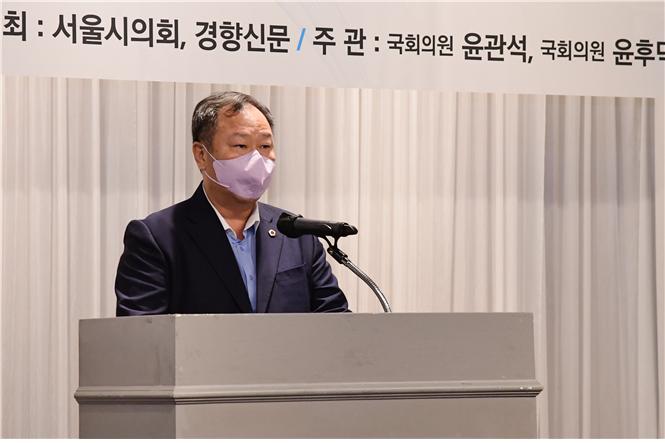
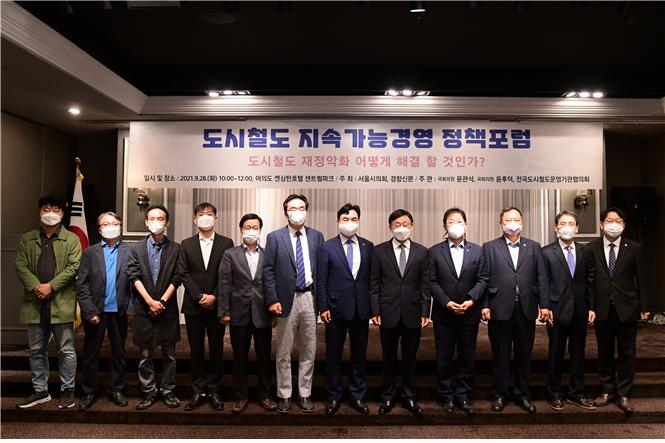
[Asia Economy Reporter Park Jong-il] Kim In-ho, Chairperson of the Seoul Metropolitan Council, attended the 'Urban Railway Sustainable Management Policy Forum' held on the morning of the 28th at the Kensington Hotel in Yeouido.
This discussion was organized to seek solutions to the increasingly worsening financial problems of urban railways. It was co-hosted by National Assembly members Yoon Hu-deok (Chairman of the Planning and Finance Committee), Yoon Kwan-seok (Secretary-General of the Democratic Party), and the National Urban Railway Operators Association.
In his opening remarks, Chairperson Kim In-ho emphasized, “As we have learned from the crisis of COVID-19, it is necessary to foresee the future ahead and prepare in advance,” adding, “This forum is a place to prepare for the future of Seoul’s urban railway.”
He also pointed out, “For the urban railway, which has served as the citizens’ means of transportation for the past 40 years, to continue providing safe public services, safety inspections, maintenance, and facility reinvestment for aging infrastructure are urgently needed. However, since the opening of the urban railway, accumulated losses due to steadily increasing fare evasion have led to chronic deficits, making reinvestment impossible,” highlighting the current reality.
Furthermore, Chairperson Kim stressed, “If the trend of aging population and expansion of welfare continues, the rate of fare evasion in urban railways will inevitably increase. The national and local governments must share responsibility and find solutions for the sustainability of urban railways.”
The event was conducted jointly by six urban railway operating agencies nationwide, including Seoul Metro, along with National Assembly members (Democratic Party’s Yoon Kwan-seok and Yoon Hu-deok) and the Seoul Metropolitan Council.
Professor Ko Hong-seok of the University of Seoul, who delivered the keynote presentation, stated, “The Seoul subway, an important transportation means, is in a crisis with a cumulative deficit of 16 trillion won and an annual deficit of 1.1137 trillion won. The fundamental cause of the problem lies in the fare level being below cost, the absence of government support for fare evasion costs, and the current structure of the corporation, which has not undergone rational operational analysis.” He added, “Now, the burden has exceeded what the corporation alone can bear. It is a stage where the government, the transportation corporation, and citizens must share responsibility to solve this problem.”
Policy Committee member Su-yeol of the Public Transportation Network, who also presented, said, “It is necessary to examine overseas cases of elderly transportation fare discounts and the financial structures of foreign public transportation operators, as well as the support for public transportation during the pandemic.” He continued, “Many countries are implementing active public policies to guarantee mobility rights and income redistribution. In Korea, there are opinions to change the level or method of fare discounts, but for universal fare evasion, financial support from either local or central government is inevitable.”
During the subsequent discussion, participants expressed various opinions reflecting their areas of expertise. Song Sang-seok, Policy Committee member of the Green Transportation Movement, said, “The government has poured most resources into road traffic, but as a result, the public transportation modal share outside the metropolitan area nationwide is less than 30%. To realize a carbon-neutral society, the Carbon Neutrality Committee recommends a 15% reduction in private car usage and a 10% increase in public transportation modal share by 2050. To follow this, government support for public transportation to shift from a car-centered to a public transportation-centered society is absolutely necessary from an environmental perspective.”
Myung Soon-pil, Policy Advisor of the Seoul Metro Labor Union, said, “There are many opinions criticizing inefficiencies such as reckless management of the corporation, but in reality, after the corporation’s integration, the workforce has decreased by 1,000 people. It is not uncommon for stations to be operated by a single person.” He added, “In difficult times such as the IMF and Lehman Brothers crises, workforce reductions and welfare sacrifices were accepted, but since the situation has not improved at all, squeezing more is not the answer. For citizen welfare, we must move toward public, free transportation that benefits everyone, and government support is necessary for this.”
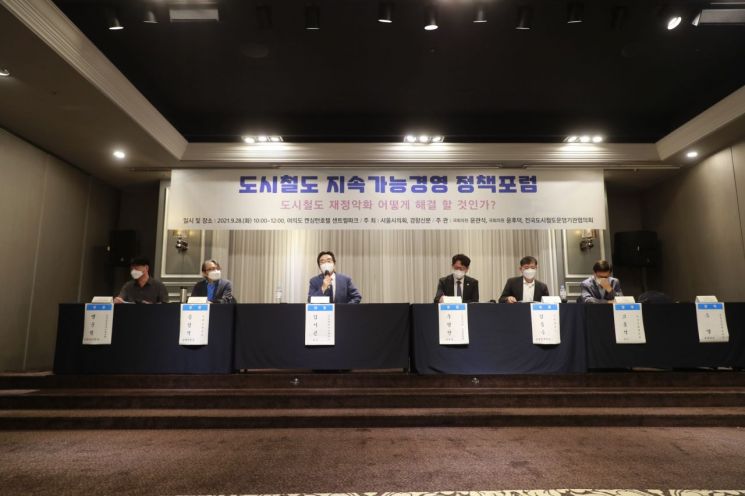 Description of discussion participants from the left: Myeong Sunpil, Chairman of the Policy Advisory Committee of the Seoul Transportation Corporation Labor Union; Song Sangseok, Chairman of the Policy Committee of the Green Transportation Movement; Kim Sigon, Professor at Seoul National University of Science and Technology; Woo Hyungchan, Chairman of the Transportation Committee of the Seoul Metropolitan Council; Kim Eulsu, Director of the Transportation Policy Division of Incheon Metropolitan City; Go Hongseok, Professor at the University of Seoul; Suyeol, Policy Committee Member of the Public Network.
Woo Hyung-chan, Chairperson of the Seoul Metropolitan Council’s Transportation Committee, stated, “The government, Seoul city, and the corporation must all be prepared to face criticism and act. The government should boldly consider raising the elderly age threshold as the population structure has changed significantly from the past. Seoul city, although hesitant to adjust fares due to local elections, must make bold choices despite criticism. The corporation also needs to create justifications that citizens can accept through efforts to change itself.” He argued, “If the state wants various services including fare evasion, it needs to properly pay the subway.”
Kim Eul-soo, Director of Transportation Policy at Incheon Metropolitan City, said, “Incheon’s finances are also severely deteriorating, reaching an unsustainable management level. The city provides financial support of 90 billion won this year and annually, but neither local governments nor operators can handle the scale of deficits.” He added, “Japan provides transportation discount services only to applicants aged 70 and over, and Korea should consider this as well.”
Discussion participants also strongly criticized government officials from the Ministry of Strategy and Finance and the Ministry of Land, Infrastructure and Transport, who were absent from the forum. Woo Hyung-chan, Chairperson of the Seoul Metropolitan Council’s Transportation Committee, said, “We repeatedly requested attendance and sent official letters to the two government ministries most closely related to national funding for fare evasion, but they consistently ignored us,” demanding reflection from government officials, calling their behavior shameless and irresponsible, and saying it would be better if they resigned from their positions.
Myung Soon-pil, Policy Advisor of the Seoul Metro Labor Union, also criticized the government’s insensitive attitude, saying, “There are continuous reports of the subway’s financial crisis and even talk of an unavoidable moratorium declaration, but the government seems completely unaware of the current situation.”
© The Asia Business Daily(www.asiae.co.kr). All rights reserved.



















