Expectations for Linked Content on Korea's Leading Natural Monument Fossil Deposit Areas
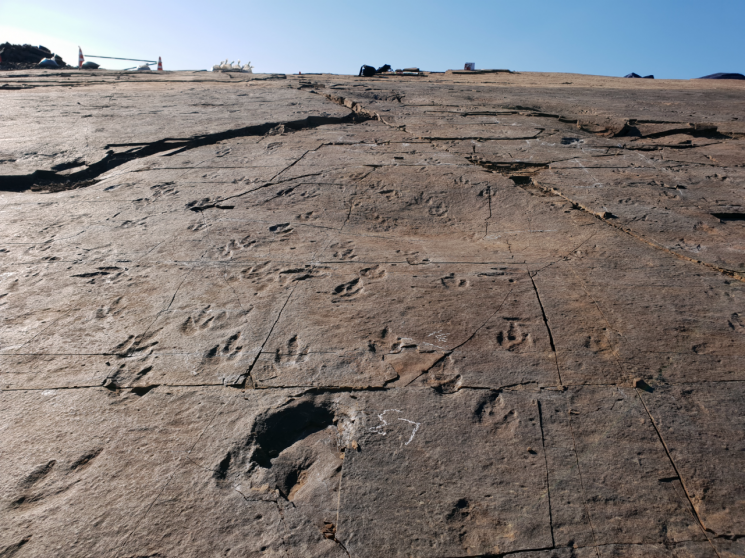
[Asia Economy Yeongnam Reporting Headquarters Reporter Choi Soon-kyung] The "Jinju Jeongchon-myeon Cretaceous Dinosaur and Pterosaur Footprint Fossil Site," which was announced for designation last August, has been officially designated as National Cultural Heritage Natural Monument No. 566.
The Jinju Jeongchon-myeon Cretaceous Dinosaur and Pterosaur Footprint Fossil Site preserves over 7,000 Mesozoic Cretaceous animal footprints, including the world's largest number of carnivorous dinosaur footprints, making it a place where the ecosystem of that time remains intact.
Major fossils include bipedal carnivorous dinosaur trackways ranging from 2 cm to 50 cm in size, footprints of large sauropod dinosaurs with hind feet measuring up to 1 meter, as well as footprints of pterosaurs, crocodiles, and turtles. The preservation state is excellent, making it an outstanding example both quantitatively and qualitatively domestically and internationally, worthy of designation as a natural monument.
With the designation of the Jeongchon-myeon fossil site as a natural monument, Jinju City plans to develop content linking carnivorous dinosaur footprints (Jeongchon-myeon fossil site), pterosaur footprints (Jinju Pterosaur Footprint Exhibition Hall, Chungmugong-dong), bird and sauropod dinosaur footprints (Gyeongnam Science Education Center, Gajin-ri), and the rare dinosaur bone fossils found domestically (Yusuri fossil site).
Meanwhile, the city plans to promptly proceed with the construction of protective shelters and the development of a fossil park by applying for national subsidies from the government in October for detailed design and land acquisition, aiming to fully preserve the exposed fossil site outdoors and utilize the cultural heritage through the construction of protective shelters.
© The Asia Business Daily(www.asiae.co.kr). All rights reserved.

![Clutching a Stolen Dior Bag, Saying "I Hate Being Poor but Real"... The Grotesque Con of a "Human Knockoff" [Slate]](https://cwcontent.asiae.co.kr/asiaresize/183/2026021902243444107_1771435474.jpg)















