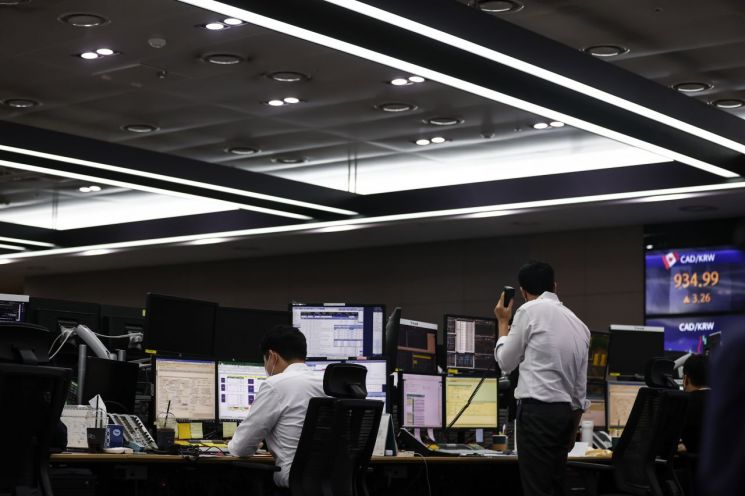
[Asia Economy Reporter Lee Seon-ae] On the 28th, the domestic index, which started lower, widened its losses throughout the day and closed down.
On this day, the KOSPI index closed down at 3,097.92, down 35.72 points (-1.14%) from the previous trading day (3,133.64). It failed to recover losses throughout the day and eventually broke below the 3,100 level to end trading. This is the first time in about a month since the 23rd of last month (3,090.21) that the KOSPI closed below 3,100. During the day, it fell as low as 3,095.72. The index started at 3,133.40, down 0.24 points (0.01%) from the previous close, and widened its losses. In the KOSPI market, institutions sold a net 555.6 billion KRW. Meanwhile, individuals and foreigners had net selling positions of 559.7 billion KRW and 9.7 billion KRW, respectively.
The KOSDAQ index closed at 1,012.51, down 22.31 points (2.16%) from the previous session. The index started at 1,034.04, down 0.78 points (0.08%) from the previous day, and widened its losses during the day. In the KOSDAQ market, foreigners and institutions sold a net 207.5 billion KRW and 236.5 billion KRW, respectively. Individuals had a net buying position of 445.6 billion KRW.
Foreigners were very active, selling a net 1.2534 trillion KRW in the futures market alone, while institutions bought 759.5 billion KRW.
Lee Kyung-min, head of the investment strategy team at Daishin Securities, explained, "The KOSPI fell 1% as foreigners switched to net selling for the first time in nine trading days," adding, "In particular, they sold more than 1 trillion KRW in futures." He continued, "Concerns over the default of China’s Evergrande and strategic difficulties have increased uncertainty about the Chinese economy, and the US debt ceiling negotiations are facing difficulties, which also heightens psychological anxiety."
He added, "Moreover, there are many factors that could shrink foreign demand, such as rising bond yields in Korea and the US, a strong dollar, and the won/dollar exchange rate breaking above 1,180 KRW," explaining, "The expansion of downward pressure on the won due to external uncertainties and the resulting increase in short-term futures selling are leading to the sharp drop in the KOSPI."
Kim Seok-hwan, a researcher at Mirae Asset Securities, said, "The Korean stock market’s losses widened as the impact of rising US Treasury yields causing a decline in tech stocks in the US market was reflected domestically," adding, "Foreigners’ selling in both spot and futures markets also increased downward pressure."
Among the top market capitalization stocks in the KOSPI, Samsung Biologics closed down more than 5%. Naver, Kakao, and Samsung SDI also showed declines in the 2% range. KakaoBank recorded gains in the 1% range, and LG Chem closed slightly higher. Among the top market capitalization stocks in the KOSDAQ, L&F closed down more than 6%. HL Biotech, Seegene, and Alteogen showed declines in the 4% range.
By sector in the KOSPI, most sectors closed lower, including pharmaceuticals (-3.61%), textiles and apparel (-2.95%), and non-metallic minerals (-2.55%), while only a few sectors such as electric and gas utilities (+2.07%), finance (+0.68%), and chemicals (+0.50%) showed strength. In the KOSDAQ, most sectors closed lower, including IT components (-3.81%), transportation equipment and parts (-3.08%), and semiconductors (-2.86%).
© The Asia Business Daily(www.asiae.co.kr). All rights reserved.

















