Concerns Grow Among Business Community Over Serious Accidents Punishment Act Passing Cabinet Meeting on 28th
Key Regulatory Standards Still Unclear
[Asia Economy Reporters Changhwan Lee and Mune Won] Company A, a heavy industry firm with a high proportion of outdoor work, experiences an average of 15 cases of heatstroke symptoms annually, while construction company B sees about 20 cases. Most recover within a few days with simple medical treatment and rest, so it has not been a major issue until now.
However, the situation will change starting January next year. If at least three workers in these workplaces require more than four days of medical care annually and are recognized as industrial accident cases by the Korea Workers' Compensation and Welfare Service, the companies could fall under the Serious Accident Punishment Act. The management responsible for the company will also be subject to investigation.
On the 28th, the draft enforcement decree of the Serious Accident Punishment Act passed the Cabinet meeting, raising alarms in the industrial sector. The core provisions of the law have ambiguous standards, and even minor negligence could lead to severe penalties for management, potentially causing significant confusion in the business field.
With the law's enforcement just four months away, companies in construction, manufacturing, and other sectors expected to be directly affected are urgently considering countermeasures.
Unclear Concept of Management Responsibility and Inadequate Severity Criteria for Diseases
A major concern among business circles regarding the Serious Accident Punishment Act is the unclear concept of management responsibility. The government simply defines the responsible party for serious accidents as the "management responsible person" in the law, leaving it ambiguous whether the ultimate responsible party is the company's largest shareholder, the CEO, or the safety officer.
Because the legal concept of management responsibility is unclear, there is criticism that law enforcement agencies themselves may face confusion in identifying who exactly to investigate as the management responsible person in the event of serious accidents such as fatalities.
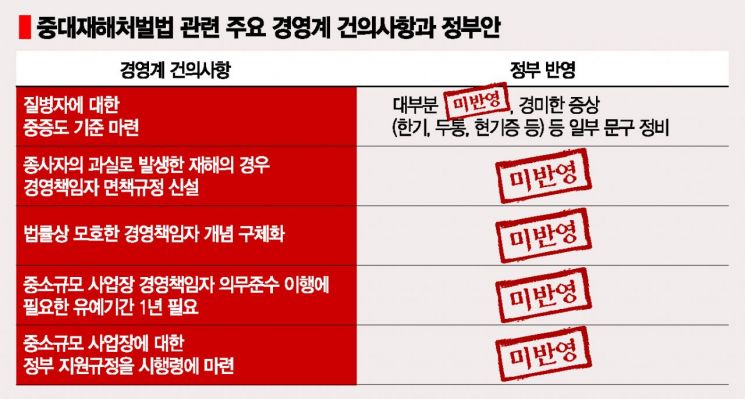
Business groups have requested that the government specify the concept of management responsibility clearly in the enforcement decree, but the government has not reflected this demand.
They have also requested the establishment of exemption clauses so that management is not punished when serious industrial accidents clearly result from worker negligence. For example, in cases of accidents caused by natural disasters or intentional negligence by workers, they proposed lowering the severity of penalties for management. However, the government has not accepted these requests either.
Professor Jinwoo Jeong of the Department of Safety Engineering at Seoul National University of Science and Technology emphasized, "Punishing companies and management severely under ambiguous legal concepts and obligations of management responsibility violates the constitutional principles of clarity and prohibition of excessive punishment."
The severity criteria for diseases are also inadequate, and demands to revise them have not been properly addressed. Since the law lacks standards for severity, there is concern that management could be unfairly punished even for minor occupational diseases.
In workplaces like Company A and B, which involve many outdoor tasks such as construction and heavy industry, minor heatstroke symptoms may frequently occur despite various health management efforts. In most cases, workers recover after short-term treatment or one to two days of rest and can return to work.
However, according to the law, such cases could still be judged as serious accidents, causing confusion at work sites. The business community requested clear standards limiting application to cases requiring at least three to six months of treatment, but this was not reflected.
Additionally, business groups submitted various proposals, including establishing grace periods for management to comply with obligations, government support regulations for small and medium-sized enterprises, and resetting public facility application standards for gas stations and charging stations considering their business characteristics, but most were not adopted.
Seungtae Jeon, head of the Industrial Safety Team at the Korea Employers Federation, expressed concern, saying, "The ambiguity of legal provisions not being concretized in the enforcement decree leaves workplaces uncertain about what to comply with, and there will likely be much confusion and side effects due to arbitrary interpretations during law enforcement by related ministries."
Companies Facing Imminent Law Enforcement Struggle to Prepare Countermeasures
Despite opposition from the business community, with the law's enforcement imminent, companies are increasingly worried. The construction industry, expected to suffer the most, is on high alert.
Most construction companies are making efforts to prepare countermeasures, such as expanding the hiring of safety managers ahead of the law's enforcement in January next year, but concerns remain high due to ambiguous standards and unrealistic penalty provisions.
A representative from a mid-sized domestic construction company said, "We are doing our best to ensure safety management on site in line with the law's intent, but since humans are involved, it is difficult to completely eliminate the possibility that minor mistakes could lead to major accidents. Considering reality, there is a need to adjust penalties."
There are also many criticisms that confusion at the frontline is inevitable as procedures proceed without fully reflecting industry demands. Another construction company official pointed out, "With the Serious Accident Punishment Act, the primary contractor will be punished, so they cannot avoid interfering with subcontractors' work, but excessive management intervention by the primary contractor could violate the Subcontracting Act, creating a practical irony."
© The Asia Business Daily(www.asiae.co.kr). All rights reserved.
![Clutching a Stolen Dior Bag, Saying "I Hate Being Poor but Real"... The Grotesque Con of a "Human Knockoff" [Slate]](https://cwcontent.asiae.co.kr/asiaresize/183/2026021902243444107_1771435474.jpg)
















