Like OTT, 1 Person 1 TV Customized
Introducing New Products to Lead the Market
Expanding Device Collaboration with Manufacturers
to Provide Diverse Services
[Asia Economy Reporter Cha Min-young] ‘Alternative TV,’ which allows viewing IPTV using portable devices such as tablet PCs, has emerged as a new trend in the wired broadcasting market. As the era of ‘one person, one TV’ arrives, where customized content tailored to individual tastes is enjoyed at home like online video streaming services (OTT), competition among companies is intensifying.
Three IPTV Providers Launch Home Mobile TVs One After Another
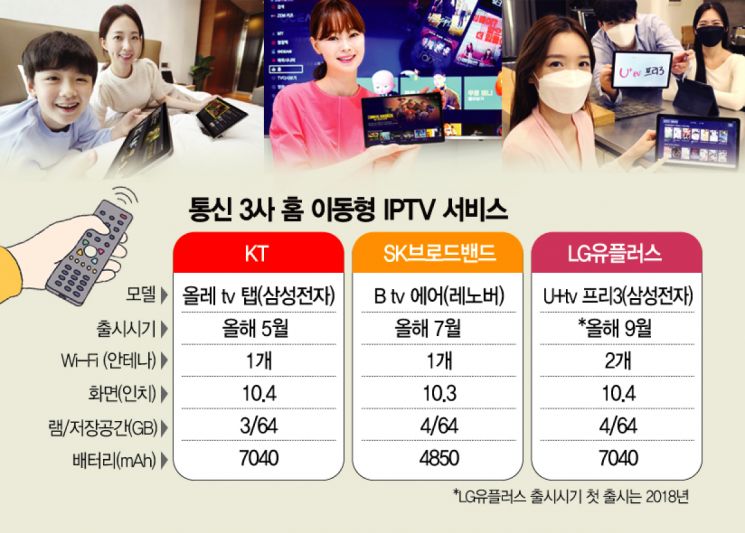
According to industry sources on the 28th, LG Uplus launched the ‘U+tv Free3’ product, which allows users to watch IPTV on a tablet PC within the same Wi-Fi network at home. Without needing to log in separately, users can watch 256 live channels and about 270,000 VOD titles simply by turning on the device. It also includes exclusive content such as Netflix, U+tv Kids’ Land, U+ Pro Baseball, U+ Golf, and U+ Idol Live. The U+tv Free3 features a larger 10.4-inch screen compared to the previous U+tv Free2’s 10.1-inch display. Its weight has been reduced by about 20%, from 580g to 465g.
LG Uplus first introduced the home mobile tablet PC in 2018, leading the domestic market. In May and July of this year, KT and SK Broadband respectively released similar products, expanding the competition among the three major telecom companies.
Cable TV has also entered the tablet PC competition. In January this year, the Ministry of Science and ICT revised the ‘Technical Standards for Wired Broadcasting Station Equipment,’ allowing cable TV to be viewed on portable devices using Wi-Fi instead of a TV receiver. This legal amendment aims to enhance the self-sustainability of cable TV, which has been losing ground to IPTV, by reflecting changes in media usage methods.
The emergence of this completely new type of TV is largely due to changes in the media environment. Since the appearance of OTT Netflix over six years ago, personalized content has spread, leading to an era where family members in one household enjoy different content individually. As education for young children and elementary students through smart devices increases, demand for kids’ content has also grown. It is also ideal for single-person households who do not need a TV due to economic burdens but want to watch live channels and VOD on a screen larger than a mobile phone.
Behind the Scenes, Competition Among Manufacturers for Device Collaboration
Some concerns have also increased regarding device development. The key is to enhance the device’s performance so that existing TV viewers, who easily changed channels with a remote control, do not feel discomfort when using a tablet PC. Lee Geon-young, head of media business at LG Uplus, explained, "The fast booting and quick channel switching speed of U+tv Free3 are perfect for the snack culture era, where content is watched in short bursts." An industry insider said, "Even a 2-second delay causes immediate discomfort for customers," adding, "The key is how quickly pain points are identified and how efficiently the price can be managed simultaneously."
Telecom companies are expanding their partner manufacturers to develop dedicated PCs as part of service diversification. Currently, Samsung Electronics and Lenovo are the main players. KT’s ‘Olleh tv Tab’ and LG Uplus’s ‘U+tv Free3’ are products made in collaboration with Samsung Electronics, while SK Broadband’s ‘B tv Air’ is a joint product with Lenovo. LG Uplus also signed a business agreement with Korea Lenovo in May to develop mobile IPTV services. Since it is a second TV, a variety of products are needed to capture diverse consumer preferences in terms of performance and price.
An official from the wired broadcasting industry said, "With the explosive increase in individual viewing through mobile viewing, OTT activation, and video on demand (VOD), demand for flexible broadcasting and video viewing has also greatly increased," adding, "Paid broadcasters can now provide services suitable for these changing viewing patterns through tablet-based mobile TVs."
© The Asia Business Daily(www.asiae.co.kr). All rights reserved.

















