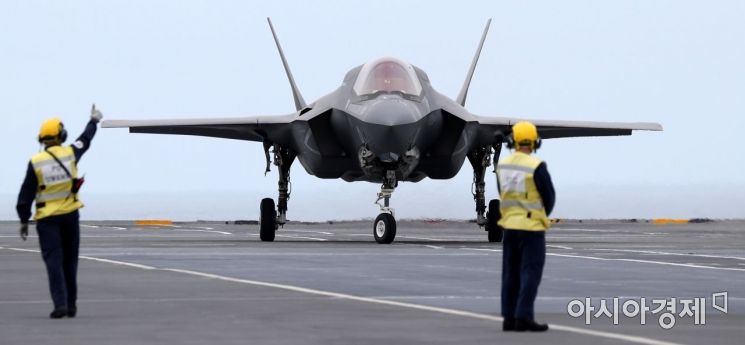
 On the afternoon of the 31st, during the Korea-UK joint maritime opportunity exercise, the British aircraft carrier Queen Elizabeth, navigating and stationed in the southern East Sea, prepared for the takeoff demonstration of the British fighter jet F-35B. 2021.08.31. Photo by Joint Press Corps
[Asia Economy Yang Nak-gyu, Military Specialist Reporter] Core stealth technology that is difficult for enemy radar to detect has been developed using domestic technology.
On the 28th, the Agency for Defense Development (ADD) announced that it has developed four core technologies applicable to low-observable unmanned aerial vehicles (UAVs) that are difficult to detect by radar for the first time in Korea. They plan to focus their research capabilities on developing broadband low-observable UAVs based on stealth technology.
This research achievement was developed based on domestic low-observable weapon system technology and was secured through a leading core technology project carried out over five years since 2016.
The four stealth technologies refer to radar-absorbing structures for aircraft, radomes, integrated antenna structures, and lightweight radar-absorbing coatings.
The radar-absorbing structure developed by ADD absorbs radar signals emitted externally through the aircraft structure, reducing the radar cross-section (RCS) of the aircraft. The radome is a technology that selectively transmits or shields electromagnetic signals depending on the frequency, preventing antennas mounted on the aircraft from being exposed to enemy radar signals.
The integrated antenna structure technology combines the antenna with the aircraft structure to create a smooth aircraft surface, reducing drag and RCS generated during flight. The lightweight radar-absorbing coating applied to the aircraft exterior reduces radar signals reflected by the aircraft structure.
ADD stated, "The achievement lies in developing functional materials with excellent radar absorption, establishing corresponding aircraft design methods, and securing manufacturing and processing technology bases," adding, "It is expected to contribute to improving radar low-observable performance not only for unmanned aerial systems but also for various weapon systems."
© The Asia Business Daily(www.asiae.co.kr). All rights reserved.

















