National Urban Railway Operators Association and Seoul Metropolitan Council Hold 'Urban Railway Sustainable Management Policy Forum'
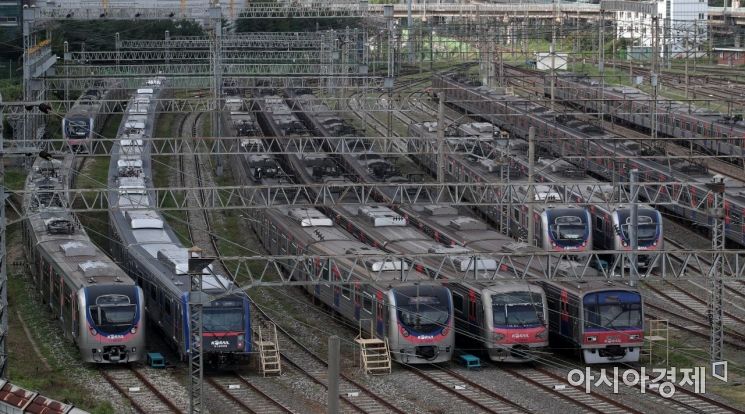 On the 13th, one day before the general strike announced by the Seoul Metro Labor Union, a train was stopped at the Korea Railroad Corporation Guro Vehicle Office in Guro-gu, Seoul. The labor and management sides are scheduled to hold final negotiations on the same day, but concerns about the strike becoming a reality are growing as both sides are sharply divided over the restructuring plan. The Seoul Metropolitan Government plans to form an emergency transportation countermeasure headquarters and deploy 13,000 substitute workers, including retirees, to prevent confusion during commuting hours. Photo by Kim Hyun-min kimhyun81@
[Asia Economy Reporter Lim Cheol-young] Seoul Metro, which has been continuing astronomical-scale deficits, may have to declare a moratorium on payment as it might not be able to repay corporate bonds (CP) worth 720 billion won on time this December, according to an analysis.
On the 28th, at the 'Urban Rail Sustainable Management Policy Forum' held at the Kensington Hotel Central Park in Yeouido, Seoul, Professor Ko Hong-seok of the University of Seoul, who appeared as the keynote speaker, explained, "If it falls into a moratorium situation, normal business activities will become impossible," adding, "Not only employee salaries but also payments to partner companies will be unpaid, and financial institutions may demand bond repayments."
He continued, "Originally, a deficit of 1.6 trillion won was expected by the end of this year, but additional operating losses due to the COVID-19 crisis will push the deficit beyond 1.7 trillion won," emphasizing, "Special disaster relief funds are necessary to resolve the financial deficit."
The corporation issued 500 billion won worth of corporate bonds in the first half of the year and must issue an additional 700 billion won worth of bonds in the second half to overcome the funding shortage crisis. However, since the Ministry of the Interior and Safety's standards for issuing corporate bonds do not include operating losses, additional fundraising is not easy. The corporation's annual net loss remained around 500 billion won each year from 2017 to 2019 but surged to 1.1 trillion won in 2020, and this year it is expected to reach between 1.6 trillion and 1.7 trillion won.
The basic subway fare has also remained unchanged for six years. The basic fare was raised from 1,050 won to 1,250 won in 2015 and has been frozen since. Considering the cost of free rides for seniors and people with disabilities, the average fare per person is 954 won, which falls far short of the cost price of 2,061 won. Previously, the corporation claimed that more than half of the annual net loss of 624.5 billion won over the past five years, amounting to 336.8 billion won, was caused by free rides.
In response, the National Assembly completed the review of a bill to support public service costs for urban rail in the Land, Infrastructure and Transport Committee's Transport Bill Subcommittee last November, but the overall voting schedule has been postponed due to a re-examination request from the Ministry of Strategy and Finance.
© The Asia Business Daily(www.asiae.co.kr). All rights reserved.
![User Who Sold Erroneously Deposited Bitcoins to Repay Debt and Fund Entertainment... What Did the Supreme Court Decide in 2021? [Legal Issue Check]](https://cwcontent.asiae.co.kr/asiaresize/183/2026020910431234020_1770601391.png)















