"Impact of Population Aging Greater Than COVID-19"
"Escaping OECD No.1" Moon Administration's Declaration 'Empty Words'
Suicide Ranks First Among Deaths in 10s to 30s Age Group

[Sejong=Asia Economy Reporter Moon Chaeseok] Last year, the number of deaths among Koreans surpassed 300,000, marking the highest figure ever recorded since statistics began. The government explained that this phenomenon is due more to population aging than the impact of COVID-19. Although the suicide mortality rate decreased for the first time in three years, it still retained the unfortunate distinction of being the highest among OECD countries.
According to the 2020 Cause of Death Statistics released by Statistics Korea on the 28th, the total number of deaths last year was 304,948, the highest since statistics began in 1983. The crude death rate per 100,000 population was 593.9, an increase of 19 (3.3%) from the previous year. Since hitting a low of 497.3 in 2009, the rate has been on the rise. Deaths among those aged 80 and over accounted for 48.6% of total deaths, with the proportion increasing by 1.6 percentage points (p) compared to the previous year and by 15.2 p compared to ten years ago. According to the government, the impact of COVID-19 was not significant.
An official from Statistics Korea said, "The increase in deaths and the record high are believed to be due to population aging," adding, "With COVID-19 deaths numbering 950, accounting for about 0.3% of total deaths, it is difficult to conclude that the overall increase in deaths last year was significantly influenced by COVID-19 deaths."
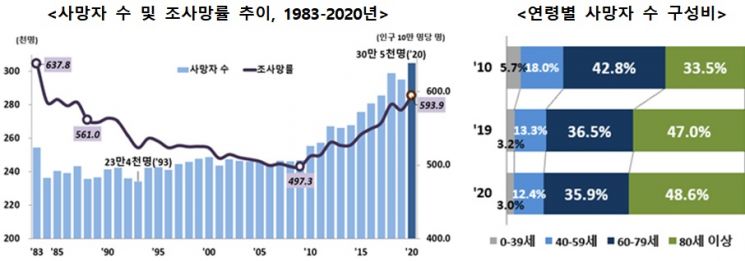 Trends in the number of Korean deaths and crude death rates last year, composition ratio of deaths by age group. (Source: Statistics Korea)
South Korea's suicide rate per 100,000 population was 25.7 last year, a 4.4% decrease from 26.9 in 2019. The suicide rate had increased from 26.6 in 2018 to 26.9 in 2019 but turned downward after three years. The total number of suicides also decreased to 13,195, reversing the upward trend seen in 2017 (12,463), 2018 (13,670), and 2019 (13,799) after four years. The average daily number of suicide deaths last year was 36.1, down 1.7 from 37.8 the previous year.
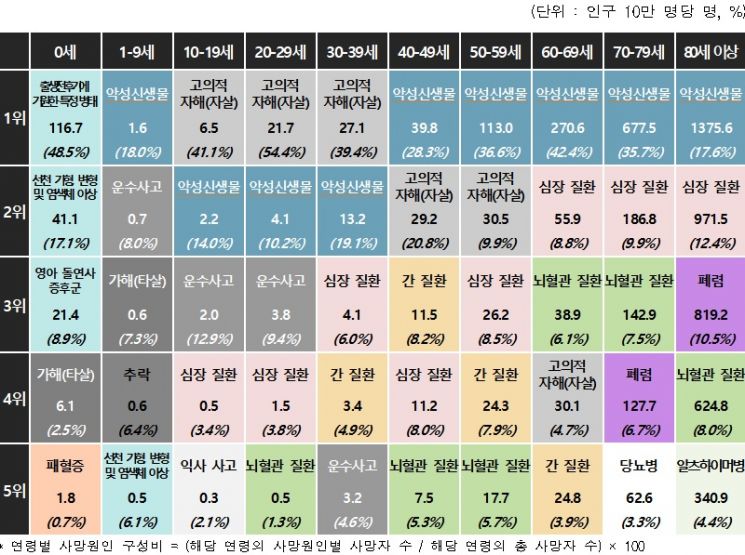 Death rates and composition ratios of the top 5 causes of death by age group. (Source: Statistics Korea)
Suicide ranked fifth among causes of death for Koreans. The male suicide rate was 35.5, higher than the female rate of 15.9. Suicide was the leading cause of death among those in their teens to 30s, and the second leading cause among people in their 40s and 50s, the so-called "economic backbone" age groups. Regionally, Chungnam had the highest suicide rate at 27.9, while Sejong had the lowest at 18.3.
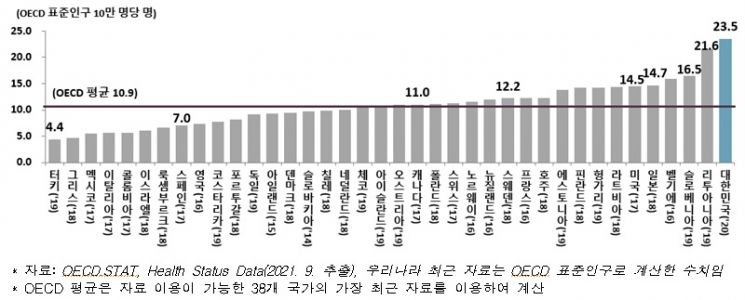
South Korea has held the unfortunate title of having the highest suicide rate among OECD countries for 17 out of the last 18 years since 2003, except for 2017. The OECD-standardized suicide rate per 100,000 population was 23.5 last year, ranking first. This was 1.9 higher than Lithuania (21.6), the second highest, and well above the United States (14.5) and Japan (14.7). The government's declaration to reduce the annual number of suicides to under 10,000 and shed the stigma of having the highest suicide rate in the OECD has yet to be realized.
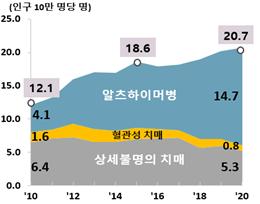 Dementia mortality rate trend. (Source: Statistics Korea)
Alzheimer's disease, an age-related illness, maintained its position as the seventh leading cause of death last year (mortality rate 14.7), following 2019. It is the most significant form of dementia. According to Statistics Korea, Alzheimer's disease has steadily risen in ranking from 13th place in 2009. The mortality rate for dementia, including Alzheimer's, was 20.7 last year, double the 12.1 recorded ten years earlier in 2010. The dementia mortality rate for women (28.4) was 2.2 times higher than that for men (13) last year.
The leading cause of death overall was cancer. The cancer mortality rate was 160.1 last year, an increase of 1.9 (1.2%) from the previous year. By cancer type, lung cancer (36.4), liver cancer (20.6), colorectal cancer (17.4), and stomach cancer (14.6) had the highest mortality rates in that order.
© The Asia Business Daily(www.asiae.co.kr). All rights reserved.



















