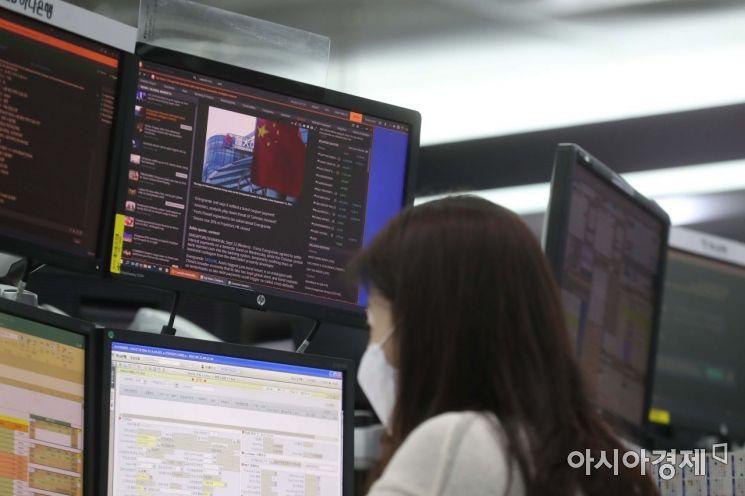
[Asia Economy Reporter Junho Hwang] On the 27th, the KOSPI closed higher amid net buying by foreign investors and institutions.
On that day, the KOSPI closed at 3,133.64, up 8.40 points (0.27%) from the previous trading day. Foreigners and institutions drove the KOSPI up by net buying 340.9 billion KRW and 8.9 billion KRW, respectively. Individuals, facing a rising phase after two days, appeared to realize profits by net selling 339.8 billion KRW.
Among all stocks, 489 rose while 373 fell. Large-cap stocks showed an upward trend. Samsung Electronics, the unwavering market leader, recorded a 0.52% increase to 77,700 KRW. SK Hynix, which also benefited from foreign buying alongside Samsung Electronics, closed up 0.48% at 104,500 KRW.
LG Chem rose 1.18% (closing price 770,000 KRW), fending off the pursuit of Kakao (0.42%, 120,000 KRW), which is threatening the 5th place in market capitalization. Samsung SDI rose 1.24% that day, surpassing the 50 trillion KRW market cap mark.
By sector, the non-metallic minerals sector stood out with gains such as Korea Petroleum (7.97%), POSCO Chemical (5.56%), Sungshin Cement (3.92%), and Hanil Hyundai Cement (3.27%). Due to concerns over crude oil supply disruptions caused by a hurricane in the U.S., pressure on oil prices increased, leading to a rise in pure refining stocks like Korea Petroleum. POSCO Chemical recorded gains following news of aggressive investments in anode materials in addition to cathode materials. Besides non-metallic minerals, sectors such as telecommunications (2.37%), paper and wood (1.19%), and chemicals (1.04%) also showed upward trends.
Seokhwan Kim, a researcher at Mirae Asset Securities, said, "The Korean stock market showed mixed trends, fluctuating within a narrow range." He added, "The market turned upward during the session due to net buying by foreigners, but the rise was limited as the Chinese stock market turned weak." He also analyzed, "Related stocks rose due to demand and investment expansion expectations for anode and cathode materials, key materials for secondary batteries, and energy-related stocks showed strength due to rising international oil prices."
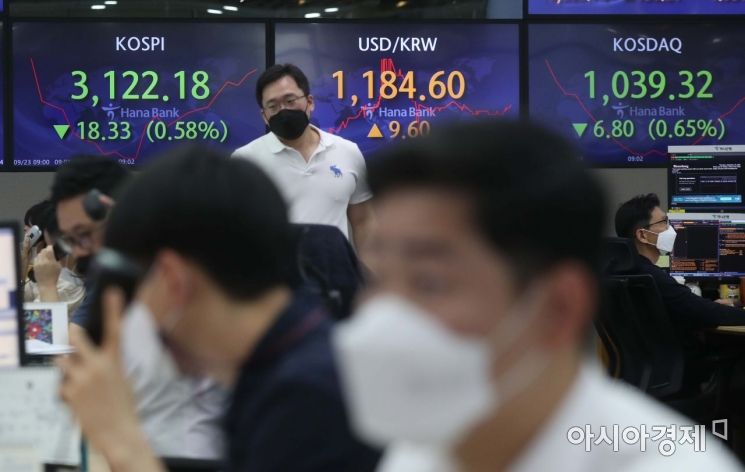
The KOSDAQ failed to gain ground that day. It closed at 1,034.82, down 2.21 points (0.21%) from the previous session. Individuals and foreigners net bought 136.1 billion KRW and 27.6 billion KRW, respectively, hoping for an index rise, but institutions net sold 152.7 billion KRW, causing the index to fall.
Among all stocks, 649 declined while 694 rose. Among the top market cap stocks, secondary battery-related shares showed an upward trend. L&F closed up 1.37% at 193,000 KRW, and EcoPro BM ended the session up 0.32% at 472,100 KRW. By sector, paper and wood (3.44%), other manufacturing (2.81%), and metals (1.63%) stood out.
Kyungmin Lee, a researcher at Daishin Securities, analyzed, "The won/dollar exchange rate, which started the day rising to 1,179 won while digesting uncertainties related to U.S. monetary policy and China’s Evergrande Group, soon reversed and fell, positively affecting foreign demand."
© The Asia Business Daily(www.asiae.co.kr). All rights reserved.
![Clutching a Stolen Dior Bag, Saying "I Hate Being Poor but Real"... The Grotesque Con of a "Human Knockoff" [Slate]](https://cwcontent.asiae.co.kr/asiaresize/183/2026021902243444107_1771435474.jpg)

















